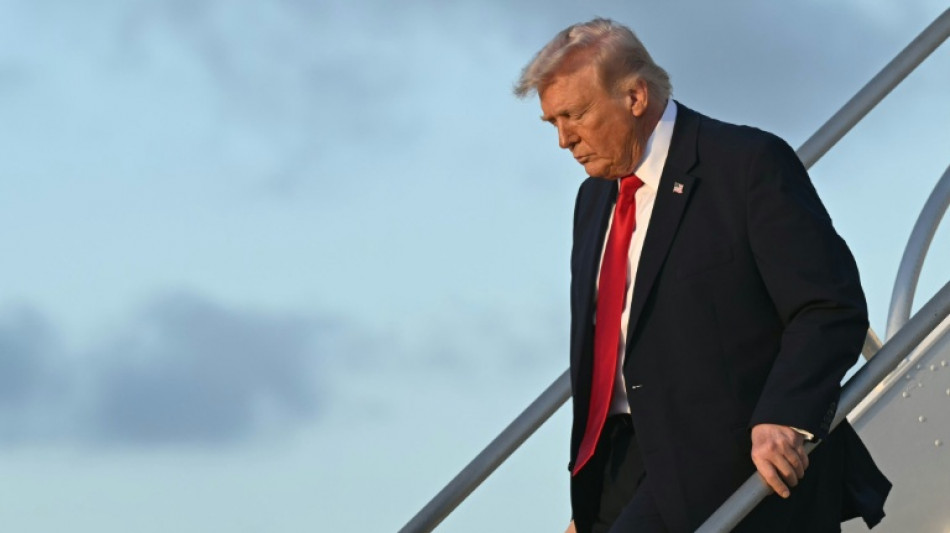
Trump hints end of Iran war in sight, saying operations 'very complete' / Photo: © AFP
President Donald Trump indicated for the first time Monday that US military operations in Iran could be coming to an end, saying the war was "very complete" and progressing ahead of schedule.
The war had sent stock markets slumping and oil prices soaring again on Monday as Tehran, under new leader Mojtaba Khamenei, fired a new barrage of missiles at its Gulf neighbours and signalled that the strategic Strait of Hormuz would likely remain closed.
But Wall Street vaulted into positive territory Monday after Trump's remarks, despite the lack of details on any solution to the conflict still raging in the Middle East.
"I think the war is very complete, pretty much. They have no navy, no communications, they've got no air force," Trump told CBS News by phone, repeating battle damage assessments that he has given in previous days.
Trump told the US broadcaster that the United States was "very far" ahead of his initially stated timeframe for the war of four or five weeks.
He is set to give a press conference shortly at around 5:30 pm (2130 GMT) in the ballroom of his Doral golf club near Miami.
On the first day in power for the 56-year-old son of slain leader Ali Khamenei, Iranian troops mustered a fresh wave of missile and drone attacks on Saudi Arabia, Bahrain, Qatar, the UAE and Israel.
Another missile was also fired at NATO member Turkey, the second such incident in five days, with the alliance's air defences intercepting it before it could hit its target.
With the Strait of Hormuz off Iran blocked for almost all oil tankers, the price of benchmark crude oil contracts rocketed past $100 a barrel on Monday -- their highest levels since Russia's invasion of Ukraine in 2022 -- before edging back slightly.
French President Emmanuel Macron said that his country and its allies were working on a "purely defensive" mission to reopen the strait, through which nearly 20 percent of the world's crude oil usually transits.
The mission would be aimed at escorting ships "after the end of the hottest phase of the conflict", but experts say it would mean putting navy vessels at risk of incoming fire from the nearby Iranian coast.
Kamal Kharazi, a foreign policy adviser to Iran's supreme leader, told CNN that Tehran was calculating that "the economic pressure will be beefed up to the extent that other countries intervene" to end the war.
Benchmark oil prices are up 40-50 percent since the US and Israel launched their attack on Iran on February 28, while stock markets around the world are down, hitting pension funds and savings.
Inflation caused by a sustained oil shock would also push up the price of goods for consumers everywhere.
Queues at petrol stations have been seen as far afield as Vietnam and the Philippines as drivers anticipate higher prices, while Hungary and Croatia in the EU announced fuel price caps.
- Rallies -
Iran faced a fresh blitz of US and Israeli strikes after its Assembly of Experts, the top clerical body, appointed its first new supreme leader in 37 years.
Iranian state media carried images of tens of thousands of people celebrating Mojtaba Khamenei's selection in central Tehran on Monday, many carrying his picture.
Iran's rebel Houthi allies in Yemen and the Hezbollah armed group in Lebanon pledged allegiance, while Russian President Vladimir Putin on Monday promised "unwavering support".
Unconfirmed US media reports over the weekend said that Moscow has been providing targeting intelligence to the Islamic republic's military.
Trump told the New York Post newspaper he was "not happy" about Khamenei's appointment, while Israel's foreign ministry called him a "tyrant".
Ali Ansari, a professor of Iranian history at the University of St Andrews in Scotland, told AFP the new supreme leader was a hardliner who had "been involved in all the most violent repressions that have taken place over the last 15-16 years".
Ali Vaez, of the International Crisis Group (ICG) think tank, said the appointment was intended to send a defiant message that Trump's war "has only replaced one Khamenei with another".
- Oil risks -
Oil traders, policymakers and central bankers are all watching the Middle East for news about Gulf energy infrastructure, which is crucial for the world economy.
About 10 vessels in or near the Strait of Hormuz have come under attack since Iran blocked the waterway in retaliation for the US-Israeli attack, shipping experts say.
Global shipping giant MSC announced that it was formally halting some export shipments from the Gulf, meaning goods sitting on ships would be unloaded.
Following strikes on Bahrain's Al Ma'ameer oil facility that ignited a fire, the country's state-owned energy company Bapco joined its counterparts in Qatar and Kuwait in declaring "force majeure" -- a warning that events beyond its control may lead it to miss export targets.
The Saudi defence ministry said Monday it had thwarted a drone attack targeting an oil field in the kingdom's east, near the Emirati border.
- 'Resistance' -
In Israel, around 10 explosions were audible in Tel Aviv after the military announced it had detected missiles inbound from Iran.
At least one Israeli was killed when he was hit by shrapnel, emergency services said.
The multi-front war also intensified in Lebanon, which was dragged into the conflict last week when Israel and Hezbollah began trading fire.
Lebanese President Joseph Aoun on Monday accused Hezbollah of working to "collapse" the state, while the head of the group's parliamentary bloc said it had "no other option to preserve honour, pride and dignity than the option of resistance".
Lebanese authorities said on Monday that Israel's attacks since March 2 have killed at least 486 people and wounded at least 1,313.
burs-adp/smw
S.Clarke--TNT