The National Times - Kurdish Iranian groups in Iraq eye opportunity for change at home

Kurdish Iranian groups in Iraq eye opportunity for change at home


Kurdish Iranian groups in Iraq eye opportunity for change at home
Kurdish Iranian groups in Iraq eye opportunity for change at home / Photo: © AFP

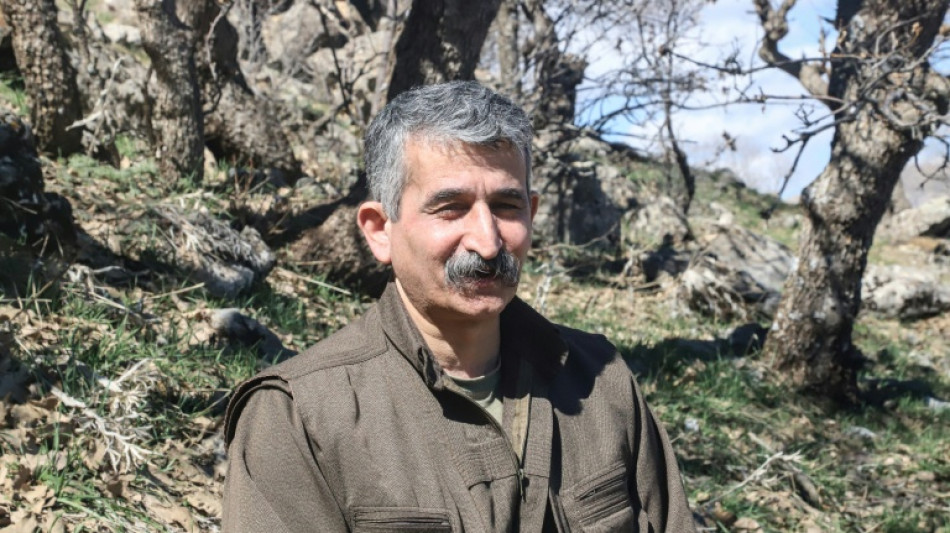
In the Iraqi mountains near Iran, an exiled Kurdish Iranian commander told AFP that whether or not the US launches strikes on Iran, he will still seek regime change in order to win self-determination for the Kurds.

Change text size:

Iraq's autonomous Kurdistan region has long been a haven for Kurdish Iranian armed factions, which have repeatedly faced cross-border strikes from Iran.

"We cannot take the side of either the Americans or the Iranians. Our cause is different... our goal is democratic change in Iran -- a democracy that will benefit the Kurdish people," said Mazloum Haftan, a senior commander in the Party of Free Life of Kurdistan (PJAK).

"We will neither attack Iran nor defend the current regime. We have chosen a third path: working towards democratic, peaceful change," the 54-year-old added.

An AFP team of journalists met Haftan and his fellow fighters in a bunker carved into a rugged mountainous area, now blanketed with snow, near the border with Iran.

Iran has designated his group as a terrorist organisation, and many Iranian Kurdish groups like his have previously fought Iranian security forces in Kurdish-majority areas along the border.

But in recent years, they have largely refrained from armed activity, although they continue to actively campaign from exile against the Islamic republic.

They recently stepped up their lobbying after mass anti-government protests in Iran that sparked a deadly crackdown, and as the United States conducted a military build-up in the region not seen in decades.

- 'With blood' -

If war breaks out, Haftan said he believes Iran might target Kurdish opposition positions in northern Iraq.

He also said Iranian authorities have already started boosting their security and military presence in Kurdish-majority areas of western Iran.

The impact of any US strikes would very much depend on how far they go. Should they go as far as effecting regime change, Haftan said groups like his would aim for "a decentralised system after having tried the monarchy and the Supreme Leader rule".

Last week, the PJAK and another four exiled groups announced a political coalition to seek the overthrow of Iran's Islamic republic and ultimately to secure Kurdish self-determination.

Kurdish opposition groups have long supported anti-government protests in Iran. Last month, they called for a general strike in support of the demonstrations.

In 2022, Iran launched deadly military strikes on exiled Kurdish Iranian militants, accusing them of instigating protests sparked by the death in custody of Kurdish Iranian woman Mahsa Amini.

In Iran, "the Kurds have been at the forefront of the struggle for democracy and freedom. When one leads people, one must pay a price—we have paid in blood," Haftan said.

- 'An opportunity' -

The Kurds, whose community spans areas of Turkey through Syria, Iraq and Iran, make up one of Iran's most important non-Persian ethnic minority groups.

The Democratic Party of Iranian Kurdistan (PDKI) is one of the oldest and biggest Kurdish Iranian opposition groups, and it has lost fighters and commanders, including three of its chiefs, to Iranian fire.

Despite his enmity with the Iranian state, PDKI commander Mohammed Nazif Kader told AFP over the phone his group has not supported Israeli or American attacks on the Islamic republic.

"Our coalition relies on the Iranian people, especially the Kurds," he said.

But "if a war breaks out, it will likely create an opportunity for the Iranian opposition to return" and "seek to establish a democratic system".

"We are on full alert and fully prepared... and for all forms of struggle," he added.

H.Davies--TNT

Featured

The "Everlasting Battery" Inside Your Joints:UConn Professor's Self-Powered Healing Material just Got Acquired

A material that turns your own movement into medicine has just landed a corporate home. PetVivo Holdings (OTCQX: PETV), a veterinary biotech and biomedical device company focused on treating osteoarthritis in dogs and horses, has acquired PiezoBioMembrane (PBM) — a startup built around a biodegradable implant that generates electricity from the everyday force of a joint in motion, and uses that charge to help regrow cartilage from the inside out. The material is the invention of Thanh Nguyen, a professor of mechanical engineering in UConn's College of Engineering, who founded PBM in 2021 to advance new implementation methods for his work with piezoelectric materials — substances that convert mechanical force into electrical energy. These materials are typically ceramics: hard, brittle, and poorly suited for medical use. But Nguyen's lab developed new forms that are so , flexible, and biodegradable, breaking down naturally within the body over time. wound healing, The materials have already shown strong potential across a range of medical applications, including tissue regeneration, implanted force sensors, and targeted drug delivery in tumor treatment. How It Works biodegradable ultrasound for In the case of arthritis, Nguyen explains, the piezoelectric materials function as an off-the-shelf product that can be implanted or injected directly into the ailing joint — with no drugs, chemicals, or cells required. The everyday force exerted on the joint generates a small electrical charge, which helps regrow healthy cartilage, mimicking the body's natural use of electricity to regenerate tissue. "The body can be electrically stimulated to regrow," Nguyen says. PBM's materials "act like a battery — an everlasting battery that works whenever there is a force applied, and vanishes safely inside the body over time." PetVivo's Vision for the Acquisition PetVivo Holdings CEO John Lai expressed enthusiasm for the merger's potential to improve the lives of companion animals globally. "PBM has developed a compelling functional biomaterials platform with the potential to support the development of multiple medical device and therapeutic product lines across both human and animal health markets," Lai said in a press release. "By combining PBM's scientific innovation with PetVivo's product development capabilities, commercialization experience, regulatory expertise, and public company infrastructure, we believe we can accelerate theadvancement of technologies that may serve as the foundation for numerous future products and strategic opportunities." For Nguyen, the deal is a chance to scale technology that could eventually benefit both animals and people. "PetVivo is an animal health company, but they do have a big passion: pushing the technology towards clinical trials for human use," Nguyen says. "That aligned perfectly with my passion for developing technology that has an impact on human life. That is why I am excited about this merger, which facilitates my passion." A Track Record of Innovation Nguyen's research sits at the intersection of medicine, micro/nanotechnology, and biomaterials. His inventions have earned him publications in prominent scientific journals and media coverage from outlets including NPR. Nguyen founded PBM during the COVID-19 pandemic, a er realizing the material he had developed could be used to create an especially effective, biodegradable face mask — one where the mechanical force of breathing generated an electrical charge that provided an extra layer of protection against viruses. PBM is not Nguyen's only venture in the acquisition pipeline. His other startup, Single-Time Microneedles (STM), is also currently undergoing an acquisition process. STM has pioneered stable, efficient vaccine delivery technology in the form of an adhesive patch. shelfNguyen's focus on biodegradable materials has translated into a remarkably diverse range of medical applications. He has received five R01 grants from the National Institutes of Health (NIH) supporting research in cartilage regeneration, bone regeneration, HIV antibody delivery systems, and biodegradable ultrasound technology to boost the effectiveness of chemotherapy for brain cancer. "Whatever we are working on, we want to show that it works very well in vitro and in vivo," Nguyen says. "Then, when we are at the point of commercialization, we set up a startup or license the technology — or maybe team up with an industry partner." Thanh Nguyen is a professor of mechanical engineering in UConn's College of Engineering. (Courtesy of Thanh Nguyen

Octrado introduces its proprietary trading offering: "Your Skill. Our Capital"

Infrastructure, transparent rules and clear legal boundaries positioned as the core of the funded-account model

Could gas prices return to 2022 highs on US-Iran war?

European gas prices have more than doubled owing to the US-Iran war, just as Europe needs to replenish its reserves ahead of winter.

CapTLX Expands Institutional-Oriented Platform for Access to U.S. Capital Markets

CapTLX, the securities trading and investment platform operated by CHAINLION TECH LTD, today announced the continued expansion of its technology infrastructure for qualified investors and institutional market participants seeking structured access to U.S. equity and private capital markets.

Change text size: