The National Times - 'Without ports, Ukraine will be destroyed': Odesa buckles under Russian bombs

'Without ports, Ukraine will be destroyed': Odesa buckles under Russian bombs


'Without ports, Ukraine will be destroyed': Odesa buckles under Russian bombs
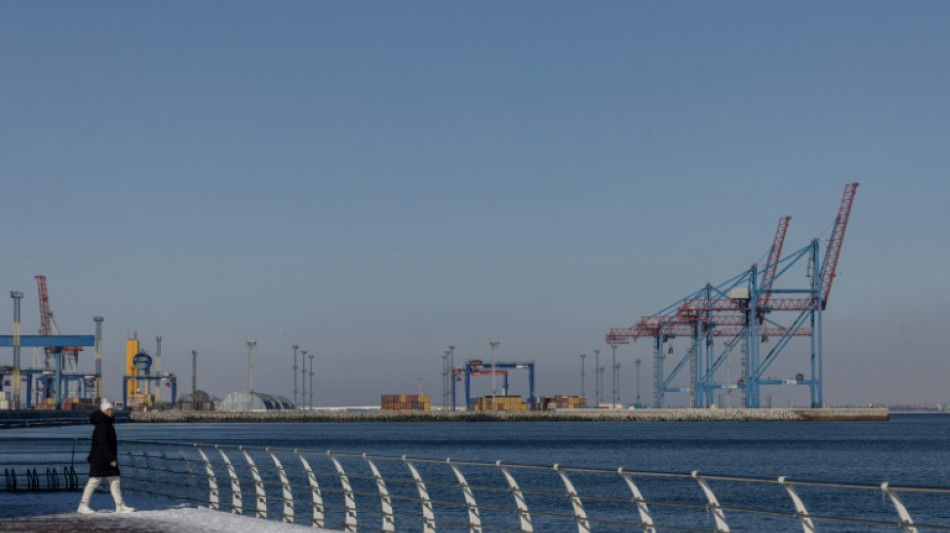
'Without ports, Ukraine will be destroyed': Odesa buckles under Russian bombs / Photo: © AFP

Looking out at the blue and yellow cranes towering over the Black Sea horizon, Viktor Berestenko worries about the relentless Russian bombardment of Odesa, Ukraine's southern port city.

Change text size:

"It's war, every night," the head of the Inter Trans logistics company told AFP.

The main gateway to the Black Sea and beyond, Odesa is a key logistics hub for Ukraine, one of the world's top agricultural exporters.

Russia has intensified its attacks on the region -- tripling the number of missile and drone strikes over the last year in what officials call an attempt to cut Ukraine off from the sea.

"Without ports, Ukraine will be destroyed," said Berestenko.

The escalation comes four years into Russia's invasion, in which Ukraine's maritime infrastructure has been a target for Moscow.

The attacks are accepted as part of daily life for the city of around one million people, dotted with ornate 19th-century architecture and where luxury cars pass mobile air defence units along the bustling seaside.

Russia's army occupies much of Ukraine's southern coast, including key port cities of Mariupol and Berdiansk further to the east.

And in 2023 Moscow walked away from a deal, brokered by the UN and Turkey, that facilitated the safe passage of Ukrainian agricultural exports across the Black Sea.

In response, Kyiv set up an alternative route with vessels hugging the sea's western coastline from Odesa, along Romania, Bulgaria and through the Bosphorus into the Mediterranean.

Ukraine touts it as a success, with more than 170 million tonnes of cargo transported through the route, including grain to some 55 countries, mostly in Africa.

The sales provide a vital source of income for the economy, decimated by the Russian invasion.

But the surge in strikes is taking a toll.

Volumes were down 15 percent last year, when some 57 ships and 336 pieces of port equipment were damaged, according to Mykola Kravchuk, head of the state-run Ukrainian Sea Ports Authority in the city.

There were more than 800 air raid alerts in Odesa in 2025 -- "this amounts to more than a month of operational time lost over the course of the year," Kravchuk told AFP.

The vast majority of Ukraine's grain exports go through Odesa.

- Two-minute warning -

Incoming ballistic missiles can hit Odesa within two minutes of being launched from Crimea, which Russia annexed in 2014.

It takes some 45 seconds for a crane operator to climb down, let alone reach a shelter, Berestenko said.

He scrolled through photos on his phone of burned-out trucks and warehouses damaged by strikes.

"It's scary, to put it briefly," said Iryna, who works at the port's container terminal.

"When the alarm sounds, we go down... we put our trust in God," the 41-year-old said.

"Sometimes alerts can last for three hours, and we sit there."

Several strikes have killed port employees or ship crew members.

In December, a ballistic missile attack killed eight people.

The strikes also have an environmental toll. Last year an attack on the nearby port of Pivdennyi hit a sunflower oil storage tank, polluting the Black Sea coast.

Thousands of birds and seahorses were killed as a result, ecologist Vladyslav Belinsky said.

Ukraine classifies its ports as strategically important infrastructure, limiting access to them.

Kravchuk said the port industry's top two priorities are protecting people, "specifically our employees" and making sure the ports stay open.

After an overnight attack on Friday Deputy Prime Minister Oleksiy Kuleba repeated that the maritime corridor was still operational despite another massive attack on Ukraine's port facilities.

But the surge in the attacks has many in the industry and the city on edge.

"What will be the next steps?" asked logistics chief Berestenko.

"To occupy Odesa? To cut Ukraine from the sea?"

S.M.Riley--TNT

Featured

The "Everlasting Battery" Inside Your Joints:UConn Professor's Self-Powered Healing Material just Got Acquired

A material that turns your own movement into medicine has just landed a corporate home. PetVivo Holdings (OTCQX: PETV), a veterinary biotech and biomedical device company focused on treating osteoarthritis in dogs and horses, has acquired PiezoBioMembrane (PBM) — a startup built around a biodegradable implant that generates electricity from the everyday force of a joint in motion, and uses that charge to help regrow cartilage from the inside out. The material is the invention of Thanh Nguyen, a professor of mechanical engineering in UConn's College of Engineering, who founded PBM in 2021 to advance new implementation methods for his work with piezoelectric materials — substances that convert mechanical force into electrical energy. These materials are typically ceramics: hard, brittle, and poorly suited for medical use. But Nguyen's lab developed new forms that are so , flexible, and biodegradable, breaking down naturally within the body over time. wound healing, The materials have already shown strong potential across a range of medical applications, including tissue regeneration, implanted force sensors, and targeted drug delivery in tumor treatment. How It Works biodegradable ultrasound for In the case of arthritis, Nguyen explains, the piezoelectric materials function as an off-the-shelf product that can be implanted or injected directly into the ailing joint — with no drugs, chemicals, or cells required. The everyday force exerted on the joint generates a small electrical charge, which helps regrow healthy cartilage, mimicking the body's natural use of electricity to regenerate tissue. "The body can be electrically stimulated to regrow," Nguyen says. PBM's materials "act like a battery — an everlasting battery that works whenever there is a force applied, and vanishes safely inside the body over time." PetVivo's Vision for the Acquisition PetVivo Holdings CEO John Lai expressed enthusiasm for the merger's potential to improve the lives of companion animals globally. "PBM has developed a compelling functional biomaterials platform with the potential to support the development of multiple medical device and therapeutic product lines across both human and animal health markets," Lai said in a press release. "By combining PBM's scientific innovation with PetVivo's product development capabilities, commercialization experience, regulatory expertise, and public company infrastructure, we believe we can accelerate theadvancement of technologies that may serve as the foundation for numerous future products and strategic opportunities." For Nguyen, the deal is a chance to scale technology that could eventually benefit both animals and people. "PetVivo is an animal health company, but they do have a big passion: pushing the technology towards clinical trials for human use," Nguyen says. "That aligned perfectly with my passion for developing technology that has an impact on human life. That is why I am excited about this merger, which facilitates my passion." A Track Record of Innovation Nguyen's research sits at the intersection of medicine, micro/nanotechnology, and biomaterials. His inventions have earned him publications in prominent scientific journals and media coverage from outlets including NPR. Nguyen founded PBM during the COVID-19 pandemic, a er realizing the material he had developed could be used to create an especially effective, biodegradable face mask — one where the mechanical force of breathing generated an electrical charge that provided an extra layer of protection against viruses. PBM is not Nguyen's only venture in the acquisition pipeline. His other startup, Single-Time Microneedles (STM), is also currently undergoing an acquisition process. STM has pioneered stable, efficient vaccine delivery technology in the form of an adhesive patch. shelfNguyen's focus on biodegradable materials has translated into a remarkably diverse range of medical applications. He has received five R01 grants from the National Institutes of Health (NIH) supporting research in cartilage regeneration, bone regeneration, HIV antibody delivery systems, and biodegradable ultrasound technology to boost the effectiveness of chemotherapy for brain cancer. "Whatever we are working on, we want to show that it works very well in vitro and in vivo," Nguyen says. "Then, when we are at the point of commercialization, we set up a startup or license the technology — or maybe team up with an industry partner." Thanh Nguyen is a professor of mechanical engineering in UConn's College of Engineering. (Courtesy of Thanh Nguyen

Octrado introduces its proprietary trading offering: "Your Skill. Our Capital"

Infrastructure, transparent rules and clear legal boundaries positioned as the core of the funded-account model

Could gas prices return to 2022 highs on US-Iran war?

European gas prices have more than doubled owing to the US-Iran war, just as Europe needs to replenish its reserves ahead of winter.

CapTLX Expands Institutional-Oriented Platform for Access to U.S. Capital Markets

CapTLX, the securities trading and investment platform operated by CHAINLION TECH LTD, today announced the continued expansion of its technology infrastructure for qualified investors and institutional market participants seeking structured access to U.S. equity and private capital markets.

Change text size: