The National Times - Germany's Merz meets Xi in China, seeking closer ties

Germany's Merz meets Xi in China, seeking closer ties


Germany's Merz meets Xi in China, seeking closer ties
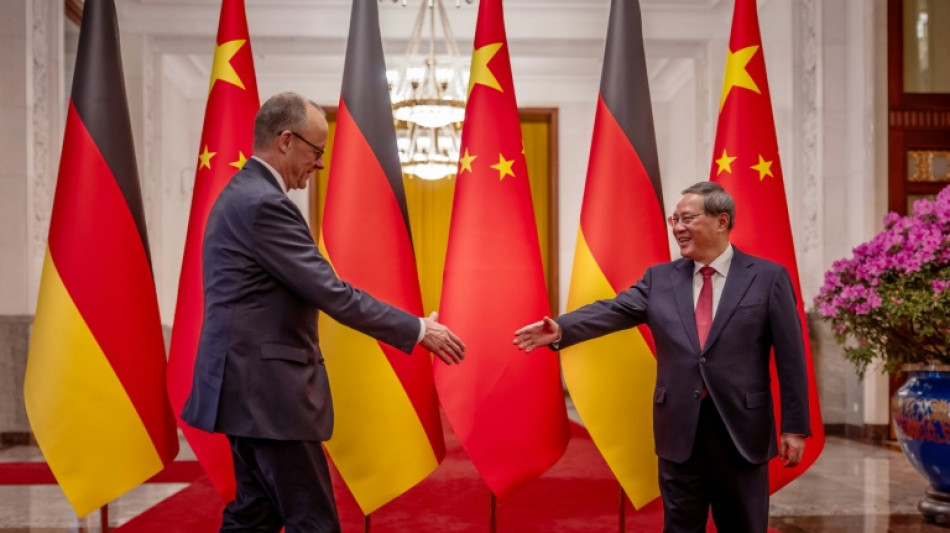
Germany's Merz meets Xi in China, seeking closer ties / Photo: © POOL/AFP

German Chancellor Friedrich Merz met with Chinese leader Xi Jinping in Beijing on Wednesday, hoping to bolster ties with his country's largest trade partner and high-tech rival as Europe's biggest economy struggles.

Change text size:

Berlin and Beijing want to build on their decades-old economic ties at a time when US President Donald Trump has sparked global chaos with his tariffs blitz and other erratic foreign policy moves.

China, the world's number two economy, overtook the United States last year to become Germany's biggest trade partner, but Berlin also regards the Communist Party-run state as a systemic rival to the West.

The two leaders reaffirmed their commitment to developing closer strategic relations, with Merz saying he saw the trip as a "great opportunity" to boost economic ties.

Xi, in turn, told Merz he was willing to take their ties to "new levels", stressing that he "always attached great importance to Sino-German relations".

Merz also noted that he wished for joint consultations between their two governments, which had been interrupted by a change in Germany's government and the pandemic, to resume "very soon".

But he is also expected to stress German and European interests during his talks with Xi, and urge him to put pressure on China's ally Russia to end the war in Ukraine.

Merz is the latest in a string of Western leaders courting Beijing in recent months, including Britain's Keir Starmer, France's Emmanuel Macron and Canada's Mark Carney, as they recoil from the mercurial policies of Trump, who is also expected from March 31.

- Large business delegation -

Export-dependent Germany needs "economic relations all over the world", Merz said before leaving for Beijing with a large business delegation in tow.

"But we should be under no illusions," he added, pointing out that China, as a rival to the United States, now "claims the right to define a new multilateral order according to its own rules".

Merz earlier met with Premier Li Qiang in Beijing's opulent Great Hall of the People, where he called for "fair" cooperation, and representatives from both sides signed agreements and memorandums -- including on climate change and food security.

In an apparent allusion to the United States, Li noted that "unilateralism and protectionism have gained ground and even become prevalent in some countries and regions".

"Against such a backdrop, China and Germany, as two major economies in the world with significant influence, should... jointly safeguard multilateralism and free trade," Li said.

China under Xi has grown far more assertive on the world stage, built up its military, stressed its claim to self-ruled Taiwan, and pushed back strongly against criticism of its human rights record.

Flexing its muscle at times of tension, Beijing has restricted exports of critical minerals used in products from microchips and wind turbines to electric-car batteries and weapons systems.

Last year, Beijing temporarily halted the export of Nexperia chips to Europe following a dispute with the Dutch government.

More broadly, European businesses complain that China, with its low domestic demand, is flooding Europe with goods made cheap through state subsidies and an undervalued currency.

Germany's trade deficit with China hit a record 89 billion euros ($105 billion) last year.

- 'Systemic competition' -

As Trump has unsettled allies and rivals alike, China has nonetheless also sought to present itself as a reliable partner and defender of the multilateral order.

China's top diplomat, Wang Yi, told Merz at the Munich Security Conference this month that Beijing hoped to bring ties "to a new level" and wanted Germany to be a "stabilising anchor for strategic relations" in the European Union.

Merz, like his predecessors Angela Merkel and Olaf Scholz, is joined by business leaders including executives of auto giants Volkswagen, BMW and Mercedes.

On Thursday, Merz is to visit Beijing's Forbidden City, then a Mercedes plant where autonomous driving vehicles will be presented.

The chancellor then travels to AI hub Hangzhou to visit the robotics group Unitree and German turbine maker Siemens Energy.

German businesses have given Merz a to-do list on his trip.

"We expect the chancellor to clearly address problems such as overcapacity, distortions of competition, and export controls on critical raw materials," said Wolfgang Niedermark of the Federation of German Industries.

German and European companies in China are not only "competing with highly innovative Chinese firms" but are also players in a "state-driven systemic competition".

Merz should advocate for "structural reforms to strengthen domestic demand and fairer competitive conditions" in China, he said, warning that without change there will be "new trade conflicts with the EU".

T.Allen--TNT

Featured

Carney touts Canada 'pivot' away from US as tariffs rise

Canadian Prime Minister Mark Carney on Tuesday said reducing economic ties with the United States would come at a cost but the long-term benefits were clear, as retaliatory tariffs on US products took effect.

The "Everlasting Battery" Inside Your Joints:UConn Professor's Self-Powered Healing Material just Got Acquired

A material that turns your own movement into medicine has just landed a corporate home. PetVivo Holdings (OTCQX: PETV), a veterinary biotech and biomedical device company focused on treating osteoarthritis in dogs and horses, has acquired PiezoBioMembrane (PBM) — a startup built around a biodegradable implant that generates electricity from the everyday force of a joint in motion, and uses that charge to help regrow cartilage from the inside out. The material is the invention of Thanh Nguyen, a professor of mechanical engineering in UConn's College of Engineering, who founded PBM in 2021 to advance new implementation methods for his work with piezoelectric materials — substances that convert mechanical force into electrical energy. These materials are typically ceramics: hard, brittle, and poorly suited for medical use. But Nguyen's lab developed new forms that are so , flexible, and biodegradable, breaking down naturally within the body over time. wound healing, The materials have already shown strong potential across a range of medical applications, including tissue regeneration, implanted force sensors, and targeted drug delivery in tumor treatment. How It Works biodegradable ultrasound for In the case of arthritis, Nguyen explains, the piezoelectric materials function as an off-the-shelf product that can be implanted or injected directly into the ailing joint — with no drugs, chemicals, or cells required. The everyday force exerted on the joint generates a small electrical charge, which helps regrow healthy cartilage, mimicking the body's natural use of electricity to regenerate tissue. "The body can be electrically stimulated to regrow," Nguyen says. PBM's materials "act like a battery — an everlasting battery that works whenever there is a force applied, and vanishes safely inside the body over time." PetVivo's Vision for the Acquisition PetVivo Holdings CEO John Lai expressed enthusiasm for the merger's potential to improve the lives of companion animals globally. "PBM has developed a compelling functional biomaterials platform with the potential to support the development of multiple medical device and therapeutic product lines across both human and animal health markets," Lai said in a press release. "By combining PBM's scientific innovation with PetVivo's product development capabilities, commercialization experience, regulatory expertise, and public company infrastructure, we believe we can accelerate theadvancement of technologies that may serve as the foundation for numerous future products and strategic opportunities." For Nguyen, the deal is a chance to scale technology that could eventually benefit both animals and people. "PetVivo is an animal health company, but they do have a big passion: pushing the technology towards clinical trials for human use," Nguyen says. "That aligned perfectly with my passion for developing technology that has an impact on human life. That is why I am excited about this merger, which facilitates my passion." A Track Record of Innovation Nguyen's research sits at the intersection of medicine, micro/nanotechnology, and biomaterials. His inventions have earned him publications in prominent scientific journals and media coverage from outlets including NPR. Nguyen founded PBM during the COVID-19 pandemic, a er realizing the material he had developed could be used to create an especially effective, biodegradable face mask — one where the mechanical force of breathing generated an electrical charge that provided an extra layer of protection against viruses. PBM is not Nguyen's only venture in the acquisition pipeline. His other startup, Single-Time Microneedles (STM), is also currently undergoing an acquisition process. STM has pioneered stable, efficient vaccine delivery technology in the form of an adhesive patch. shelfNguyen's focus on biodegradable materials has translated into a remarkably diverse range of medical applications. He has received five R01 grants from the National Institutes of Health (NIH) supporting research in cartilage regeneration, bone regeneration, HIV antibody delivery systems, and biodegradable ultrasound technology to boost the effectiveness of chemotherapy for brain cancer. "Whatever we are working on, we want to show that it works very well in vitro and in vivo," Nguyen says. "Then, when we are at the point of commercialization, we set up a startup or license the technology — or maybe team up with an industry partner." Thanh Nguyen is a professor of mechanical engineering in UConn's College of Engineering. (Courtesy of Thanh Nguyen

Octrado introduces its proprietary trading offering: "Your Skill. Our Capital"

Infrastructure, transparent rules and clear legal boundaries positioned as the core of the funded-account model

Could gas prices return to 2022 highs on US-Iran war?

European gas prices have more than doubled owing to the US-Iran war, just as Europe needs to replenish its reserves ahead of winter.

Change text size: