The National Times - Alexandria bids farewell to historic tram in latest urban upheaval

Alexandria bids farewell to historic tram in latest urban upheaval


Alexandria bids farewell to historic tram in latest urban upheaval
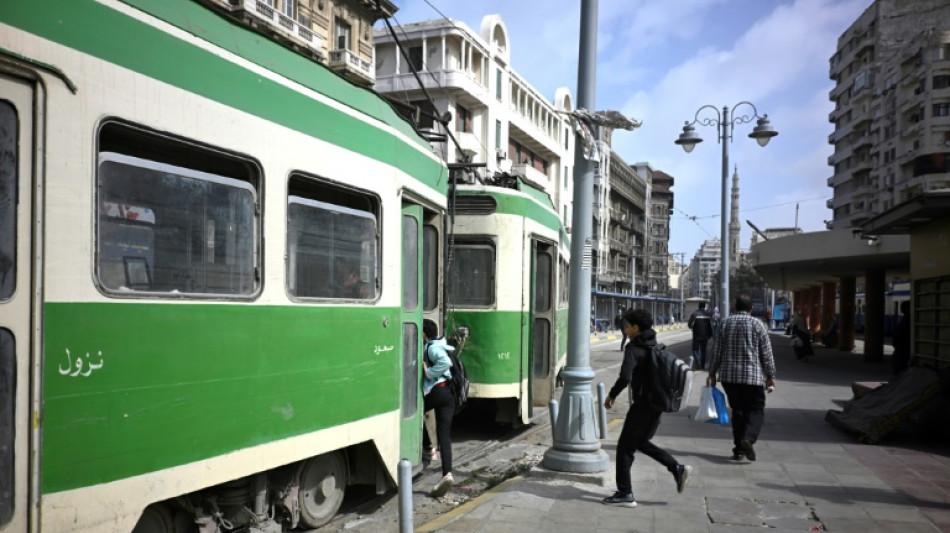
Alexandria bids farewell to historic tram in latest urban upheaval / Photo: © AFP

Along Egypt's Mediterranean coast, the oldest tram in Africa and the Middle East rumbles for a final few weeks before its removal -- the latest urban upheaval Alexandrians say is hollowing out their city's identity.

Change text size:

Government plans to replace the colourful streetcars on one of the city's routes with a partially elevated light rail line have angered Alexandrians, for whom the 163-year-old track is "heritage, not just a means of transport", local urban researcher Nahla Saleh told AFP.

Inaugurated in 1863, the tram is one of the world's oldest, and among only a few to operate double-decker cars.

In the 19th and 20th centuries, it helped the city become a bustling metropolis, home to sizable European diasporas and a distinct cosmopolitan culture.

Now, Egyptians young and old have flocked for farewell rides, before the streetcars come to a halt in April.

As one locomotive screeches into the old El-Raml Station, commuters and visitors crane their necks out of giant windows at the historic neo-Venetian buildings overhead.

"We're not against progress," psychologist and writer on culture Mona Lamloum told AFP.

She and other Alexandrians agree the tramway needs work: inside the hand-calligraphied blue exterior, grime covers every surface. Underfoot, the rubber flooring is torn and strewn with trash.

"We just have bad experiences of everything they call 'progress' becoming synonymous with destruction," Lamloum said.

In recent years, development projects in Egypt's second city have razed historic parks and -- most egregiously to locals -- privatised and obstructed much of its Mediterranean coastline.

- Heart of Alexandria -

For over 160 years, the tram has cut through Alexandria's heart, in an 11-kilometre stretch that includes many of the city's schools and main universities.

The new project, led by Egyptian and international companies including Systra, Hyundai and Hitachi, promises to double speed and triple capacity.

Over half of it will be elevated -- a major concern for Alexandrians who fear the tree-lined track will be replaced by eyesore concrete stilts.

Ahead of the first phase of suspension, the transport ministry said the new project was the "only solution to the city's traffic problems".

Locals like Saleh and Lamloum disagree, saying government plans are making the city more car-dependent and worsening traffic.

Already, because so many students rely on the tram, the city has staggered school and university hours to pick up the slack of the partial shutdown.

"Traffic's getting worse, people can't get anywhere, when we've already lost the inner-city train," said Saleh, referring to another project under construction for the past two years, the new Alexandria Metro Line.

"Besides, it being slow was always an advantage," she added, making it safe for "the most vulnerable in society: children and the elderly".

Retired science teacher Hisham Abdelwahab, 64, has been riding the tram since he was a child.

"I don't want it to go fast, I like watching the world go by," he told AFP on a station bench.

"Our parents never thought twice about sending us out on the tram alone. Now I have a car, I just like leaving it parked to come ride the tram."

When the next streetcar rolls in, the upper deck fills with a gaggle of schoolgirls, squabbling over who gets the window seat closest to the sea breeze.

- The old tram and the sea -

"This tram is our heritage," Abdelwahab said, his sentiment shared by those several decades younger.

Engineering student Mahmoud Bassam, 24, has visited Alexandria just to ride the streetcar "since our tram in Cairo was removed", he told AFP.

With a controversial slew of bridges and widened streets completed in 2020, Cairo's historic Heliopolis neighbourhood lost its last tram tracks, along with many of its trees.

"Now the same is happening here," Bassam lamented.

Many Alexandrians are feeling the loss, intermingled with their other most treasured heritage.

"It's like the sea. We used to go for long scenic drives on the corniche, but now we're losing both the sea and the tram," Abdelwahab said.

Parallel to the tramway, much of Alexandria's iconic corniche is now hidden behind overpasses, private businesses and beachside food courts.

By 2024, over half of the city's Mediterranean coastline had disappeared from view, according to a study by the Human and the City for Social Research centre.

Four-lane highways now dominate long stretches of the seaside, where the landmark sight of fishermen perched over the waves grows ever-rarer.

For many, the waterfront that Lebanese singer Fairouz immortalised in 1961 -- crooning about "the coast of Alexandria, coast of love" -- is no more.

"Now all you see is concrete," said Lamloum.

Saleh calls it "short-sighted" that the city could lose its charm to sprawling concrete.

"Tourists used to love coming to see the tram and sit by the sea, why take away both?"

N.Taylor--TNT

Featured

Carney touts Canada 'pivot' away from US as tariffs rise

Canadian Prime Minister Mark Carney on Tuesday said reducing economic ties with the United States would come at a cost but the long-term benefits were clear, as retaliatory tariffs on US products took effect.

The "Everlasting Battery" Inside Your Joints:UConn Professor's Self-Powered Healing Material just Got Acquired

A material that turns your own movement into medicine has just landed a corporate home. PetVivo Holdings (OTCQX: PETV), a veterinary biotech and biomedical device company focused on treating osteoarthritis in dogs and horses, has acquired PiezoBioMembrane (PBM) — a startup built around a biodegradable implant that generates electricity from the everyday force of a joint in motion, and uses that charge to help regrow cartilage from the inside out. The material is the invention of Thanh Nguyen, a professor of mechanical engineering in UConn's College of Engineering, who founded PBM in 2021 to advance new implementation methods for his work with piezoelectric materials — substances that convert mechanical force into electrical energy. These materials are typically ceramics: hard, brittle, and poorly suited for medical use. But Nguyen's lab developed new forms that are so , flexible, and biodegradable, breaking down naturally within the body over time. wound healing, The materials have already shown strong potential across a range of medical applications, including tissue regeneration, implanted force sensors, and targeted drug delivery in tumor treatment. How It Works biodegradable ultrasound for In the case of arthritis, Nguyen explains, the piezoelectric materials function as an off-the-shelf product that can be implanted or injected directly into the ailing joint — with no drugs, chemicals, or cells required. The everyday force exerted on the joint generates a small electrical charge, which helps regrow healthy cartilage, mimicking the body's natural use of electricity to regenerate tissue. "The body can be electrically stimulated to regrow," Nguyen says. PBM's materials "act like a battery — an everlasting battery that works whenever there is a force applied, and vanishes safely inside the body over time." PetVivo's Vision for the Acquisition PetVivo Holdings CEO John Lai expressed enthusiasm for the merger's potential to improve the lives of companion animals globally. "PBM has developed a compelling functional biomaterials platform with the potential to support the development of multiple medical device and therapeutic product lines across both human and animal health markets," Lai said in a press release. "By combining PBM's scientific innovation with PetVivo's product development capabilities, commercialization experience, regulatory expertise, and public company infrastructure, we believe we can accelerate theadvancement of technologies that may serve as the foundation for numerous future products and strategic opportunities." For Nguyen, the deal is a chance to scale technology that could eventually benefit both animals and people. "PetVivo is an animal health company, but they do have a big passion: pushing the technology towards clinical trials for human use," Nguyen says. "That aligned perfectly with my passion for developing technology that has an impact on human life. That is why I am excited about this merger, which facilitates my passion." A Track Record of Innovation Nguyen's research sits at the intersection of medicine, micro/nanotechnology, and biomaterials. His inventions have earned him publications in prominent scientific journals and media coverage from outlets including NPR. Nguyen founded PBM during the COVID-19 pandemic, a er realizing the material he had developed could be used to create an especially effective, biodegradable face mask — one where the mechanical force of breathing generated an electrical charge that provided an extra layer of protection against viruses. PBM is not Nguyen's only venture in the acquisition pipeline. His other startup, Single-Time Microneedles (STM), is also currently undergoing an acquisition process. STM has pioneered stable, efficient vaccine delivery technology in the form of an adhesive patch. shelfNguyen's focus on biodegradable materials has translated into a remarkably diverse range of medical applications. He has received five R01 grants from the National Institutes of Health (NIH) supporting research in cartilage regeneration, bone regeneration, HIV antibody delivery systems, and biodegradable ultrasound technology to boost the effectiveness of chemotherapy for brain cancer. "Whatever we are working on, we want to show that it works very well in vitro and in vivo," Nguyen says. "Then, when we are at the point of commercialization, we set up a startup or license the technology — or maybe team up with an industry partner." Thanh Nguyen is a professor of mechanical engineering in UConn's College of Engineering. (Courtesy of Thanh Nguyen

Octrado introduces its proprietary trading offering: "Your Skill. Our Capital"

Infrastructure, transparent rules and clear legal boundaries positioned as the core of the funded-account model

Could gas prices return to 2022 highs on US-Iran war?

European gas prices have more than doubled owing to the US-Iran war, just as Europe needs to replenish its reserves ahead of winter.

Change text size: