The National Times - Japan inflation eases in welcome news for PM Takaichi

Japan inflation eases in welcome news for PM Takaichi


Japan inflation eases in welcome news for PM Takaichi
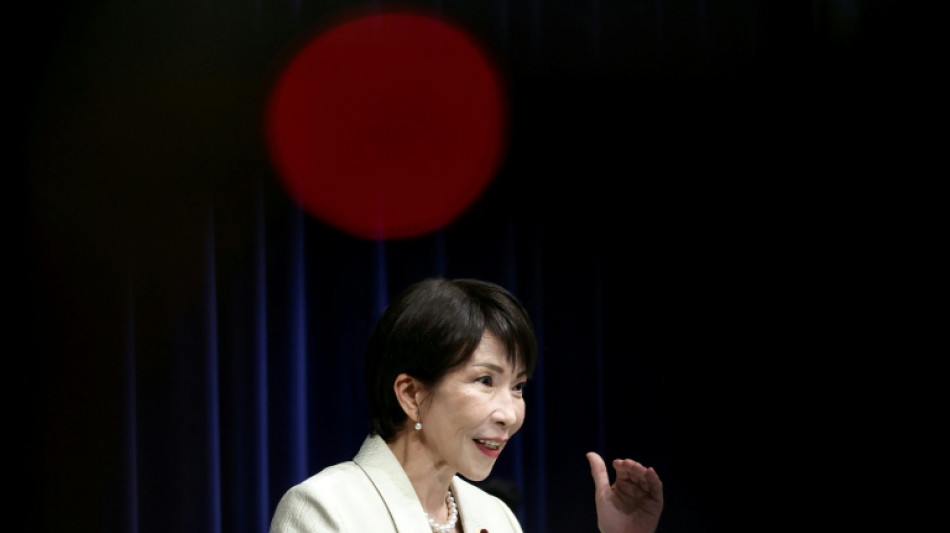
Japan inflation eases in welcome news for PM Takaichi / Photo: © POOL/AFP

Japanese inflation slowed in January, government data showed Friday, in welcome news for Prime Minister Sanae Takaichi after her recent election landslide win.

Change text size:

Soaring inflation in Asia's number-two economy -- after decades of flat or falling prices -- contributed to the downfall of Takaichi's two predecessors and Japan's first woman premier has made helping households a priority.

Excluding fresh food, "core" consumer prices rose 2.0 percent year-on-year, the slowest rise in two years, down from 2.4 percent in December, and in line with market forecasts.

Also stripping out energy prices, inflation mellowed to 2.6 percent from 2.9 percent, while headline unadjusted inflation was 1.5 percent, down from 2.1 percent.

Petrol prices fell 14.6 percent, thanks in part to government subsidies, but food excluding fresh produce rose 6.2 percent. Rice prices -- which doubled last year -- soared 27.9 percent.

"Looking ahead, we expect headline inflation to weaken further to just over 1 percent in February and March as generous energy subsidies kick in," said Abhijit Surya at Capital Economics.

He added that with price pressures easing, the Bank of Japan "won't be in a rush" to hike interest rates but will still do so by mid-year.

- Godzilla-sized debts -

Takaichi was due to give a policy address in parliament later on Friday after winning a historic two-thirds majority in February 8 snap elections.

A poll by the Yomiuri newspaper published Friday put support for Takaichi's cabinet at 73 percent, up six percentage points and her highest yet.

In the address, Takaichi will likely repeat her campaign pledge to suspend consumption tax on food for two years to help households cope with inflation.

This has exacerbated market worries about Japan's Godzilla-sized debts, with yields on long-dated government bonds hitting record highs last month.

To ease such concerns, Takaichi on Wednesday repeated her mantra of having a "responsible, proactive" fiscal policy and promised to reduce debt.

She will also announce in her policy speech a cross-party "national council" to discuss taxation and how to fund ageing Japan's ballooning social security bill, media reports said.

- Pacific strategy -

But Takaichi's first order of business will be obtaining approval for Japan's budget for the fiscal year beginning on April 1 after the process was delayed by the election.

She is also expected to announce that the government wants to update Japan's 10-year-old "Free and Open Indo-Pacific" (FOIP) strategic framework.

"The international situation surrounding Japan and its security environment are growing increasingly severe," Foreign Minister Toshimitsu Motegi said Thursday.

"Furthermore, new challenges have emerged in economic security and international competition over emerging technologies," Motegi told reporters.

He said the focus of the changes would be to reflect the increased importance of ensuring "resilient supply chains" of items like critical minerals.

In addition it would cover the capacity of nations in the region to safeguard maritime security, Motegi said.

This is a nod to China, which is beefing up its military and is enbroiled in several territorial disputes, including with Japan.

Takaichi, seen before becoming premier as a China hawk, suggested in November that Japan could intervene militarily if Beijing sought to take Taiwan by force.

China, which regards the democratic island as part of its territory and has not ruled out force to annex it, was furious.

Beijing's top diplomat Wang Yi told the Munich Security Conference on Saturday that forces in Japan were seeking to "revive militarism".

Takaichi was also expected to announce plans to create a powerful new National Intelligence Agency that will consolidate information collected currently by different government bodies.

The new agency, along with a mooted new "spy prevention" law, has however raised some concerns.

The new agency "is intended to respond to an increasingly unstable international situation, but it must not be allowed to unjustly infringe upon citizens' rights", the Mainichi Shimbun said in an editorial Friday.

F.Hammond--TNT

Featured

Carney touts Canada 'pivot' away from US as tariffs rise

Canadian Prime Minister Mark Carney on Tuesday said reducing economic ties with the United States would come at a cost but the long-term benefits were clear, as retaliatory tariffs on US products took effect.

The "Everlasting Battery" Inside Your Joints:UConn Professor's Self-Powered Healing Material just Got Acquired

A material that turns your own movement into medicine has just landed a corporate home. PetVivo Holdings (OTCQX: PETV), a veterinary biotech and biomedical device company focused on treating osteoarthritis in dogs and horses, has acquired PiezoBioMembrane (PBM) — a startup built around a biodegradable implant that generates electricity from the everyday force of a joint in motion, and uses that charge to help regrow cartilage from the inside out. The material is the invention of Thanh Nguyen, a professor of mechanical engineering in UConn's College of Engineering, who founded PBM in 2021 to advance new implementation methods for his work with piezoelectric materials — substances that convert mechanical force into electrical energy. These materials are typically ceramics: hard, brittle, and poorly suited for medical use. But Nguyen's lab developed new forms that are so , flexible, and biodegradable, breaking down naturally within the body over time. wound healing, The materials have already shown strong potential across a range of medical applications, including tissue regeneration, implanted force sensors, and targeted drug delivery in tumor treatment. How It Works biodegradable ultrasound for In the case of arthritis, Nguyen explains, the piezoelectric materials function as an off-the-shelf product that can be implanted or injected directly into the ailing joint — with no drugs, chemicals, or cells required. The everyday force exerted on the joint generates a small electrical charge, which helps regrow healthy cartilage, mimicking the body's natural use of electricity to regenerate tissue. "The body can be electrically stimulated to regrow," Nguyen says. PBM's materials "act like a battery — an everlasting battery that works whenever there is a force applied, and vanishes safely inside the body over time." PetVivo's Vision for the Acquisition PetVivo Holdings CEO John Lai expressed enthusiasm for the merger's potential to improve the lives of companion animals globally. "PBM has developed a compelling functional biomaterials platform with the potential to support the development of multiple medical device and therapeutic product lines across both human and animal health markets," Lai said in a press release. "By combining PBM's scientific innovation with PetVivo's product development capabilities, commercialization experience, regulatory expertise, and public company infrastructure, we believe we can accelerate theadvancement of technologies that may serve as the foundation for numerous future products and strategic opportunities." For Nguyen, the deal is a chance to scale technology that could eventually benefit both animals and people. "PetVivo is an animal health company, but they do have a big passion: pushing the technology towards clinical trials for human use," Nguyen says. "That aligned perfectly with my passion for developing technology that has an impact on human life. That is why I am excited about this merger, which facilitates my passion." A Track Record of Innovation Nguyen's research sits at the intersection of medicine, micro/nanotechnology, and biomaterials. His inventions have earned him publications in prominent scientific journals and media coverage from outlets including NPR. Nguyen founded PBM during the COVID-19 pandemic, a er realizing the material he had developed could be used to create an especially effective, biodegradable face mask — one where the mechanical force of breathing generated an electrical charge that provided an extra layer of protection against viruses. PBM is not Nguyen's only venture in the acquisition pipeline. His other startup, Single-Time Microneedles (STM), is also currently undergoing an acquisition process. STM has pioneered stable, efficient vaccine delivery technology in the form of an adhesive patch. shelfNguyen's focus on biodegradable materials has translated into a remarkably diverse range of medical applications. He has received five R01 grants from the National Institutes of Health (NIH) supporting research in cartilage regeneration, bone regeneration, HIV antibody delivery systems, and biodegradable ultrasound technology to boost the effectiveness of chemotherapy for brain cancer. "Whatever we are working on, we want to show that it works very well in vitro and in vivo," Nguyen says. "Then, when we are at the point of commercialization, we set up a startup or license the technology — or maybe team up with an industry partner." Thanh Nguyen is a professor of mechanical engineering in UConn's College of Engineering. (Courtesy of Thanh Nguyen

Octrado introduces its proprietary trading offering: "Your Skill. Our Capital"

Infrastructure, transparent rules and clear legal boundaries positioned as the core of the funded-account model

Could gas prices return to 2022 highs on US-Iran war?

European gas prices have more than doubled owing to the US-Iran war, just as Europe needs to replenish its reserves ahead of winter.

Change text size: