The National Times - Turkey fires up coal pollution even as it hosts COP31

Turkey fires up coal pollution even as it hosts COP31


Turkey fires up coal pollution even as it hosts COP31
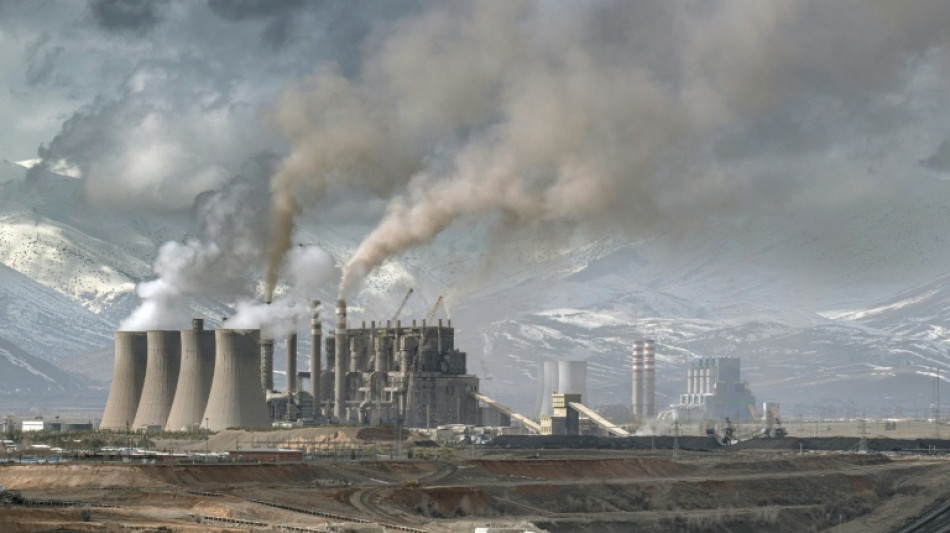
Turkey fires up coal pollution even as it hosts COP31 / Photo: © AFP

Kaddafi Polat rarely mentions his own health after decades of breathing the polluted air blanketing his village beneath the towering chimneys of a coal‑fired power plant in southern Turkey. What troubles him most is his children.

Change text size:

Fine dust settles on cars, laundry and the narrow streets of Cogulhan, a village in the Afsin district of Kahramanmaras province, leaving a grey film over daily life -- and over the now-rotting playground where his kids once played.

Afsin‑Elbistan is one of the country's most polluting power plants, environmentalists say, but the government is planning to expand it, even as Turkey prepares to host the COP31 UN climate summit next November.

"In the mornings, when the school bus comes, dust rises everywhere," Polat, 52, told AFP at a local coffeehouse.

"Children breathe this in, what will happen when they're 30 or 40? As a father, you worry."

Once home to 10,000 people, most of the village's residents have fled because of the pollution, locals say. Only a few hundred are left.

Crumbling houses line the streets, watched over by a solitary clock tower. The chimneys of the power plant dominate the skyline, pumping plumes of ash and smoke.

"Living here is like suicide," Polat sighs, saying some stay because they are poor, others because they have land here.

"I've watched pollution change everything: people, animals, the soil, even the trees."

- A genuine climate leader? -

One of Turkey's largest thermal power facilities, the plant generates 2,795 megawatts of power from highly polluting lignite, or brown coal, mined in the Afsin‑Elbistan basin that holds 40 percent of the country's reserves.

Opened in 1984, the eight-unit complex comprises privately-run Afsin-Elbistan A, and the state‑run plant B.

But plans to expand Plant A by two units have alarmed environmentalists, especially with Turkey preparing to host COP31, where the shift away from fossil fuels will be a central theme.

"If Turkey is pursuing the COP31 presidency with a claim to being a genuine climate leader yet continues to insist on fossil fuel investments, particularly coal, then this is a paradox it must resolve," said Emel Turker Alpay of Greenpeace Turkey.

Turkey aims to reach net-zero emissions by 2053, but coal still accounted for 33.6 percent of the resources used in electricity generation last year, official data shows.

Last week, Environment Minister Murat Kurum tried to dismiss a question about hosting COP31 and Turkey's increasing reliance on coal.

"We cannot reduce the matter solely to fossil fuels," he told a news conference alongside UN climate chief Simon Stiell.

But Alpay said expanding one of the country's most polluting plants contradicts both "Turkey's climate goals and the state's responsibility to protect public health".

Activists link the complex and its emissions of particulate matter and sulphur dioxide to an estimated 16,530 premature deaths.

Adding two more units could cause a further 2,268 deaths and impose 88.4 billion lira ($2.6 billion) in health costs, even with improved filtration technology, they warn.

Contacted by AFP, the plant declined to comment on the expansion plans.

- Government 'must choose' -

Lutfi Tiyekli, who heads the Kahramanmaras doctors' association, said the government "must choose between energy from this power plant and public health".

"We are knowingly sacrificing people here to cancer, chronic obstructive pulmonary disease and asthma," he told AFP.

A local environmental activist, Mehmet Dalkanat, said sickness was widespread.

"People are dying. There isn't a single household in this village without cancer," said Dalkanat, who suffers chronic respiratory problems.

His son, Ali, said he worked as a security guard at the plant but left in 2020 with severe bronchitis.

"Had I kept working there, my health would have taken an irreversible path," he said.

- Danger levels -

Air pollution in the Elbistan district remains far above World Health Organization and Turkish safety thresholds, said Deniz Gumusel of the Right to Clean Air Platform.

Under Turkish limits annual PM10 particulate matter should be capped at 40 micrograms per cubic meter, she said, but Elbistan has levels of up to three times higher.

And the daily average of PM10 particle levels reached 128.3 micrograms per cubic meter in Elbistan last year -- over eight times the WHO guideline of 15 micrograms.

For Dalkanat, expansion would be the final blow.

"While the world is phasing out coal, building a new power plant here means this region is being written off," he said.

In Cogulhan, residents have largely given up.

"Look where I walked, my footprints show like walking on snow," said 62‑year‑old Eyup Kisa of the ash that constantly falls on the village.

"If they expand this plant, we'll all die".

A.M.Murray--TNT

Featured

Carney touts Canada 'pivot' away from US as tariffs rise

Canadian Prime Minister Mark Carney on Tuesday said reducing economic ties with the United States would come at a cost but the long-term benefits were clear, as retaliatory tariffs on US products took effect.

The "Everlasting Battery" Inside Your Joints:UConn Professor's Self-Powered Healing Material just Got Acquired

A material that turns your own movement into medicine has just landed a corporate home. PetVivo Holdings (OTCQX: PETV), a veterinary biotech and biomedical device company focused on treating osteoarthritis in dogs and horses, has acquired PiezoBioMembrane (PBM) — a startup built around a biodegradable implant that generates electricity from the everyday force of a joint in motion, and uses that charge to help regrow cartilage from the inside out. The material is the invention of Thanh Nguyen, a professor of mechanical engineering in UConn's College of Engineering, who founded PBM in 2021 to advance new implementation methods for his work with piezoelectric materials — substances that convert mechanical force into electrical energy. These materials are typically ceramics: hard, brittle, and poorly suited for medical use. But Nguyen's lab developed new forms that are so , flexible, and biodegradable, breaking down naturally within the body over time. wound healing, The materials have already shown strong potential across a range of medical applications, including tissue regeneration, implanted force sensors, and targeted drug delivery in tumor treatment. How It Works biodegradable ultrasound for In the case of arthritis, Nguyen explains, the piezoelectric materials function as an off-the-shelf product that can be implanted or injected directly into the ailing joint — with no drugs, chemicals, or cells required. The everyday force exerted on the joint generates a small electrical charge, which helps regrow healthy cartilage, mimicking the body's natural use of electricity to regenerate tissue. "The body can be electrically stimulated to regrow," Nguyen says. PBM's materials "act like a battery — an everlasting battery that works whenever there is a force applied, and vanishes safely inside the body over time." PetVivo's Vision for the Acquisition PetVivo Holdings CEO John Lai expressed enthusiasm for the merger's potential to improve the lives of companion animals globally. "PBM has developed a compelling functional biomaterials platform with the potential to support the development of multiple medical device and therapeutic product lines across both human and animal health markets," Lai said in a press release. "By combining PBM's scientific innovation with PetVivo's product development capabilities, commercialization experience, regulatory expertise, and public company infrastructure, we believe we can accelerate theadvancement of technologies that may serve as the foundation for numerous future products and strategic opportunities." For Nguyen, the deal is a chance to scale technology that could eventually benefit both animals and people. "PetVivo is an animal health company, but they do have a big passion: pushing the technology towards clinical trials for human use," Nguyen says. "That aligned perfectly with my passion for developing technology that has an impact on human life. That is why I am excited about this merger, which facilitates my passion." A Track Record of Innovation Nguyen's research sits at the intersection of medicine, micro/nanotechnology, and biomaterials. His inventions have earned him publications in prominent scientific journals and media coverage from outlets including NPR. Nguyen founded PBM during the COVID-19 pandemic, a er realizing the material he had developed could be used to create an especially effective, biodegradable face mask — one where the mechanical force of breathing generated an electrical charge that provided an extra layer of protection against viruses. PBM is not Nguyen's only venture in the acquisition pipeline. His other startup, Single-Time Microneedles (STM), is also currently undergoing an acquisition process. STM has pioneered stable, efficient vaccine delivery technology in the form of an adhesive patch. shelfNguyen's focus on biodegradable materials has translated into a remarkably diverse range of medical applications. He has received five R01 grants from the National Institutes of Health (NIH) supporting research in cartilage regeneration, bone regeneration, HIV antibody delivery systems, and biodegradable ultrasound technology to boost the effectiveness of chemotherapy for brain cancer. "Whatever we are working on, we want to show that it works very well in vitro and in vivo," Nguyen says. "Then, when we are at the point of commercialization, we set up a startup or license the technology — or maybe team up with an industry partner." Thanh Nguyen is a professor of mechanical engineering in UConn's College of Engineering. (Courtesy of Thanh Nguyen

Octrado introduces its proprietary trading offering: "Your Skill. Our Capital"

Infrastructure, transparent rules and clear legal boundaries positioned as the core of the funded-account model

Could gas prices return to 2022 highs on US-Iran war?

European gas prices have more than doubled owing to the US-Iran war, just as Europe needs to replenish its reserves ahead of winter.

Change text size: