The National Times - Polish bishop goes on trial for paedophilia cover-up

Polish bishop goes on trial for paedophilia cover-up


Polish bishop goes on trial for paedophilia cover-up
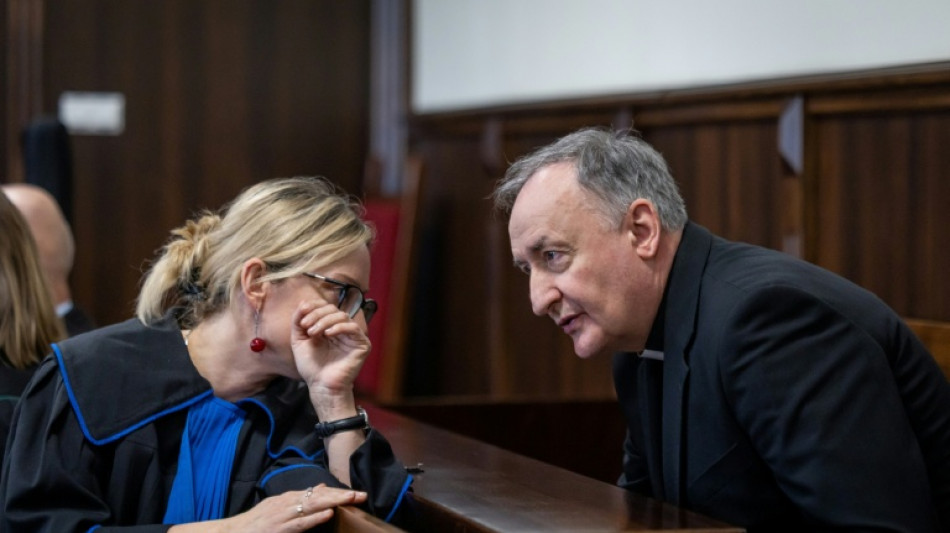
Polish bishop goes on trial for paedophilia cover-up / Photo: © AFP

A Polish bishop went on trial Wednesday for allegedly covering up paedophilia by priests in his diocese in a landmark case for the deeply Catholic country.

Change text size:

The Bishop of Tarnow Andrzej Jez is the first member of the hierarchy to face criminal charges for failing to inform authorities of abuse by clergy.

The bishop, who denies the charges, told the court that "if we had not reported these two cases at all, this trial would not be taking place."

"Paradoxically, I am being charged for my zeal," he added.

Prosecutors said the bishop -- who could face three years in jail -- was aware of two cases of priests abusing underage altar boys.

One of the priests is believed to have abused 95 children, and committed sexual crimes against 77.

It was one of the largest cases of sexual abuse in the Catholic Church in Poland, with incidents going as far back as the 1980s in every parish where he served.

Neither clergyman -- whose surnames have been withheld due to Polish privacy laws -- was charged.

Too many years had passed in some cases and others who accused Stanislaw P. were not able to remember precisely when the abuse took place, as they were small children. The second priest, Father Tomasz K., claimed poor health, and the case was dropped.

Stanislaw P. was ultimately stripped of the priesthood by the church.

"This is a spectacular case, and in Polish realities essentially unprecedented," said Artur Nowak, a lawyer and writer who appeared in a watershed documentary about sexual abuse in the Catholic Church in Poland.

- Increasing scandals -

In previous cases of alleged church cover-ups, prosecutors had declined to open investigations into church officials, arguing that the criminal code did not require police to be notified.

But a 2017 amendment to the code made it obligatory in cases of sexual offences committed against children under 15.

Bishop Jez's Tarnow diocese insisted Tuesday that "it made a dozen or so reports to law enforcement over the past years, implementing a 'zero tolerance' policy."

"I believe we are dealing with a kind of scapegoat situation," Zbigniew Cwiakalski, from the bishop's defence team, told reporters.

"It is not as if a victim immediately runs to the bishop and starts informing (him)," he added.

But victims of clerical child abuse welcomed the trial.

"I'm beyond happy that this is finally becoming public," Lilianna Kupaj -- who was sexually abused by a priest as a child -- said at the courthouse ahead of the trial.

"Let the world finally hear this," she added tearfully.

Poland had seemed to be bucking the European trend towards secularisation until recently, with 88.8 percent of Poles feeling a "sense of belonging" to the Catholic Church.

But an increasing number of abuse scandals, pushback against the country's strict abortion laws, and concern over the church's involvement in politics has contributed to a steep decline in the number of practising Catholics.

Last year Poland's Centre for Public Opinion Research found that only 34 percent of Poles said they attended weekly mass -- down from almost 70 percent in the early 1990s.

Church abuse scandals have even touched former Polish Pope John Paul II.

Investigations into his time as archbishop of Krakow in the 1960s and 1970s accused him of neglecting to report known cases of child sexual abuse.

The Vatican barred three Polish bishops from celebrating mass in public in 2021 and ordered their dioceses to pay into a fund for victims over allegations of negligence.

- Growing secularisation -

Although the Polish constitution is secular, the state funds Catholic religious education in public schools.

A study in the Nature Communications journal last year found that Poland is the world's fastest-secularising country, especially among young people.

Earlier this week, a commission formed to investigate child sex abuse in the Sosnowiec diocese in southern Poland identified at least 50 children who were harmed and 29 suspected abusers, most of them clergy.

It revealed that local bishops had repeatedly failed to act when they received credible reports of abuse.

On Tuesday another Polish court began the trial of a priest accused of nine sexual offences against minors, as well as possession of child sexual abuse materials.

Polish bishops will meet next month to vote on a nationwide church commission on paedophilia.

P.Johnston--TNT

Featured

Carney touts Canada 'pivot' away from US as tariffs rise

Canadian Prime Minister Mark Carney on Tuesday said reducing economic ties with the United States would come at a cost but the long-term benefits were clear, as retaliatory tariffs on US products took effect.

The "Everlasting Battery" Inside Your Joints:UConn Professor's Self-Powered Healing Material just Got Acquired

A material that turns your own movement into medicine has just landed a corporate home. PetVivo Holdings (OTCQX: PETV), a veterinary biotech and biomedical device company focused on treating osteoarthritis in dogs and horses, has acquired PiezoBioMembrane (PBM) — a startup built around a biodegradable implant that generates electricity from the everyday force of a joint in motion, and uses that charge to help regrow cartilage from the inside out. The material is the invention of Thanh Nguyen, a professor of mechanical engineering in UConn's College of Engineering, who founded PBM in 2021 to advance new implementation methods for his work with piezoelectric materials — substances that convert mechanical force into electrical energy. These materials are typically ceramics: hard, brittle, and poorly suited for medical use. But Nguyen's lab developed new forms that are so , flexible, and biodegradable, breaking down naturally within the body over time. wound healing, The materials have already shown strong potential across a range of medical applications, including tissue regeneration, implanted force sensors, and targeted drug delivery in tumor treatment. How It Works biodegradable ultrasound for In the case of arthritis, Nguyen explains, the piezoelectric materials function as an off-the-shelf product that can be implanted or injected directly into the ailing joint — with no drugs, chemicals, or cells required. The everyday force exerted on the joint generates a small electrical charge, which helps regrow healthy cartilage, mimicking the body's natural use of electricity to regenerate tissue. "The body can be electrically stimulated to regrow," Nguyen says. PBM's materials "act like a battery — an everlasting battery that works whenever there is a force applied, and vanishes safely inside the body over time." PetVivo's Vision for the Acquisition PetVivo Holdings CEO John Lai expressed enthusiasm for the merger's potential to improve the lives of companion animals globally. "PBM has developed a compelling functional biomaterials platform with the potential to support the development of multiple medical device and therapeutic product lines across both human and animal health markets," Lai said in a press release. "By combining PBM's scientific innovation with PetVivo's product development capabilities, commercialization experience, regulatory expertise, and public company infrastructure, we believe we can accelerate theadvancement of technologies that may serve as the foundation for numerous future products and strategic opportunities." For Nguyen, the deal is a chance to scale technology that could eventually benefit both animals and people. "PetVivo is an animal health company, but they do have a big passion: pushing the technology towards clinical trials for human use," Nguyen says. "That aligned perfectly with my passion for developing technology that has an impact on human life. That is why I am excited about this merger, which facilitates my passion." A Track Record of Innovation Nguyen's research sits at the intersection of medicine, micro/nanotechnology, and biomaterials. His inventions have earned him publications in prominent scientific journals and media coverage from outlets including NPR. Nguyen founded PBM during the COVID-19 pandemic, a er realizing the material he had developed could be used to create an especially effective, biodegradable face mask — one where the mechanical force of breathing generated an electrical charge that provided an extra layer of protection against viruses. PBM is not Nguyen's only venture in the acquisition pipeline. His other startup, Single-Time Microneedles (STM), is also currently undergoing an acquisition process. STM has pioneered stable, efficient vaccine delivery technology in the form of an adhesive patch. shelfNguyen's focus on biodegradable materials has translated into a remarkably diverse range of medical applications. He has received five R01 grants from the National Institutes of Health (NIH) supporting research in cartilage regeneration, bone regeneration, HIV antibody delivery systems, and biodegradable ultrasound technology to boost the effectiveness of chemotherapy for brain cancer. "Whatever we are working on, we want to show that it works very well in vitro and in vivo," Nguyen says. "Then, when we are at the point of commercialization, we set up a startup or license the technology — or maybe team up with an industry partner." Thanh Nguyen is a professor of mechanical engineering in UConn's College of Engineering. (Courtesy of Thanh Nguyen

Octrado introduces its proprietary trading offering: "Your Skill. Our Capital"

Infrastructure, transparent rules and clear legal boundaries positioned as the core of the funded-account model

Could gas prices return to 2022 highs on US-Iran war?

European gas prices have more than doubled owing to the US-Iran war, just as Europe needs to replenish its reserves ahead of winter.

Change text size: