The National Times - Struggling farmers find hope in India co-operative

Struggling farmers find hope in India co-operative


Struggling farmers find hope in India co-operative
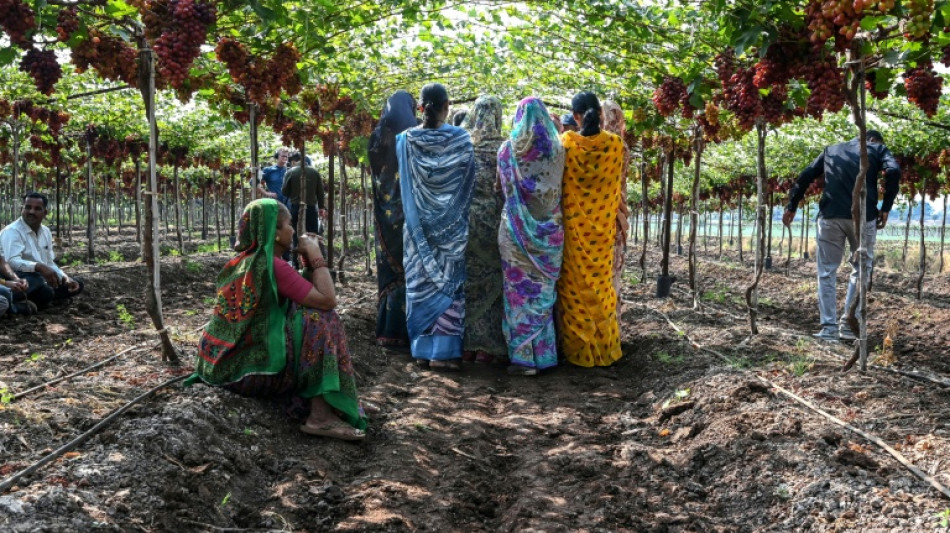
Struggling farmers find hope in India co-operative / Photo: © AFP

Kiran Ramnath Waghchaurebeams as he plucks deep-red grapes from his vines in India's Maharashtra state, one of thousands of farmers reaping the benefits of a cooperative bringing hope to a long-suffering sector.

Change text size:

Agriculture is the backbone of India's rural-driven economy, employing more than 700 million people. But the industry has been mired in crisis for decades, with slow‑moving reforms and growing vulnerability to climate change.

Often burdened by debts and crop failure, more than 3,090 farmers killed themselves in Maharashtra between 2022 and 2024.

"This new variety is better suited to the climate," says Waghchaure, gesturing to the perfectly round, firm and sweet grapes that will soon be on European supermarket shelves thousands of kilometres away.

The 42‑year‑old credits Sahyadri Farms, a cooperative launched in 2011 by 110 small growers, which helps members cut costs and gain access to markets.

Today, Sahyadri Farms is India's leading exporter of grapes and a major supplier of tomatoes, mangoes and cashew nuts, processing 385,000 tonnes of produce last year.

More than 95 percent of its 30,000 members own less than a hectare of land.

- 'Compete internationally' -

"The biggest problem in Indian agriculture is the small size of farms," says Santosh Watpade, the cooperative's chief financial officer.

"A producer on his own cannot compete internationally. Joining forces is the only solution."

A trade deal with the United States announced this month angered Indian farmers' unions, who argued that a flood of cheap US imports would rob local producers of their livelihoods. It is not clear how the agreement would impact the cooperative.

"The farmer is at the centre of our model, which offers access to markets and long‑term profitability," Watpade told AFP.

Waghchaure used to tend a two-hectare vegetable plot before joining Sahyadri Farms in 2012.

He now manages six hectares of vineyards, employing 15 workers and cashing in 4.5 to 5 million rupees ($50,000-$55,000) profit per year.

"My income has been rising," Waghchaure says, his eyes lighting up.

The cooperative's origins go back to farmer Vilas Shinde, who realised that producers "can achieve so much more" by working together, after he repeatedly failed to export his grapes, Watpade told AFP.

"He invested his own capital and reinvested everything he earned."

Pankaj Nathe joined Sahyadri Farms in the cooperative's early days, and now heads agricultural research and certification, developing grape varieties more resilient to erratic weather.

Seedless white Thompson grapes for years dominated Indian vineyards, but shifting weather patterns, including unexpected rain at the start of this year, now cause the berries to burst, sometimes wiping out entire harvests.

- Cash injection -

"We started planting new varieties better adapted to climate extremes and foreign consumer demand," Nathe said.

The cooperative, which also trains farmers on curbing excessive use of fertilisers and pesticides, has expanded its operations with the help of external investment.

Diane Jegam, South Asia director at Proparco -- a subsidiary of the French Development Agency (AFD) -- fell in love with the project during a visit to Sahyadri in 2022.

Later that year, Proparco joined a pool of investors who injected nearly $40 million into the cooperative.

The funds helped expand export markets, diversify crops, and finance a biogas plant and a microalgae facility for water recycling.

Around 6,500 staff -- 40 percent of whom are women -- sort, process and package fruits and vegetables in vast warehouses every day thanks to Proparco funds.

"It's an investment perfectly aligned with our goals -- protecting the planet and reducing inequalities by integrating smallholders and supporting farmer‑led enterprises," Jegam told AFP.

The cash has "accelerated everything," Watpade said.

"Ensuring a decent income for farmers will help curb problems like suicide and ensure that the next generation stays in agriculture."

T.Allen--TNT

Featured

Carney touts Canada 'pivot' away from US as tariffs rise

Canadian Prime Minister Mark Carney on Tuesday said reducing economic ties with the United States would come at a cost but the long-term benefits were clear, as retaliatory tariffs on US products took effect.

The "Everlasting Battery" Inside Your Joints:UConn Professor's Self-Powered Healing Material just Got Acquired

A material that turns your own movement into medicine has just landed a corporate home. PetVivo Holdings (OTCQX: PETV), a veterinary biotech and biomedical device company focused on treating osteoarthritis in dogs and horses, has acquired PiezoBioMembrane (PBM) — a startup built around a biodegradable implant that generates electricity from the everyday force of a joint in motion, and uses that charge to help regrow cartilage from the inside out. The material is the invention of Thanh Nguyen, a professor of mechanical engineering in UConn's College of Engineering, who founded PBM in 2021 to advance new implementation methods for his work with piezoelectric materials — substances that convert mechanical force into electrical energy. These materials are typically ceramics: hard, brittle, and poorly suited for medical use. But Nguyen's lab developed new forms that are so , flexible, and biodegradable, breaking down naturally within the body over time. wound healing, The materials have already shown strong potential across a range of medical applications, including tissue regeneration, implanted force sensors, and targeted drug delivery in tumor treatment. How It Works biodegradable ultrasound for In the case of arthritis, Nguyen explains, the piezoelectric materials function as an off-the-shelf product that can be implanted or injected directly into the ailing joint — with no drugs, chemicals, or cells required. The everyday force exerted on the joint generates a small electrical charge, which helps regrow healthy cartilage, mimicking the body's natural use of electricity to regenerate tissue. "The body can be electrically stimulated to regrow," Nguyen says. PBM's materials "act like a battery — an everlasting battery that works whenever there is a force applied, and vanishes safely inside the body over time." PetVivo's Vision for the Acquisition PetVivo Holdings CEO John Lai expressed enthusiasm for the merger's potential to improve the lives of companion animals globally. "PBM has developed a compelling functional biomaterials platform with the potential to support the development of multiple medical device and therapeutic product lines across both human and animal health markets," Lai said in a press release. "By combining PBM's scientific innovation with PetVivo's product development capabilities, commercialization experience, regulatory expertise, and public company infrastructure, we believe we can accelerate theadvancement of technologies that may serve as the foundation for numerous future products and strategic opportunities." For Nguyen, the deal is a chance to scale technology that could eventually benefit both animals and people. "PetVivo is an animal health company, but they do have a big passion: pushing the technology towards clinical trials for human use," Nguyen says. "That aligned perfectly with my passion for developing technology that has an impact on human life. That is why I am excited about this merger, which facilitates my passion." A Track Record of Innovation Nguyen's research sits at the intersection of medicine, micro/nanotechnology, and biomaterials. His inventions have earned him publications in prominent scientific journals and media coverage from outlets including NPR. Nguyen founded PBM during the COVID-19 pandemic, a er realizing the material he had developed could be used to create an especially effective, biodegradable face mask — one where the mechanical force of breathing generated an electrical charge that provided an extra layer of protection against viruses. PBM is not Nguyen's only venture in the acquisition pipeline. His other startup, Single-Time Microneedles (STM), is also currently undergoing an acquisition process. STM has pioneered stable, efficient vaccine delivery technology in the form of an adhesive patch. shelfNguyen's focus on biodegradable materials has translated into a remarkably diverse range of medical applications. He has received five R01 grants from the National Institutes of Health (NIH) supporting research in cartilage regeneration, bone regeneration, HIV antibody delivery systems, and biodegradable ultrasound technology to boost the effectiveness of chemotherapy for brain cancer. "Whatever we are working on, we want to show that it works very well in vitro and in vivo," Nguyen says. "Then, when we are at the point of commercialization, we set up a startup or license the technology — or maybe team up with an industry partner." Thanh Nguyen is a professor of mechanical engineering in UConn's College of Engineering. (Courtesy of Thanh Nguyen

Octrado introduces its proprietary trading offering: "Your Skill. Our Capital"

Infrastructure, transparent rules and clear legal boundaries positioned as the core of the funded-account model

Could gas prices return to 2022 highs on US-Iran war?

European gas prices have more than doubled owing to the US-Iran war, just as Europe needs to replenish its reserves ahead of winter.

Change text size: