The National Times - UK manufacturers struggle under sky-high energy bills

UK manufacturers struggle under sky-high energy bills


UK manufacturers struggle under sky-high energy bills
UK manufacturers struggle under sky-high energy bills / Photo: © AFP

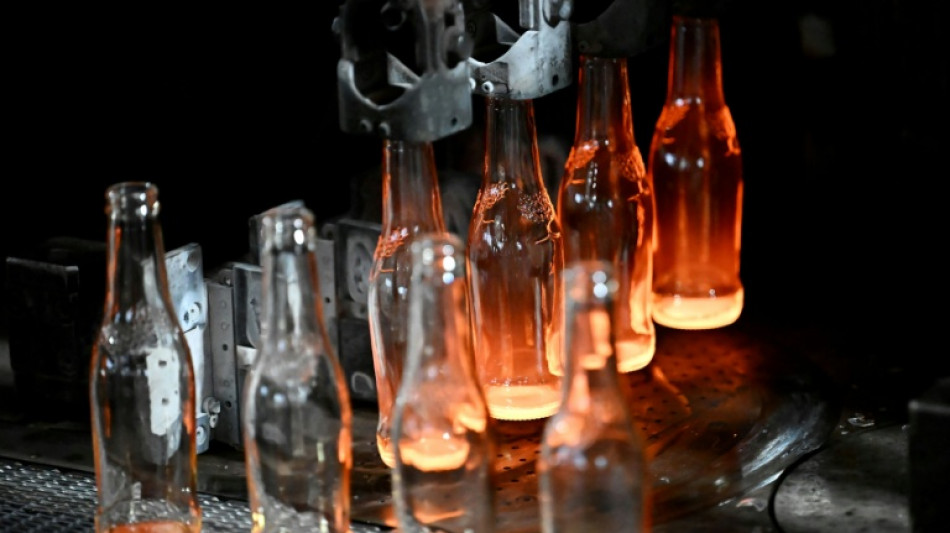
Molten glass drops through chutes before being blown into bottles at manufacturer Encirc's northwest England plant, where intensive operations are under strain from exorbitant energy prices weighing on Britain's heavy industry.

Change text size:

"We're paying a lot more energy costs than our European competitors," said Oliver Harry, head of corporate affairs at Encirc, which makes over a third of the UK's glass bottles.

Britain has some of the highest energy prices in Europe, driven by its reliance on natural gas and the costs of transitioning to renewables, which are passed on to bills.

The country's industrial electricity prices were also the steepest in Europe in 2024, according to the latest annual government data.

Standing in the intense heat of the factory's two huge furnaces, Harry warned: "We're already seeing an increase in imports into the UK as customers turn to cheap, more unsustainable glass producers", notably from China and Turkey.

- More action needed -

Across energy-intensive industries -- from steel and chemicals to glass and cement -- companies are warning that government support does not go far enough to keep them competitive.

The government said it will increase discounts on electricity network charges to 90 percent from April, which will save around 500 of the UK's biggest energy users a cumulative £420 million ($570 million) per year in electricity bills.

"Lowering bills is central to every decision we make," a government spokesperson told AFP.

But the steel sector, already weakened by the closure of traditional coal-fired blast furnaces, argues that more action is needed.

"The industry still faces industrial power prices almost 40 percent higher than in France and Germany," Gareth Stace, director general of the steel union, UK Steel, told AFP.

The union has called for stronger protections similar to those in France, Italy, Spain and the UAE to shield heavy industry from high wholesale power costs.

- Decarbonisation -

Electricity is so expensive in the UK largely because more than a quarter of its power still comes from gas, which surged in price after Russia's 2022 invasion of Ukraine.

While wholesale prices have since fallen, they remain elevated.

Under the liberalised electricity market, the last power station switched on to meet demand sets the price for all generators, and in the UK, that station is usually gas-powered.

"In France, nuclear sets the price fairly often and nuclear is cheaper ... so it's not always the same expensive gas that sets the price," Sam Frankhauser, professor of economics and climate change policy at Oxford University, told AFP.

In other countries "there's moments in the day where somebody cheaper sets the price and in the UK, those moments don't exist" as it is almost always a natural gas plant setting the price, he added.

At Encirc's Elton factory, where bottles clatter along the conveyor belts to be filled and labelled, executives say energy prices are inseparable from the push to decarbonise.

By the end of the decade, "we're going to be producing glass bottles that are 80 percent reduced carbon," said Harry.

"The UK managed to decarbonise the grid phenomenally because of the exit of coal," said Gregor Singer, professor at the London School of Economics.

"It's really unfortunate that this gas price shock came now, exactly at that point where you sort of exited coal but you don't quite have enough renewables yet."

"In the medium to long run... it's almost guaranteed that prices are coming down," he said.

F.Hughes--TNT

Featured

Carney touts Canada 'pivot' away from US as tariffs rise

Canadian Prime Minister Mark Carney on Tuesday said reducing economic ties with the United States would come at a cost but the long-term benefits were clear, as retaliatory tariffs on US products took effect.

The "Everlasting Battery" Inside Your Joints:UConn Professor's Self-Powered Healing Material just Got Acquired

A material that turns your own movement into medicine has just landed a corporate home. PetVivo Holdings (OTCQX: PETV), a veterinary biotech and biomedical device company focused on treating osteoarthritis in dogs and horses, has acquired PiezoBioMembrane (PBM) — a startup built around a biodegradable implant that generates electricity from the everyday force of a joint in motion, and uses that charge to help regrow cartilage from the inside out. The material is the invention of Thanh Nguyen, a professor of mechanical engineering in UConn's College of Engineering, who founded PBM in 2021 to advance new implementation methods for his work with piezoelectric materials — substances that convert mechanical force into electrical energy. These materials are typically ceramics: hard, brittle, and poorly suited for medical use. But Nguyen's lab developed new forms that are so , flexible, and biodegradable, breaking down naturally within the body over time. wound healing, The materials have already shown strong potential across a range of medical applications, including tissue regeneration, implanted force sensors, and targeted drug delivery in tumor treatment. How It Works biodegradable ultrasound for In the case of arthritis, Nguyen explains, the piezoelectric materials function as an off-the-shelf product that can be implanted or injected directly into the ailing joint — with no drugs, chemicals, or cells required. The everyday force exerted on the joint generates a small electrical charge, which helps regrow healthy cartilage, mimicking the body's natural use of electricity to regenerate tissue. "The body can be electrically stimulated to regrow," Nguyen says. PBM's materials "act like a battery — an everlasting battery that works whenever there is a force applied, and vanishes safely inside the body over time." PetVivo's Vision for the Acquisition PetVivo Holdings CEO John Lai expressed enthusiasm for the merger's potential to improve the lives of companion animals globally. "PBM has developed a compelling functional biomaterials platform with the potential to support the development of multiple medical device and therapeutic product lines across both human and animal health markets," Lai said in a press release. "By combining PBM's scientific innovation with PetVivo's product development capabilities, commercialization experience, regulatory expertise, and public company infrastructure, we believe we can accelerate theadvancement of technologies that may serve as the foundation for numerous future products and strategic opportunities." For Nguyen, the deal is a chance to scale technology that could eventually benefit both animals and people. "PetVivo is an animal health company, but they do have a big passion: pushing the technology towards clinical trials for human use," Nguyen says. "That aligned perfectly with my passion for developing technology that has an impact on human life. That is why I am excited about this merger, which facilitates my passion." A Track Record of Innovation Nguyen's research sits at the intersection of medicine, micro/nanotechnology, and biomaterials. His inventions have earned him publications in prominent scientific journals and media coverage from outlets including NPR. Nguyen founded PBM during the COVID-19 pandemic, a er realizing the material he had developed could be used to create an especially effective, biodegradable face mask — one where the mechanical force of breathing generated an electrical charge that provided an extra layer of protection against viruses. PBM is not Nguyen's only venture in the acquisition pipeline. His other startup, Single-Time Microneedles (STM), is also currently undergoing an acquisition process. STM has pioneered stable, efficient vaccine delivery technology in the form of an adhesive patch. shelfNguyen's focus on biodegradable materials has translated into a remarkably diverse range of medical applications. He has received five R01 grants from the National Institutes of Health (NIH) supporting research in cartilage regeneration, bone regeneration, HIV antibody delivery systems, and biodegradable ultrasound technology to boost the effectiveness of chemotherapy for brain cancer. "Whatever we are working on, we want to show that it works very well in vitro and in vivo," Nguyen says. "Then, when we are at the point of commercialization, we set up a startup or license the technology — or maybe team up with an industry partner." Thanh Nguyen is a professor of mechanical engineering in UConn's College of Engineering. (Courtesy of Thanh Nguyen

Octrado introduces its proprietary trading offering: "Your Skill. Our Capital"

Infrastructure, transparent rules and clear legal boundaries positioned as the core of the funded-account model

Could gas prices return to 2022 highs on US-Iran war?

European gas prices have more than doubled owing to the US-Iran war, just as Europe needs to replenish its reserves ahead of winter.

Change text size: