The National Times - Greenland prepares next generation for mining future

Greenland prepares next generation for mining future


Greenland prepares next generation for mining future
Greenland prepares next generation for mining future / Photo: © AFP

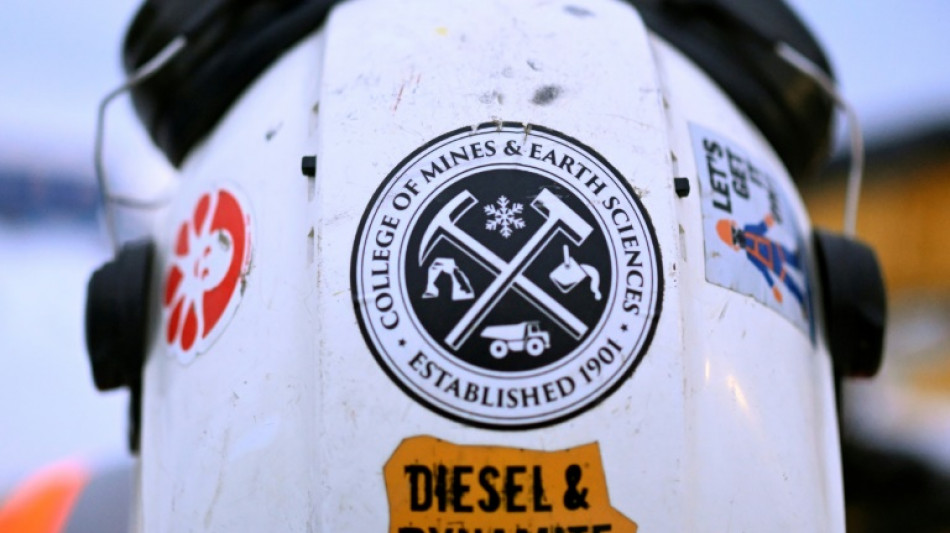
At the Greenland School of Minerals and Petroleum, a dozen students in hi-viz vests and helmets are out for the day learning to operate bulldozers, dump trucks, excavators and other equipment.

Change text size:

The Greenlandic government is counting on this generation to help fulfill its dream of a lucrative mining future for the vast Arctic territory coveted by US President Donald Trump.

Founded in 2008, the school, based in Sisimiut in the southwest of the island, offers students from across Greenland a three-year post-secondary vocational training.

Apart from their practical classes, the students, aged 18 to 35, also learn the basics of geology, rock mechanics, maths and English.

Teacher Kim Heilmann keeps a watchful eye on his students as they learn to manoeuvre the heavy equipment.

"I want them to know it's possible to mine in Greenland if you do it the right way," he told AFP.

"But mostly the challenge is to make them motivated about mining," he added.

The remote location of Greenland's two operational mines, and the ensuing isolation, puts many people off, the school's director Emilie Olsen Skjelsager said.

A Danish autonomous territory, Greenland gained control over its raw materials and minerals in 2009.

The local government relies heavily on Danish subsidies to complement its revenues from fishing, and is hoping that mining and tourism will bring it financial independence in the future so that it can someday cut ties with Denmark.

"The school was created because there is hope for more activities in mining, but also to have more skilled workers in Greenland for heavy machine operating and drilling and blasting, and exploration services," Olsen Skjelsager said.

By the end of their studies, some of the students -- "a small number, maybe up to five" -- will go on to work in the mines.

The rest will work on construction sites.

- Lack of skills -

Greenland is home to 57,000 people, and has historically relied on foreign workers to develop mining projects due to a lack of local know-how.

"We have some good people that can go out mining and blasting and drilling and all that kind of stuff," explained Deputy Minister of Minerals Resources, Jorgen T Hammeken-Holm.

"But if you have a production facility close to the mining facility, then you need some technical skills in these processing facilities," he said.

"There is a lack of educated people to do that."

Going forward, geologists, engineers and economists will be needed, especially as Greenland's traditional livelihoods of hunting and fishing are expected to gradually die out as professions.

The students' tuition is paid by the Greenland government, which also gives them a monthly stipend of around 5,000 kroner ($800).

Inside the school, a glass case displays some of the minerals that lie -- or are believed to lie -- under Greenland, including cryolite, anorthosite and eudialyte, which contains rare earth elements essential to the green and digital transitions.

"New mine sites have been searched (for) all over Greenland," said Angerla Berthelsen, a 30-year-old student who hopes to find a job in the mining sector one day.

There are "lots of possibilities" in Greenland, he said, sounding an optimistic note.

- Doubts over deposits -

But questions remain about Greenland's actual resources, with the existence and size of the deposits still to be confirmed.

According to the Geological Survey of Denmark and Greenland (GEUS), Greenland is home to 24 of the 34 critical raw materials identified by the EU as essential for the green and digital transitions.

"A large variety of geological terrains exists, which have been formed by many different processes. As a result, Greenland has several types of metals, minerals and gemstones," it says in a document on its website.

"However, only in a few cases have the occurrences been thoroughly quantified, which is a prerequisite for classifying them as actual deposits," it stressed.

Deputy minister Hammeken-Holm said it was "more or less a guess" for now.

"Nobody knows actually."

In addition, the island -- with its harsh Arctic climate and no roads connecting its towns -- currently doesn't have the infrastructure needed for large-scale mining.

There are currently only two operational mines on the island -- one gold mine in the south, and one for anorthosite, a rock containing titanium, on the west coast.

T.F.Russell--TNT

Featured

Carney touts Canada 'pivot' away from US as tariffs rise

Canadian Prime Minister Mark Carney on Tuesday said reducing economic ties with the United States would come at a cost but the long-term benefits were clear, as retaliatory tariffs on US products took effect.

The "Everlasting Battery" Inside Your Joints:UConn Professor's Self-Powered Healing Material just Got Acquired

A material that turns your own movement into medicine has just landed a corporate home. PetVivo Holdings (OTCQX: PETV), a veterinary biotech and biomedical device company focused on treating osteoarthritis in dogs and horses, has acquired PiezoBioMembrane (PBM) — a startup built around a biodegradable implant that generates electricity from the everyday force of a joint in motion, and uses that charge to help regrow cartilage from the inside out. The material is the invention of Thanh Nguyen, a professor of mechanical engineering in UConn's College of Engineering, who founded PBM in 2021 to advance new implementation methods for his work with piezoelectric materials — substances that convert mechanical force into electrical energy. These materials are typically ceramics: hard, brittle, and poorly suited for medical use. But Nguyen's lab developed new forms that are so , flexible, and biodegradable, breaking down naturally within the body over time. wound healing, The materials have already shown strong potential across a range of medical applications, including tissue regeneration, implanted force sensors, and targeted drug delivery in tumor treatment. How It Works biodegradable ultrasound for In the case of arthritis, Nguyen explains, the piezoelectric materials function as an off-the-shelf product that can be implanted or injected directly into the ailing joint — with no drugs, chemicals, or cells required. The everyday force exerted on the joint generates a small electrical charge, which helps regrow healthy cartilage, mimicking the body's natural use of electricity to regenerate tissue. "The body can be electrically stimulated to regrow," Nguyen says. PBM's materials "act like a battery — an everlasting battery that works whenever there is a force applied, and vanishes safely inside the body over time." PetVivo's Vision for the Acquisition PetVivo Holdings CEO John Lai expressed enthusiasm for the merger's potential to improve the lives of companion animals globally. "PBM has developed a compelling functional biomaterials platform with the potential to support the development of multiple medical device and therapeutic product lines across both human and animal health markets," Lai said in a press release. "By combining PBM's scientific innovation with PetVivo's product development capabilities, commercialization experience, regulatory expertise, and public company infrastructure, we believe we can accelerate theadvancement of technologies that may serve as the foundation for numerous future products and strategic opportunities." For Nguyen, the deal is a chance to scale technology that could eventually benefit both animals and people. "PetVivo is an animal health company, but they do have a big passion: pushing the technology towards clinical trials for human use," Nguyen says. "That aligned perfectly with my passion for developing technology that has an impact on human life. That is why I am excited about this merger, which facilitates my passion." A Track Record of Innovation Nguyen's research sits at the intersection of medicine, micro/nanotechnology, and biomaterials. His inventions have earned him publications in prominent scientific journals and media coverage from outlets including NPR. Nguyen founded PBM during the COVID-19 pandemic, a er realizing the material he had developed could be used to create an especially effective, biodegradable face mask — one where the mechanical force of breathing generated an electrical charge that provided an extra layer of protection against viruses. PBM is not Nguyen's only venture in the acquisition pipeline. His other startup, Single-Time Microneedles (STM), is also currently undergoing an acquisition process. STM has pioneered stable, efficient vaccine delivery technology in the form of an adhesive patch. shelfNguyen's focus on biodegradable materials has translated into a remarkably diverse range of medical applications. He has received five R01 grants from the National Institutes of Health (NIH) supporting research in cartilage regeneration, bone regeneration, HIV antibody delivery systems, and biodegradable ultrasound technology to boost the effectiveness of chemotherapy for brain cancer. "Whatever we are working on, we want to show that it works very well in vitro and in vivo," Nguyen says. "Then, when we are at the point of commercialization, we set up a startup or license the technology — or maybe team up with an industry partner." Thanh Nguyen is a professor of mechanical engineering in UConn's College of Engineering. (Courtesy of Thanh Nguyen

Octrado introduces its proprietary trading offering: "Your Skill. Our Capital"

Infrastructure, transparent rules and clear legal boundaries positioned as the core of the funded-account model

Could gas prices return to 2022 highs on US-Iran war?

European gas prices have more than doubled owing to the US-Iran war, just as Europe needs to replenish its reserves ahead of winter.

Change text size: