The National Times - Ghana rallies round traditional tunic after foreign mockery

Ghana rallies round traditional tunic after foreign mockery


Ghana rallies round traditional tunic after foreign mockery
Ghana rallies round traditional tunic after foreign mockery / Photo: © AFP

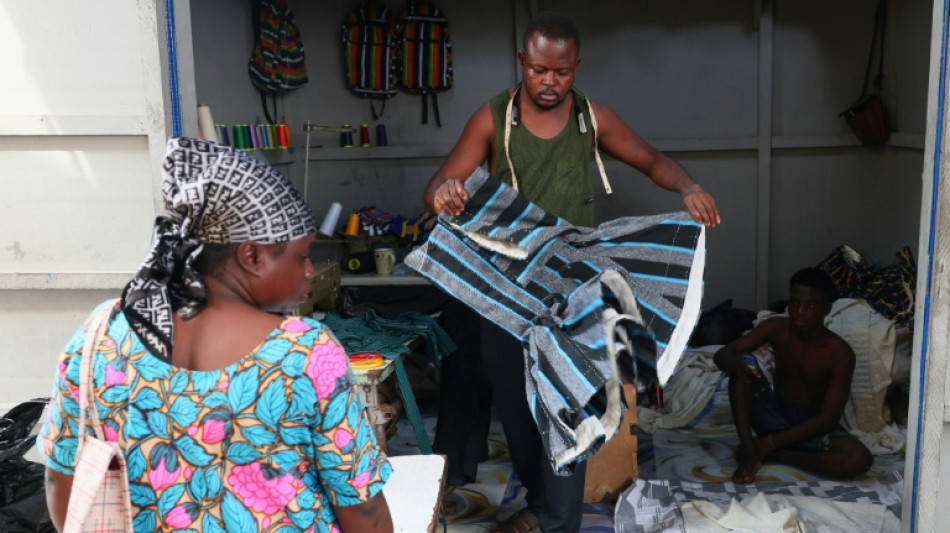
Ghanaians have rushed to defend their colourful handwoven "fugu" smocks after President John Mahama's wearing of the loose-fitting traditional garment on a recent state visit to Zambia caused an online storm.

Change text size:

Traditionally produced in northern Ghana on narrow-strip looms, the fugu is widely treated as the west African country's national costume, worn at festivals, political events and -- increasingly -- in offices and public life.

But Mahama's choice to walk the red carpet and inspect a guard-of-honour parade in Lusaka while rocking a blue-white-grey striped version of the flare-armed tunic drew mockery from non-Ghanaians on social media, with some calling the garment inappropriate for a head of state.

Unfazed, Mahama's government declared Wednesdays "fugu" day on his return home, with traders and weavers reporting a spike in demand for the centuries-old attire since.

"People are coming specifically for it now," textile trader William Nene said as he folded freshly woven smocks, which are also known as "batakari", at his small stall in central Accra.

Customers have filtered in asking for the same style recently worn by the president.

"Since the discussion online, many want to wear something that shows they are Ghanaian," said Nene.

The furore has triggered a broader conversation about identity, heritage and support for local textiles.

- 'This cloth is ours' -

Shadrack Yao Agboli, a fugu weaver who also works with the National Commission on Culture, has a home workshop where long bands of hand-loomed fabric hang to dry in the afternoon sun.

"More young people are asking questions: how it's made, where it comes from," he told AFP as he guided a thread through a wooden loom.

Weaving provides livelihoods for many families, he said, adding that each garment can take days to complete.

"When leaders wear it, it reminds people this cloth is ours," Agboli said.

Historian and cultural commentator Yaw Anokye Frimpong called the fugu "an unofficial national dress" with practical and historical roots.

"Unlike kente, which is largely ceremonial, the smock is everyday wear," he said, referring to another form of traditional Ghanian dress worn during major celebrations. "Our ancestors even wore it into battle. It represents Indigenous technology and self-reliance."

Beyond patriotic symbolism, the renewed demand for fugus could provide a lift for local artisans competing against cheaper imported clothing, mainly from China.

For Frederick Ohene Offei-Addo, who wears a locally woven fugu to his work as radio station head at the Asaase Broadcasting Company, choosing Ghana-made textiles is both a matter of cultural pride and economic strategy.

"If we keep talking about industrialisation and jobs, then we must also be intentional about what we buy and wear. Culture is not just heritage -- it's livelihoods," he said.

The debate comes as the Ghanaian government has sought to promote local industries and cultural exports as part of efforts to create jobs and reduce reliance on imports.

But for traders like Nene, the politics matter less than the immediate effect. "When people see it on the president, they want one too," he said, gesturing towards an almost empty rack. "Right now, we can't weave them fast enough."

A.M.Owen--TNT

Featured

Carney touts Canada 'pivot' away from US as tariffs rise

Canadian Prime Minister Mark Carney on Tuesday said reducing economic ties with the United States would come at a cost but the long-term benefits were clear, as retaliatory tariffs on US products took effect.

The "Everlasting Battery" Inside Your Joints:UConn Professor's Self-Powered Healing Material just Got Acquired

A material that turns your own movement into medicine has just landed a corporate home. PetVivo Holdings (OTCQX: PETV), a veterinary biotech and biomedical device company focused on treating osteoarthritis in dogs and horses, has acquired PiezoBioMembrane (PBM) — a startup built around a biodegradable implant that generates electricity from the everyday force of a joint in motion, and uses that charge to help regrow cartilage from the inside out. The material is the invention of Thanh Nguyen, a professor of mechanical engineering in UConn's College of Engineering, who founded PBM in 2021 to advance new implementation methods for his work with piezoelectric materials — substances that convert mechanical force into electrical energy. These materials are typically ceramics: hard, brittle, and poorly suited for medical use. But Nguyen's lab developed new forms that are so , flexible, and biodegradable, breaking down naturally within the body over time. wound healing, The materials have already shown strong potential across a range of medical applications, including tissue regeneration, implanted force sensors, and targeted drug delivery in tumor treatment. How It Works biodegradable ultrasound for In the case of arthritis, Nguyen explains, the piezoelectric materials function as an off-the-shelf product that can be implanted or injected directly into the ailing joint — with no drugs, chemicals, or cells required. The everyday force exerted on the joint generates a small electrical charge, which helps regrow healthy cartilage, mimicking the body's natural use of electricity to regenerate tissue. "The body can be electrically stimulated to regrow," Nguyen says. PBM's materials "act like a battery — an everlasting battery that works whenever there is a force applied, and vanishes safely inside the body over time." PetVivo's Vision for the Acquisition PetVivo Holdings CEO John Lai expressed enthusiasm for the merger's potential to improve the lives of companion animals globally. "PBM has developed a compelling functional biomaterials platform with the potential to support the development of multiple medical device and therapeutic product lines across both human and animal health markets," Lai said in a press release. "By combining PBM's scientific innovation with PetVivo's product development capabilities, commercialization experience, regulatory expertise, and public company infrastructure, we believe we can accelerate theadvancement of technologies that may serve as the foundation for numerous future products and strategic opportunities." For Nguyen, the deal is a chance to scale technology that could eventually benefit both animals and people. "PetVivo is an animal health company, but they do have a big passion: pushing the technology towards clinical trials for human use," Nguyen says. "That aligned perfectly with my passion for developing technology that has an impact on human life. That is why I am excited about this merger, which facilitates my passion." A Track Record of Innovation Nguyen's research sits at the intersection of medicine, micro/nanotechnology, and biomaterials. His inventions have earned him publications in prominent scientific journals and media coverage from outlets including NPR. Nguyen founded PBM during the COVID-19 pandemic, a er realizing the material he had developed could be used to create an especially effective, biodegradable face mask — one where the mechanical force of breathing generated an electrical charge that provided an extra layer of protection against viruses. PBM is not Nguyen's only venture in the acquisition pipeline. His other startup, Single-Time Microneedles (STM), is also currently undergoing an acquisition process. STM has pioneered stable, efficient vaccine delivery technology in the form of an adhesive patch. shelfNguyen's focus on biodegradable materials has translated into a remarkably diverse range of medical applications. He has received five R01 grants from the National Institutes of Health (NIH) supporting research in cartilage regeneration, bone regeneration, HIV antibody delivery systems, and biodegradable ultrasound technology to boost the effectiveness of chemotherapy for brain cancer. "Whatever we are working on, we want to show that it works very well in vitro and in vivo," Nguyen says. "Then, when we are at the point of commercialization, we set up a startup or license the technology — or maybe team up with an industry partner." Thanh Nguyen is a professor of mechanical engineering in UConn's College of Engineering. (Courtesy of Thanh Nguyen

Octrado introduces its proprietary trading offering: "Your Skill. Our Capital"

Infrastructure, transparent rules and clear legal boundaries positioned as the core of the funded-account model

Could gas prices return to 2022 highs on US-Iran war?

European gas prices have more than doubled owing to the US-Iran war, just as Europe needs to replenish its reserves ahead of winter.

Change text size: