The National Times - China's fireworks heartland faces fizzling Lunar New Year sales

China's fireworks heartland faces fizzling Lunar New Year sales


China's fireworks heartland faces fizzling Lunar New Year sales
China's fireworks heartland faces fizzling Lunar New Year sales / Photo: © AFP

A fiery crack of red and gold explodes above a village in China's pyrotechnics hub of Liuyang, where residents are accustomed to ear-splitting fireworks tests year-round.

Change text size:

But factories and businesses in the mountainous district say the age-old tradition is struggling against weak consumerism, with even the approaching Lunar New Year failing to boost sales.

Liuyang, where the pyrotechnics trade dates back more than 1,000 years, produces around 60 percent of the fireworks sold in China and 70 percent of those exported.

"The fireworks industry has been passed down from generation to generation," said Li Shijie, a fifth-generation manager of Zhongzhou Fireworks in the southern city.

"It's a cultural heritage I cherish very much."

Fireworks feature at every major milestone, including birthdays, weddings and funerals, said Zhu Ting, a quality manager at a Zhongzhou warehouse.

Outside of major cities, rural communities still light sparklers and screeching "missile" fireworks to celebrate the Lunar New Year, which falls next week.

Working in the local industry brings "a lot of pride", Zhu told AFP.

But despite relaxed restrictions on fireworks nationwide in a bid to encourage domestic spending, sales have softened since a post-pandemic boom.

Shop owners at a Liuyang trading centre told AFP business has slowed. Dozens of stores selling fireworks resembling flamethrowers and packaged in garish boxes saw little foot traffic on a weekday morning.

The last year was "a relatively 'cold' year for China", said Melissa Cai, the US sales manager for Pyroshine, an export-focused company in Liuyang.

"Domestic orders have decreased significantly in the past two years."

- Turning abroad -

In the mountains surrounding the city, more than 400 firework manufacturers occupy strictly regulated factories, where workshops are topped with lightning rods.

Flashy billboards advertising dozens of brands hang above the highway linking Liuyang to its nearest airport.

The noisy blasts that pepper towns across China in the weeks surrounding the Lunar New Year holiday were stymied after provinces began imposing strict bans on fireworks in the 2010s over safety and pollution concerns.

But looking to revitalise weak spending, China discouraged "one-size-fits-all" bans in 2024, contributing to a resurgence of the ancient fireworks trade.

"Of course the loosening of this policy is good for industry," said Li.

Liuyang's fireworks industry saw a huge boom in 2023 after pandemic restrictions were lifted, with total output value jumping more than 60 percent year-on-year to 50.8 billion yuan ($7.3 billion).

The city's fireworks industry recorded 50.2 billion yuan in output value in 2024 and 50.6 billion yuan a year later.

"Folks were happy, so sales performed very well both domestically and outside China," said Pyroshine's Cai.

While around 10 percent of the company's clients were domestic during the post-lockdown boom, now all are based overseas.

Unlike in China, sales abroad have remained comparatively stable, Cai said, despite steep US tariffs imposed last year, which forced the company to haul back truckloads of orders from ports.

- 'Keep up with the pace' -

Workers at the Pyroshine factory were now busy pasting wolf-themed packaging onto boxes to be shipped to the United States.

But domestically, factories and shopkeepers have to contend with a concoction of issues, including persistently weak consumer spending and tighter safety regulations.

Cold snaps in the area of Liuyang can also halt production lines, and fatal accidents remain a risk.

Last year, an explosion at a fireworks factory in Hunan province killed nine people, and in 2023, three people were killed after blasts struck residential buildings in the northern city of Tianjin.

The fireworks business "is indeed an older industry", Li, the fifth-generation manager, told AFP.

People's aesthetic preferences inevitably evolve, requiring upgrades in technology and branding, he said.

In a showroom targeting the US market, images of cowboy hats, military tanks and whiskey adorned display shelves.

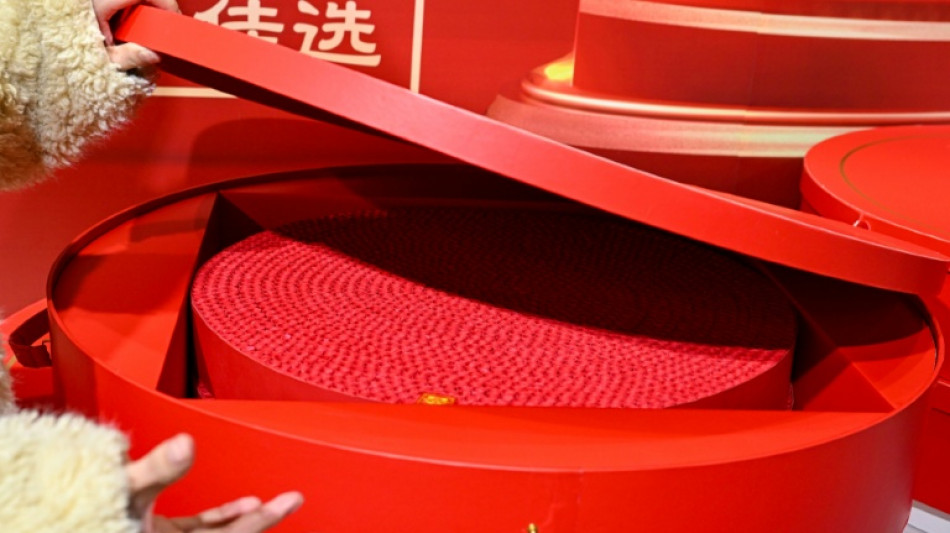
An area for Chinese customers was a sea of red, which symbolises good fortune.

"What traditional industries need is to keep up with the pace," said Li, whose company has started to experiment with integrating drones into fireworks shows.

But, he added, modernising the industry is not only a financial concern.

"It is a totem of celebration for Chinese people and people around the world," he said.

R.Evans--TNT

Featured

Carney touts Canada 'pivot' away from US as tariffs rise

Canadian Prime Minister Mark Carney on Tuesday said reducing economic ties with the United States would come at a cost but the long-term benefits were clear, as retaliatory tariffs on US products took effect.

The "Everlasting Battery" Inside Your Joints:UConn Professor's Self-Powered Healing Material just Got Acquired

A material that turns your own movement into medicine has just landed a corporate home. PetVivo Holdings (OTCQX: PETV), a veterinary biotech and biomedical device company focused on treating osteoarthritis in dogs and horses, has acquired PiezoBioMembrane (PBM) — a startup built around a biodegradable implant that generates electricity from the everyday force of a joint in motion, and uses that charge to help regrow cartilage from the inside out. The material is the invention of Thanh Nguyen, a professor of mechanical engineering in UConn's College of Engineering, who founded PBM in 2021 to advance new implementation methods for his work with piezoelectric materials — substances that convert mechanical force into electrical energy. These materials are typically ceramics: hard, brittle, and poorly suited for medical use. But Nguyen's lab developed new forms that are so , flexible, and biodegradable, breaking down naturally within the body over time. wound healing, The materials have already shown strong potential across a range of medical applications, including tissue regeneration, implanted force sensors, and targeted drug delivery in tumor treatment. How It Works biodegradable ultrasound for In the case of arthritis, Nguyen explains, the piezoelectric materials function as an off-the-shelf product that can be implanted or injected directly into the ailing joint — with no drugs, chemicals, or cells required. The everyday force exerted on the joint generates a small electrical charge, which helps regrow healthy cartilage, mimicking the body's natural use of electricity to regenerate tissue. "The body can be electrically stimulated to regrow," Nguyen says. PBM's materials "act like a battery — an everlasting battery that works whenever there is a force applied, and vanishes safely inside the body over time." PetVivo's Vision for the Acquisition PetVivo Holdings CEO John Lai expressed enthusiasm for the merger's potential to improve the lives of companion animals globally. "PBM has developed a compelling functional biomaterials platform with the potential to support the development of multiple medical device and therapeutic product lines across both human and animal health markets," Lai said in a press release. "By combining PBM's scientific innovation with PetVivo's product development capabilities, commercialization experience, regulatory expertise, and public company infrastructure, we believe we can accelerate theadvancement of technologies that may serve as the foundation for numerous future products and strategic opportunities." For Nguyen, the deal is a chance to scale technology that could eventually benefit both animals and people. "PetVivo is an animal health company, but they do have a big passion: pushing the technology towards clinical trials for human use," Nguyen says. "That aligned perfectly with my passion for developing technology that has an impact on human life. That is why I am excited about this merger, which facilitates my passion." A Track Record of Innovation Nguyen's research sits at the intersection of medicine, micro/nanotechnology, and biomaterials. His inventions have earned him publications in prominent scientific journals and media coverage from outlets including NPR. Nguyen founded PBM during the COVID-19 pandemic, a er realizing the material he had developed could be used to create an especially effective, biodegradable face mask — one where the mechanical force of breathing generated an electrical charge that provided an extra layer of protection against viruses. PBM is not Nguyen's only venture in the acquisition pipeline. His other startup, Single-Time Microneedles (STM), is also currently undergoing an acquisition process. STM has pioneered stable, efficient vaccine delivery technology in the form of an adhesive patch. shelfNguyen's focus on biodegradable materials has translated into a remarkably diverse range of medical applications. He has received five R01 grants from the National Institutes of Health (NIH) supporting research in cartilage regeneration, bone regeneration, HIV antibody delivery systems, and biodegradable ultrasound technology to boost the effectiveness of chemotherapy for brain cancer. "Whatever we are working on, we want to show that it works very well in vitro and in vivo," Nguyen says. "Then, when we are at the point of commercialization, we set up a startup or license the technology — or maybe team up with an industry partner." Thanh Nguyen is a professor of mechanical engineering in UConn's College of Engineering. (Courtesy of Thanh Nguyen

Octrado introduces its proprietary trading offering: "Your Skill. Our Capital"

Infrastructure, transparent rules and clear legal boundaries positioned as the core of the funded-account model

Could gas prices return to 2022 highs on US-Iran war?

European gas prices have more than doubled owing to the US-Iran war, just as Europe needs to replenish its reserves ahead of winter.

Change text size: