The National Times - Bangladesh's Yunus 'banker to the poor', pushing democratic reform

Bangladesh's Yunus 'banker to the poor', pushing democratic reform


Bangladesh's Yunus 'banker to the poor', pushing democratic reform
Bangladesh's Yunus 'banker to the poor', pushing democratic reform / Photo: © AFP

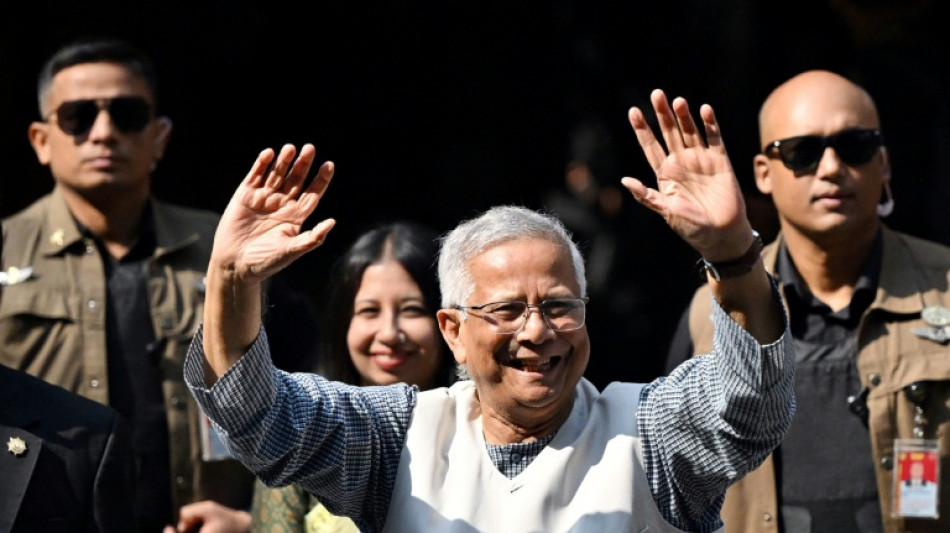
After a life dedicated to fighting extreme poverty, Bangladesh's 85-year-old Nobel-winning microfinance pioneer Muhammad Yunus is set to end his biggest mission.

Change text size:

Yunus will hand over the reins of power to an elected government after 18 months as caretaker leader, steering the nation of 170 million people through peaceful elections after one of its most turbulent political periods.

The landslide victory of the Bangladesh Nationalist Party (BNP) -- whose leader Tarique Rahman is poised to become prime minister -- effectively marks Yunus's political retirement.

"We have ended the nightmare and begun a new dream," Yunus said as he voted on Thursday, beaming and calling the election "a day of freedom".

Yunus returned from self‑imposed exile in August 2024, days after the iron‑fisted government of Sheikh Hasina was overthrown and she fled to India by helicopter.

Students who spearheaded the uprising urged him to return, and the army handed over power to him as "Chief Advisor" of the interim government.

- 'Build the country' -

"Be calm and get ready to build the country," he declared on arrival.

He launched an ambitious programme to seek justice against the ousted regime, and Hasina -- now a convicted fugitive in hiding in India -- was sentenced in absentia to death for crimes against humanity.

He pushed constitutional reforms aimed at preventing any future slide into authoritarian rule, and to overhaul a "completely broken-down" system of public administration.

His administration established multiple commissions to coax rival political factions into agreeing on a package of reforms.

That democratic charter -- including prime ministerial term limits, the creation of an upper house of parliament, stronger presidential powers and greater judicial independence -- was endorsed by 60 percent of voters, in a referendum held alongside the election.

But the early euphoria surrounding Yunus's leadership gradually gave way to frustration at the scale of the task.

He was criticised as a distant figure, and his unelected administration was accused of failing to rein in abuses by powerful security forces.

Rights groups, including Amnesty International, accused his government of the "misuse" of a draconian anti-terrorism act, under which hundreds of people were detained.

- 'Not born to suffer' -

Yunus, known worldwide as the "banker to the poorest of the poor", won the 2006 Nobel Peace Prize for pioneering microloans to rural women, enabling them to buy tools or equipment and raise their incomes.

Grameen Bank, which he founded, was hailed for helping unleash rapid economic growth in Bangladesh and became a model replicated across dozens of developing countries.

"Human beings are not born to suffer the misery of hunger and poverty," Yunus said during his Nobel lecture.

But his public profile in Bangladesh earned him the hostility of Hasina, and he was targeted with more than 100 criminal cases and a smear campaign accusing him of promoting homosexuality.

Hasina's government forced him out of Grameen Bank in 2011. In 2024 he was sentenced to six months in jail over alleged failures to create a workers' welfare fund -- charges widely condemned as politically motivated.

He was freed on bail and fled abroad, and was later acquitted on appeal after Hasina was ousted.

- 'Help people' -

The son of a goldsmith, Yunus was born in 1940 into a well-off family in the port city of Chittagong, now Chattogram. He credits his mother -- who never turned away anyone in need -- as his greatest influence.

Yunus won a Fulbright scholarship to study in the United States and returned soon after Bangladesh won independence from Pakistan in 1971 following a war.

He was chosen to head Chittagong University's economics department, but the young country was struggling through a famine, and he felt compelled to take practical action.

"I found it difficult to teach elegant theories of economics in the university classroom... I wanted to do something immediate to help people around me."

G.Morris--TNT

Featured

Carney touts Canada 'pivot' away from US as tariffs rise

Canadian Prime Minister Mark Carney on Tuesday said reducing economic ties with the United States would come at a cost but the long-term benefits were clear, as retaliatory tariffs on US products took effect.

The "Everlasting Battery" Inside Your Joints:UConn Professor's Self-Powered Healing Material just Got Acquired

A material that turns your own movement into medicine has just landed a corporate home. PetVivo Holdings (OTCQX: PETV), a veterinary biotech and biomedical device company focused on treating osteoarthritis in dogs and horses, has acquired PiezoBioMembrane (PBM) — a startup built around a biodegradable implant that generates electricity from the everyday force of a joint in motion, and uses that charge to help regrow cartilage from the inside out. The material is the invention of Thanh Nguyen, a professor of mechanical engineering in UConn's College of Engineering, who founded PBM in 2021 to advance new implementation methods for his work with piezoelectric materials — substances that convert mechanical force into electrical energy. These materials are typically ceramics: hard, brittle, and poorly suited for medical use. But Nguyen's lab developed new forms that are so , flexible, and biodegradable, breaking down naturally within the body over time. wound healing, The materials have already shown strong potential across a range of medical applications, including tissue regeneration, implanted force sensors, and targeted drug delivery in tumor treatment. How It Works biodegradable ultrasound for In the case of arthritis, Nguyen explains, the piezoelectric materials function as an off-the-shelf product that can be implanted or injected directly into the ailing joint — with no drugs, chemicals, or cells required. The everyday force exerted on the joint generates a small electrical charge, which helps regrow healthy cartilage, mimicking the body's natural use of electricity to regenerate tissue. "The body can be electrically stimulated to regrow," Nguyen says. PBM's materials "act like a battery — an everlasting battery that works whenever there is a force applied, and vanishes safely inside the body over time." PetVivo's Vision for the Acquisition PetVivo Holdings CEO John Lai expressed enthusiasm for the merger's potential to improve the lives of companion animals globally. "PBM has developed a compelling functional biomaterials platform with the potential to support the development of multiple medical device and therapeutic product lines across both human and animal health markets," Lai said in a press release. "By combining PBM's scientific innovation with PetVivo's product development capabilities, commercialization experience, regulatory expertise, and public company infrastructure, we believe we can accelerate theadvancement of technologies that may serve as the foundation for numerous future products and strategic opportunities." For Nguyen, the deal is a chance to scale technology that could eventually benefit both animals and people. "PetVivo is an animal health company, but they do have a big passion: pushing the technology towards clinical trials for human use," Nguyen says. "That aligned perfectly with my passion for developing technology that has an impact on human life. That is why I am excited about this merger, which facilitates my passion." A Track Record of Innovation Nguyen's research sits at the intersection of medicine, micro/nanotechnology, and biomaterials. His inventions have earned him publications in prominent scientific journals and media coverage from outlets including NPR. Nguyen founded PBM during the COVID-19 pandemic, a er realizing the material he had developed could be used to create an especially effective, biodegradable face mask — one where the mechanical force of breathing generated an electrical charge that provided an extra layer of protection against viruses. PBM is not Nguyen's only venture in the acquisition pipeline. His other startup, Single-Time Microneedles (STM), is also currently undergoing an acquisition process. STM has pioneered stable, efficient vaccine delivery technology in the form of an adhesive patch. shelfNguyen's focus on biodegradable materials has translated into a remarkably diverse range of medical applications. He has received five R01 grants from the National Institutes of Health (NIH) supporting research in cartilage regeneration, bone regeneration, HIV antibody delivery systems, and biodegradable ultrasound technology to boost the effectiveness of chemotherapy for brain cancer. "Whatever we are working on, we want to show that it works very well in vitro and in vivo," Nguyen says. "Then, when we are at the point of commercialization, we set up a startup or license the technology — or maybe team up with an industry partner." Thanh Nguyen is a professor of mechanical engineering in UConn's College of Engineering. (Courtesy of Thanh Nguyen

Octrado introduces its proprietary trading offering: "Your Skill. Our Capital"

Infrastructure, transparent rules and clear legal boundaries positioned as the core of the funded-account model

Could gas prices return to 2022 highs on US-Iran war?

European gas prices have more than doubled owing to the US-Iran war, just as Europe needs to replenish its reserves ahead of winter.

Change text size: