The National Times - Japan seizes Chinese fishing vessel, arrests captain

Japan seizes Chinese fishing vessel, arrests captain


Japan seizes Chinese fishing vessel, arrests captain
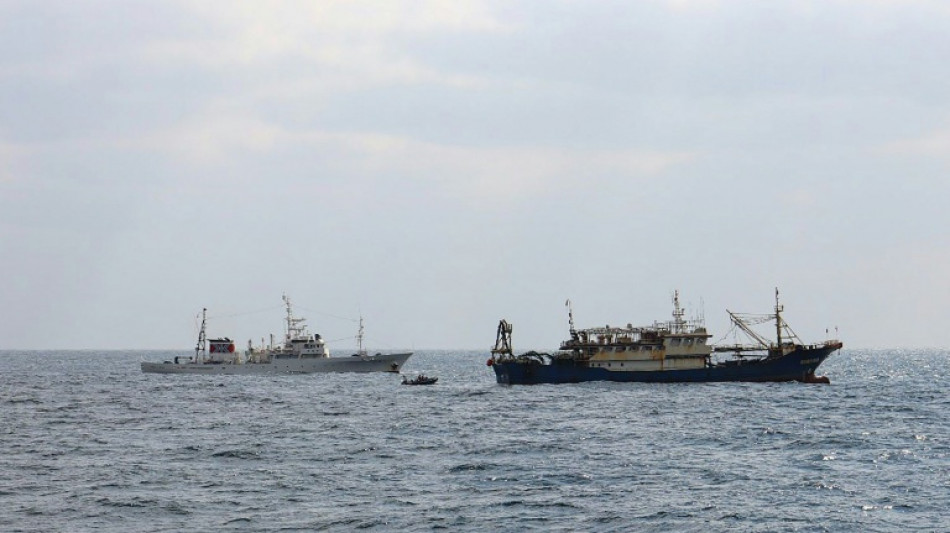
Japan seizes Chinese fishing vessel, arrests captain / Photo: © JAPAN'S FISHERIES AGENCY/AFP

Japan seized a Chinese fishing boat and arrested its skipper, authorities said Friday, an incident that could deepen a spat between the Asian giants.

Change text size:

The episode on Thursday off southern Japan came three months after Prime Minister Sanae Takaichi suggested that Japan would intervene militarily if Beijing sought to take Taiwan by force.

"The vessel's captain was ordered to stop for an inspection by a fisheries inspector, but the vessel failed to comply and fled," Japan's fisheries agency said.

"Consequently, the vessel's captain was arrested on the same day," it said in a statement.

The boat was inside Japan's exclusive economic zone 89.4 nautical miles (166 kilometres) south-southwest of Meshima island in the Goto archipelago, Japan's statement said -- not a disputed area.

China was yet to comment.

It was the first time since 2022 that the Japanese fisheries agency has seized a Chinese fishing boat.

The captain was named as Chinese national Zheng Nianli, 47. The status of the other 10 people on board the vessel, named the Qiong Dong Yu, was unclear.

"To prevent illegal fishing operations by foreign vessels, we will continue to take firm action and engage in enforcement activities," chief government spokesman Minoru Kihara said.

China has a number of territorial tussles with Japan, and there have been repeated incidents around the Senkaku Islands, known as the Diaoyu in China.

The 2010 arrest of another Chinese fishing boat captain off those islands in the East China Sea became a major diplomatic incident.

- Taiwan spat -

Japan and China have close economic ties but Takaichi's comments about Taiwan have sent relations spiralling downwards again.

China has long insisted that Taiwan, occupied for decades by Japan until 1945, is its territory and has not ruled out force to achieve "reunification".

Taiwanese President Lai Ching-te told AFP in an interview this week that other countries -- including Japan -- would be China's next targets should Beijing seize the democratic island.

"The next countries under threat would be Japan, the Philippines, and others in the Indo-Pacific region, with repercussions eventually reaching the Americas and Europe," Lai said.

After Takaichi's comments, Beijing summoned Tokyo's ambassador, warned Chinese citizens against visiting Japan and conducted joint air drills with Russia.

In December, J-15 jets from China's Liaoning aircraft carrier twice locked radar on Japanese aircraft in international waters near Okinawa, according to Japan.

China also tightened controls on exports to Japan for items with potential military uses, fuelling worries that Beijing may choke supplies of vital rare-earth minerals.

Japan's last two pandas were even returned to China last month.

- Hawkish leader -

Takaichi, 64, was seen as a China hawk before becoming Japan's first woman prime minister in October.

She won a landslide victory in snap elections on Sunday, putting her in a strong position for the next four years to stamp her mark on Japanese domestic and foreign policy.

Takaichi said Monday that under her leadership Japan -- which hosts some 60,000 US military personnel -- would bolster its defences and "steadfastly protect" its territory.

She also said that she was "open to various dialogues with China".

But China's foreign ministry said "genuine dialogue should be built on respect for one another".

"Proclaiming dialogue with one's mouth while engaging in confrontation -- no one will accept this kind of dialogue," foreign ministry spokesman Lin Jian said Tuesday.

"If Japan truly wants to develop a strategic and mutually beneficial relationship with China, it's very easy and clear: withdraw Takaichi's erroneous remarks about Taiwan," he said.

F.Hughes--TNT

Featured

Carney touts Canada 'pivot' away from US as tariffs rise

Canadian Prime Minister Mark Carney on Tuesday said reducing economic ties with the United States would come at a cost but the long-term benefits were clear, as retaliatory tariffs on US products took effect.

The "Everlasting Battery" Inside Your Joints:UConn Professor's Self-Powered Healing Material just Got Acquired

A material that turns your own movement into medicine has just landed a corporate home. PetVivo Holdings (OTCQX: PETV), a veterinary biotech and biomedical device company focused on treating osteoarthritis in dogs and horses, has acquired PiezoBioMembrane (PBM) — a startup built around a biodegradable implant that generates electricity from the everyday force of a joint in motion, and uses that charge to help regrow cartilage from the inside out. The material is the invention of Thanh Nguyen, a professor of mechanical engineering in UConn's College of Engineering, who founded PBM in 2021 to advance new implementation methods for his work with piezoelectric materials — substances that convert mechanical force into electrical energy. These materials are typically ceramics: hard, brittle, and poorly suited for medical use. But Nguyen's lab developed new forms that are so , flexible, and biodegradable, breaking down naturally within the body over time. wound healing, The materials have already shown strong potential across a range of medical applications, including tissue regeneration, implanted force sensors, and targeted drug delivery in tumor treatment. How It Works biodegradable ultrasound for In the case of arthritis, Nguyen explains, the piezoelectric materials function as an off-the-shelf product that can be implanted or injected directly into the ailing joint — with no drugs, chemicals, or cells required. The everyday force exerted on the joint generates a small electrical charge, which helps regrow healthy cartilage, mimicking the body's natural use of electricity to regenerate tissue. "The body can be electrically stimulated to regrow," Nguyen says. PBM's materials "act like a battery — an everlasting battery that works whenever there is a force applied, and vanishes safely inside the body over time." PetVivo's Vision for the Acquisition PetVivo Holdings CEO John Lai expressed enthusiasm for the merger's potential to improve the lives of companion animals globally. "PBM has developed a compelling functional biomaterials platform with the potential to support the development of multiple medical device and therapeutic product lines across both human and animal health markets," Lai said in a press release. "By combining PBM's scientific innovation with PetVivo's product development capabilities, commercialization experience, regulatory expertise, and public company infrastructure, we believe we can accelerate theadvancement of technologies that may serve as the foundation for numerous future products and strategic opportunities." For Nguyen, the deal is a chance to scale technology that could eventually benefit both animals and people. "PetVivo is an animal health company, but they do have a big passion: pushing the technology towards clinical trials for human use," Nguyen says. "That aligned perfectly with my passion for developing technology that has an impact on human life. That is why I am excited about this merger, which facilitates my passion." A Track Record of Innovation Nguyen's research sits at the intersection of medicine, micro/nanotechnology, and biomaterials. His inventions have earned him publications in prominent scientific journals and media coverage from outlets including NPR. Nguyen founded PBM during the COVID-19 pandemic, a er realizing the material he had developed could be used to create an especially effective, biodegradable face mask — one where the mechanical force of breathing generated an electrical charge that provided an extra layer of protection against viruses. PBM is not Nguyen's only venture in the acquisition pipeline. His other startup, Single-Time Microneedles (STM), is also currently undergoing an acquisition process. STM has pioneered stable, efficient vaccine delivery technology in the form of an adhesive patch. shelfNguyen's focus on biodegradable materials has translated into a remarkably diverse range of medical applications. He has received five R01 grants from the National Institutes of Health (NIH) supporting research in cartilage regeneration, bone regeneration, HIV antibody delivery systems, and biodegradable ultrasound technology to boost the effectiveness of chemotherapy for brain cancer. "Whatever we are working on, we want to show that it works very well in vitro and in vivo," Nguyen says. "Then, when we are at the point of commercialization, we set up a startup or license the technology — or maybe team up with an industry partner." Thanh Nguyen is a professor of mechanical engineering in UConn's College of Engineering. (Courtesy of Thanh Nguyen

Octrado introduces its proprietary trading offering: "Your Skill. Our Capital"

Infrastructure, transparent rules and clear legal boundaries positioned as the core of the funded-account model

Could gas prices return to 2022 highs on US-Iran war?

European gas prices have more than doubled owing to the US-Iran war, just as Europe needs to replenish its reserves ahead of winter.

Change text size: