The National Times - 'Want to go home': Indonesian crew abandoned off Africa demand wages

'Want to go home': Indonesian crew abandoned off Africa demand wages


'Want to go home': Indonesian crew abandoned off Africa demand wages
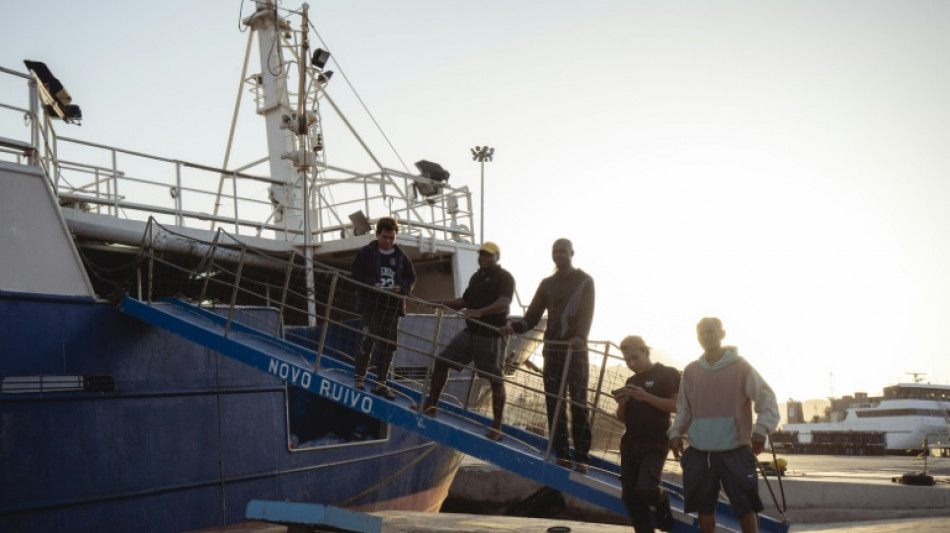
'Want to go home': Indonesian crew abandoned off Africa demand wages / Photo: © AFP

Abandoned for months on their fishing boat off West Africa, Indonesian sailor Surono and his shipmates face a dilemma: return home without almost a year's wages or stay on the docked vessel.

Change text size:

He is among a growing number of migrant workers abandoned by shipowners, who flout their obligations and desert crews without paying the salaries owed.

"My family cries because I can't get any money. My children and wife need money to eat," Surono, 47, who like many Indonesians goes by one name, told AFP from the abandoned ship in Cape Verde.

"We want to go home, but if we go home without money, then what? We've been working ourselves to the bone out at sea. How can we just be abandoned like that?"

The engine technician flew from Indonesia to Namibia in March 2025 to work onboard the Portuguese-flagged Novo Ruivo, a tuna longliner fishing boat.

But when they docked at Mindelo in Cape Verde in September to offload their catch, the owner left with the crew's passports and without paying their wages.

Surono said his salary was $1,200 a month and that with the five months stranded in Mindelo's Porto Grande, he is now owed $13,200.

The father-of-three admitted that his family in Tegal, Central Java, has struggled without this income, more than eight times the minimum wage there.

"This is really hard. To survive, I have to go into debt," his wife, Kiki Andriani, 38, told AFP through tears.

"I want my husband to come home, but if he does without his salary, then a whole year's work would be for nothing."

- Thousands stranded -

A ship is deemed abandoned by the International Labour Organization (ILO) under certain criteria, including when a shipowner does not cover the crew's repatriation costs or cuts ties with them and fails to pay wages for at least two months.

While fishing boats make up only a fraction of abandonment cases, overall figures for the shipping industry paint a worrying picture.

Reported cases reached record levels in 2025, with around 6,200 seafarers left stranded across 410 ships, according to figures released by the International Transport Workers' Federation (ITF) last month.

Surono contacted the ITF, who reported the Novo Ruivo abandoned to authorities and helped contact the Indonesian embassy in Dakar, Senegal.

"We offered them repatriation from day one, but they refused because they are afraid of not getting the money," said Gonzalo Galan, the ITF inspector handling the case.

The crew's last resort is getting a court order to seize and sell the boat to pay off the owner's debts, an option ITF is exploring with its legal team.

- 'Plenty of fish' -

The designated shipowner, Spaniard Javier Martinez of the Somar Produtos do Mar company, told AFP he does not have the money but is trying to solve the problem.

"They have not been abandoned. They have everything on the boat -- electricity, fresh water and food," he said.

"You think I'm not in more of a hurry than them to solve this? Having the boat parked there is costing me a lot of money."

Martinez said he sends each of the crew a stipend of around 50 euros ($60) every few weeks, which Surono said pays for phone credit, some snacks and drinks.

Workers in the fishing industry are covered by the ILO's work in fishing convention 188.

But the treaty, which aims to ensure a minimum standard is applied across the sector, is very weak and poorly implemented, Galan said.

"It basically just says that a fisher must have an employment contract in writing and that salaries should be paid in intervals, but does not specify the time frame," he said.

The crew of six Indonesians and six Angolans have mainly been living off old supplies of rice and frozen food, according to Surono, who said he spends "almost all day, every day on the boat".

"I have a fiancee waiting for me at home in Cirebon (West Java). We planned to get married soon," said crewmate Wahyudin, 36, who has also not been paid.

"If we didn't get any fish, I would've understood, but we got plenty of fish."

The recruitment agency in Indonesia that hired Surono agreed last week to front half his salary, but he is unlikely to see another penny should he leave, Galan said.

"The kids don't want to go to school because they're embarrassed about being behind on tuition. Even the neighbourhood shop won't trust us anymore," said Surono.

"I want my rights. We've worked, and we're asking for our wages because we have families."

A.Wood--TNT

Featured

Nearly 1,100 flights cancelled after UK air traffic control glitch

Almost 1,100 flights to and from UK airports were cancelled Tuesday due to what the country's air traffic control service called a technical issue, in the latest glitch to spark travel chaos.

Carney touts Canada 'pivot' away from US as tariffs rise

Canadian Prime Minister Mark Carney on Tuesday said reducing economic ties with the United States would come at a cost but the long-term benefits were clear, as retaliatory tariffs on US products took effect.

The "Everlasting Battery" Inside Your Joints:UConn Professor's Self-Powered Healing Material just Got Acquired

A material that turns your own movement into medicine has just landed a corporate home. PetVivo Holdings (OTCQX: PETV), a veterinary biotech and biomedical device company focused on treating osteoarthritis in dogs and horses, has acquired PiezoBioMembrane (PBM) — a startup built around a biodegradable implant that generates electricity from the everyday force of a joint in motion, and uses that charge to help regrow cartilage from the inside out. The material is the invention of Thanh Nguyen, a professor of mechanical engineering in UConn's College of Engineering, who founded PBM in 2021 to advance new implementation methods for his work with piezoelectric materials — substances that convert mechanical force into electrical energy. These materials are typically ceramics: hard, brittle, and poorly suited for medical use. But Nguyen's lab developed new forms that are so , flexible, and biodegradable, breaking down naturally within the body over time. wound healing, The materials have already shown strong potential across a range of medical applications, including tissue regeneration, implanted force sensors, and targeted drug delivery in tumor treatment. How It Works biodegradable ultrasound for In the case of arthritis, Nguyen explains, the piezoelectric materials function as an off-the-shelf product that can be implanted or injected directly into the ailing joint — with no drugs, chemicals, or cells required. The everyday force exerted on the joint generates a small electrical charge, which helps regrow healthy cartilage, mimicking the body's natural use of electricity to regenerate tissue. "The body can be electrically stimulated to regrow," Nguyen says. PBM's materials "act like a battery — an everlasting battery that works whenever there is a force applied, and vanishes safely inside the body over time." PetVivo's Vision for the Acquisition PetVivo Holdings CEO John Lai expressed enthusiasm for the merger's potential to improve the lives of companion animals globally. "PBM has developed a compelling functional biomaterials platform with the potential to support the development of multiple medical device and therapeutic product lines across both human and animal health markets," Lai said in a press release. "By combining PBM's scientific innovation with PetVivo's product development capabilities, commercialization experience, regulatory expertise, and public company infrastructure, we believe we can accelerate theadvancement of technologies that may serve as the foundation for numerous future products and strategic opportunities." For Nguyen, the deal is a chance to scale technology that could eventually benefit both animals and people. "PetVivo is an animal health company, but they do have a big passion: pushing the technology towards clinical trials for human use," Nguyen says. "That aligned perfectly with my passion for developing technology that has an impact on human life. That is why I am excited about this merger, which facilitates my passion." A Track Record of Innovation Nguyen's research sits at the intersection of medicine, micro/nanotechnology, and biomaterials. His inventions have earned him publications in prominent scientific journals and media coverage from outlets including NPR. Nguyen founded PBM during the COVID-19 pandemic, a er realizing the material he had developed could be used to create an especially effective, biodegradable face mask — one where the mechanical force of breathing generated an electrical charge that provided an extra layer of protection against viruses. PBM is not Nguyen's only venture in the acquisition pipeline. His other startup, Single-Time Microneedles (STM), is also currently undergoing an acquisition process. STM has pioneered stable, efficient vaccine delivery technology in the form of an adhesive patch. shelfNguyen's focus on biodegradable materials has translated into a remarkably diverse range of medical applications. He has received five R01 grants from the National Institutes of Health (NIH) supporting research in cartilage regeneration, bone regeneration, HIV antibody delivery systems, and biodegradable ultrasound technology to boost the effectiveness of chemotherapy for brain cancer. "Whatever we are working on, we want to show that it works very well in vitro and in vivo," Nguyen says. "Then, when we are at the point of commercialization, we set up a startup or license the technology — or maybe team up with an industry partner." Thanh Nguyen is a professor of mechanical engineering in UConn's College of Engineering. (Courtesy of Thanh Nguyen

Octrado introduces its proprietary trading offering: "Your Skill. Our Capital"

Infrastructure, transparent rules and clear legal boundaries positioned as the core of the funded-account model

Change text size: