The National Times - What's at stake for Indian agriculture in Trump's trade deal?

What's at stake for Indian agriculture in Trump's trade deal?


What's at stake for Indian agriculture in Trump's trade deal?
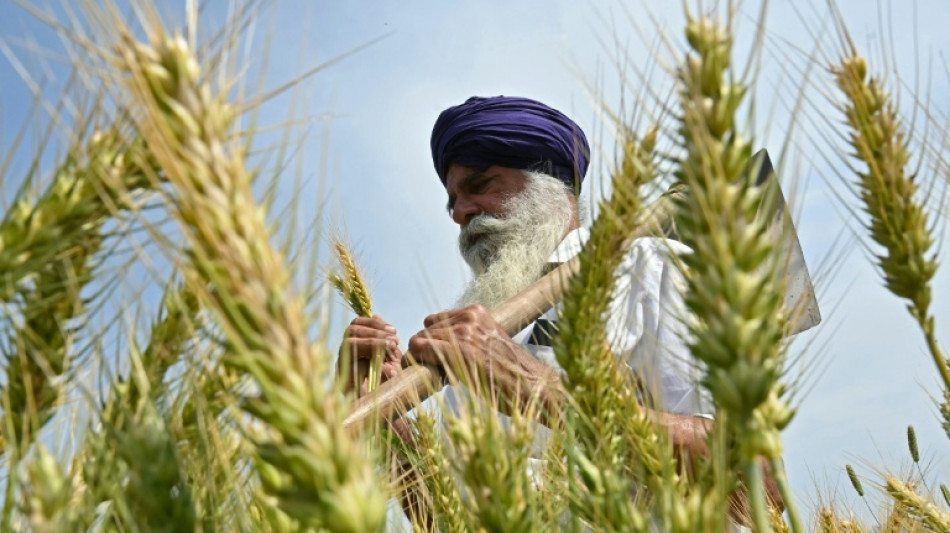
What's at stake for Indian agriculture in Trump's trade deal? / Photo: © AFP/File

Indian farmers have expressed concern that New Delhi has made too many concessions to Washington after the two countries brokered a new trade deal that would lower tariffs.

Change text size:

Under the terms of the deal that was laid out in a joint statement from both countries released on Saturday, India will "eliminate or reduce tariffs on all US industrial goods" and other food and agricultural products.

Meanwhile, the US will apply a reciprocal tariff rate of 18 percent on goods from India, including textiles and apparel, leather and footwear, plastic and rubber, organic chemicals, and certain machinery, the joint statement added.

The terms were released after US President Donald Trump announced a trade deal with India, stating that Prime Minister Narendra Modi had promised to halt Russian oil purchases.

Modi lauded the new trade deal in a post on the social media platform X later on Saturday, saying it would open up opportunities and generate jobs.

But Indian farmer unions weren't convinced, calling the deal a "total surrender" to American agricultural giants.

"Indian industry, agriculture... are now under grave threat of cheap imports that will be dumped into Indian markets," the Samyukt Kisan Morcha (SKM), a coalition of multiple farmers' unions, said in a statement following the announcement.

The group also called on farmers to join a nationwide protest on February 12.

- What's on the table? -

The joint statement states that India will "eliminate or reduce" tariffs on a "wide range of US food and agricultural products".

This includes tree nuts, some fresh fruit, soybean oil, wine, spirits and other "additional products" that were not specified.

Siraj Hussain, a former agriculture ministry top official, said Indian consumers were purchasing more nuts, "so it's import may not have much impact on local production", and will help satisfy high demand.

Domestic growers do worry, however, about cheap imports on items such as apples, which they believe could have dire impacts on local producers.

"Import of fresh fruits such as apples... will ruin the farmers," SKM said. Officials hope safeguards included into the agreement -- such as import quotas or minimum import prices for commodities including apples -- will reduce the impact of foreign competition.

New Delhi's promise of lower duties on dried distillers' grains and red sorghum for animal feed could also reduce the need for local soybean meal.

Opposition lawmaker Jairam Ramesh said the move to ease imports of dried distillers' grains and soybean oil would hurt "millions of soybean farmers" in key Indian states such as Maharashtra and Madhya Pradesh.

- What's off the table? -

To stem concerns, India's Trade Minister Piyush Goyal reassured farmers that their interests would be safeguarded, adding that the key red lines that had been drawn by New Delhi had not been crossed.

He said "no concessions" had been extended in "sensitive areas" such as grains, spices, dairy, poultry, meat and several vegetables and fruits -- including potatoes, oranges and strawberries.

The trade minister also said genetically modified crops were not part of the agreement.

This includes GM soybean, which the US has searched hard to find new markets for.

- Small farms 'can't compete' -

While the farm sector contributes just 16 percent to India's GDP, it provides livelihood to over 45 percent of the population.

This makes the industry a key voting bloc often wooed by political parties. Farmer groups have also shown, on multiple occasions, that they are a street force to be reckoned with.

In 2021, the government abandoned plans to reform the sector after months of intense protests that blocked the national capital's highways and led to Delhi's historic Red Fort complex being stormed by tractors.

"Indian farms are very small and they can't really compete with highly subsidised US agriculture," Hussain, the former agriculture ministry official, said.

- India and US trade -

Between January-November 2025, when New Delhi was negotiating with Washington, Indian imports of American agricultural goods rose 34 percent year-on-year, raking in just under $2.9 billion.

Top imports included cotton, soybean oil, ethanol and various nuts such as almonds. This happened even before the trade deal, although the rise is partly due to India reducing tariffs on some of these US items.

Experts have said that a further reduction on duties for products such as soybean oil, which was announced in the joint statement, will likely lead to a jump in goods being imported by India from the US.

W.Baxter--TNT

Featured

Nearly 1,100 flights cancelled after UK air traffic control glitch

Almost 1,100 flights to and from UK airports were cancelled Tuesday due to what the country's air traffic control service called a technical issue, in the latest glitch to spark travel chaos.

Carney touts Canada 'pivot' away from US as tariffs rise

Canadian Prime Minister Mark Carney on Tuesday said reducing economic ties with the United States would come at a cost but the long-term benefits were clear, as retaliatory tariffs on US products took effect.

The "Everlasting Battery" Inside Your Joints:UConn Professor's Self-Powered Healing Material just Got Acquired

A material that turns your own movement into medicine has just landed a corporate home. PetVivo Holdings (OTCQX: PETV), a veterinary biotech and biomedical device company focused on treating osteoarthritis in dogs and horses, has acquired PiezoBioMembrane (PBM) — a startup built around a biodegradable implant that generates electricity from the everyday force of a joint in motion, and uses that charge to help regrow cartilage from the inside out. The material is the invention of Thanh Nguyen, a professor of mechanical engineering in UConn's College of Engineering, who founded PBM in 2021 to advance new implementation methods for his work with piezoelectric materials — substances that convert mechanical force into electrical energy. These materials are typically ceramics: hard, brittle, and poorly suited for medical use. But Nguyen's lab developed new forms that are so , flexible, and biodegradable, breaking down naturally within the body over time. wound healing, The materials have already shown strong potential across a range of medical applications, including tissue regeneration, implanted force sensors, and targeted drug delivery in tumor treatment. How It Works biodegradable ultrasound for In the case of arthritis, Nguyen explains, the piezoelectric materials function as an off-the-shelf product that can be implanted or injected directly into the ailing joint — with no drugs, chemicals, or cells required. The everyday force exerted on the joint generates a small electrical charge, which helps regrow healthy cartilage, mimicking the body's natural use of electricity to regenerate tissue. "The body can be electrically stimulated to regrow," Nguyen says. PBM's materials "act like a battery — an everlasting battery that works whenever there is a force applied, and vanishes safely inside the body over time." PetVivo's Vision for the Acquisition PetVivo Holdings CEO John Lai expressed enthusiasm for the merger's potential to improve the lives of companion animals globally. "PBM has developed a compelling functional biomaterials platform with the potential to support the development of multiple medical device and therapeutic product lines across both human and animal health markets," Lai said in a press release. "By combining PBM's scientific innovation with PetVivo's product development capabilities, commercialization experience, regulatory expertise, and public company infrastructure, we believe we can accelerate theadvancement of technologies that may serve as the foundation for numerous future products and strategic opportunities." For Nguyen, the deal is a chance to scale technology that could eventually benefit both animals and people. "PetVivo is an animal health company, but they do have a big passion: pushing the technology towards clinical trials for human use," Nguyen says. "That aligned perfectly with my passion for developing technology that has an impact on human life. That is why I am excited about this merger, which facilitates my passion." A Track Record of Innovation Nguyen's research sits at the intersection of medicine, micro/nanotechnology, and biomaterials. His inventions have earned him publications in prominent scientific journals and media coverage from outlets including NPR. Nguyen founded PBM during the COVID-19 pandemic, a er realizing the material he had developed could be used to create an especially effective, biodegradable face mask — one where the mechanical force of breathing generated an electrical charge that provided an extra layer of protection against viruses. PBM is not Nguyen's only venture in the acquisition pipeline. His other startup, Single-Time Microneedles (STM), is also currently undergoing an acquisition process. STM has pioneered stable, efficient vaccine delivery technology in the form of an adhesive patch. shelfNguyen's focus on biodegradable materials has translated into a remarkably diverse range of medical applications. He has received five R01 grants from the National Institutes of Health (NIH) supporting research in cartilage regeneration, bone regeneration, HIV antibody delivery systems, and biodegradable ultrasound technology to boost the effectiveness of chemotherapy for brain cancer. "Whatever we are working on, we want to show that it works very well in vitro and in vivo," Nguyen says. "Then, when we are at the point of commercialization, we set up a startup or license the technology — or maybe team up with an industry partner." Thanh Nguyen is a professor of mechanical engineering in UConn's College of Engineering. (Courtesy of Thanh Nguyen

Octrado introduces its proprietary trading offering: "Your Skill. Our Capital"

Infrastructure, transparent rules and clear legal boundaries positioned as the core of the funded-account model

Change text size: