The National Times - ECB warns of stronger euro impact, holds rates

ECB warns of stronger euro impact, holds rates


ECB warns of stronger euro impact, holds rates
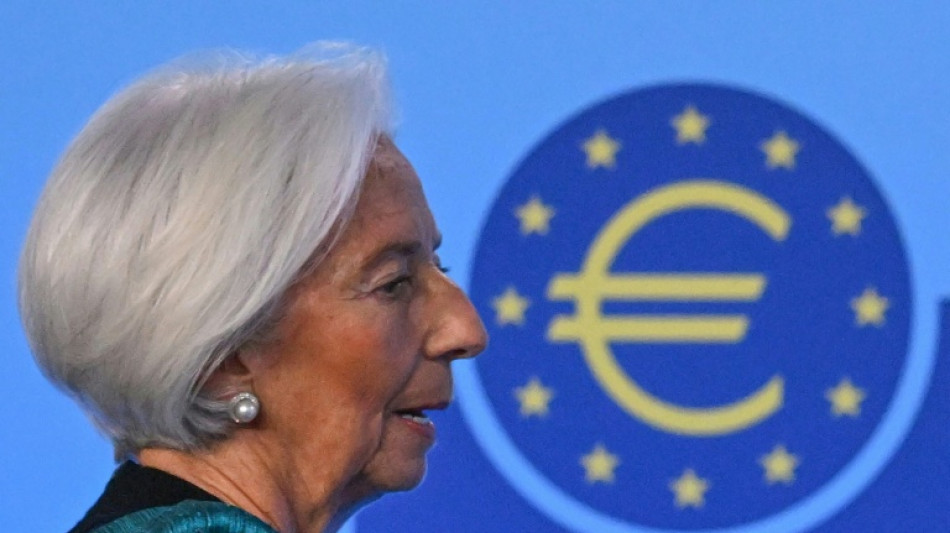
ECB warns of stronger euro impact, holds rates / Photo: © AFP

The European Central Bank warned Thursday a stronger euro could push inflation down too far after recent gains in the single currency, but sought to downplay any immediate threat to the eurozone economy.

Change text size:

As expected, the central bank for the 21-nation single-currency area kept its benchmark interest rate on hold at two percent, where it has been since June last year.

ECB President Christine Lagarde stressed the eurozone economy, which has been picking up speed recently, remained "resilient" and officials were confident inflation would settle around the central bank's two-percent target.

But much attention at her press conference focused on the recent gains of the euro, which jumped above the $1.20 threshold last week as the dollar weakened on renewed worries about US economic policy under President Donald Trump.

Combined with news that inflation had dropped below the ECB's target in January, speculation had mounted that the central bank might start mulling if and when to cut rates.

Lagarde made a nod to these concerns, warning that "a stronger euro could bring inflation down beyond current expectations", and noted the issue had been discussed by ECB officials at Thursday's meeting.

- Currency concerns -

A stronger currency makes imports cheaper, which tends to push inflation down -- potentially leading consumers to delay purchases, with negative ripple effects across the economy.

A strong euro can also weigh on the eurozone's crucial exporters, particularly Germany, as it makes the cost of companies' goods pricier overseas.

But despite the gains last week, Lagarde pointed out that the euro had been steadily strengthening against the dollar since shortly after Trump took power last year.

And the current exchange rate was "very much in line with the overall average" since the euro was introduced, she stressed.

She also reiterated that the ECB feels it is in a "good place" -- phrasing which has been taken to mean the central bank is happy with the current level of rates.

The euro was barely changed against the dollar after Thursday's meeting at $1.18.

However Frederik Ducrozet, an economist at Pictet Wealth Management, said some of the central bank's language appeared to signal "the ECB's growing discomfort with regard to the stronger euro".

Lagarde's comments indicate "that further currency appreciation would bring us closer to a pain threshold", he added.

- 'Uncertain outlook' -

As usual, the ECB chief gave no signal about the central bank's next move on rates.

But, given the movements in currencies and inflation, some analysts are now raising their bets on rate cuts in the second half of the year.

The Bank of England also left its benchmark interest rate unchanged Thursday, at 3.75 percent, while cutting its forecasts for UK growth this year and next.

Lagarde also said the global environment remained "challenging".

"The outlook is still uncertain, owing particularly to ongoing global trade policy uncertainty and geopolitical tensions," she said.

Trump's volatile trade policies in particular have unnerved Europe.

There was another flare-up last month when Trump threatened to hit eight European countries with new tariffs over their opposition to his desire to annex Greenland, but he later climbed down.

Central bankers around the world have been especially worried by Trump's targeting of US Federal Reserve chair Jerome Powell, whom he has criticised for not cutting rates faster.

On Thursday however Lagarde welcomed Trump's nomination of Kevin Warsh, a former Fed official, to be the next chief of the US central bank, a move that has broadly reassured markets.

"We go back a long way and I very much welcome (the) announcement of his appointment," said Lagarde.

S.Collins--TNT

Featured

Nearly 1,100 flights cancelled after UK air traffic control glitch

Almost 1,100 flights to and from UK airports were cancelled Tuesday due to what the country's air traffic control service called a technical issue, in the latest glitch to spark travel chaos.

Carney touts Canada 'pivot' away from US as tariffs rise

Canadian Prime Minister Mark Carney on Tuesday said reducing economic ties with the United States would come at a cost but the long-term benefits were clear, as retaliatory tariffs on US products took effect.

The "Everlasting Battery" Inside Your Joints:UConn Professor's Self-Powered Healing Material just Got Acquired

A material that turns your own movement into medicine has just landed a corporate home. PetVivo Holdings (OTCQX: PETV), a veterinary biotech and biomedical device company focused on treating osteoarthritis in dogs and horses, has acquired PiezoBioMembrane (PBM) — a startup built around a biodegradable implant that generates electricity from the everyday force of a joint in motion, and uses that charge to help regrow cartilage from the inside out. The material is the invention of Thanh Nguyen, a professor of mechanical engineering in UConn's College of Engineering, who founded PBM in 2021 to advance new implementation methods for his work with piezoelectric materials — substances that convert mechanical force into electrical energy. These materials are typically ceramics: hard, brittle, and poorly suited for medical use. But Nguyen's lab developed new forms that are so , flexible, and biodegradable, breaking down naturally within the body over time. wound healing, The materials have already shown strong potential across a range of medical applications, including tissue regeneration, implanted force sensors, and targeted drug delivery in tumor treatment. How It Works biodegradable ultrasound for In the case of arthritis, Nguyen explains, the piezoelectric materials function as an off-the-shelf product that can be implanted or injected directly into the ailing joint — with no drugs, chemicals, or cells required. The everyday force exerted on the joint generates a small electrical charge, which helps regrow healthy cartilage, mimicking the body's natural use of electricity to regenerate tissue. "The body can be electrically stimulated to regrow," Nguyen says. PBM's materials "act like a battery — an everlasting battery that works whenever there is a force applied, and vanishes safely inside the body over time." PetVivo's Vision for the Acquisition PetVivo Holdings CEO John Lai expressed enthusiasm for the merger's potential to improve the lives of companion animals globally. "PBM has developed a compelling functional biomaterials platform with the potential to support the development of multiple medical device and therapeutic product lines across both human and animal health markets," Lai said in a press release. "By combining PBM's scientific innovation with PetVivo's product development capabilities, commercialization experience, regulatory expertise, and public company infrastructure, we believe we can accelerate theadvancement of technologies that may serve as the foundation for numerous future products and strategic opportunities." For Nguyen, the deal is a chance to scale technology that could eventually benefit both animals and people. "PetVivo is an animal health company, but they do have a big passion: pushing the technology towards clinical trials for human use," Nguyen says. "That aligned perfectly with my passion for developing technology that has an impact on human life. That is why I am excited about this merger, which facilitates my passion." A Track Record of Innovation Nguyen's research sits at the intersection of medicine, micro/nanotechnology, and biomaterials. His inventions have earned him publications in prominent scientific journals and media coverage from outlets including NPR. Nguyen founded PBM during the COVID-19 pandemic, a er realizing the material he had developed could be used to create an especially effective, biodegradable face mask — one where the mechanical force of breathing generated an electrical charge that provided an extra layer of protection against viruses. PBM is not Nguyen's only venture in the acquisition pipeline. His other startup, Single-Time Microneedles (STM), is also currently undergoing an acquisition process. STM has pioneered stable, efficient vaccine delivery technology in the form of an adhesive patch. shelfNguyen's focus on biodegradable materials has translated into a remarkably diverse range of medical applications. He has received five R01 grants from the National Institutes of Health (NIH) supporting research in cartilage regeneration, bone regeneration, HIV antibody delivery systems, and biodegradable ultrasound technology to boost the effectiveness of chemotherapy for brain cancer. "Whatever we are working on, we want to show that it works very well in vitro and in vivo," Nguyen says. "Then, when we are at the point of commercialization, we set up a startup or license the technology — or maybe team up with an industry partner." Thanh Nguyen is a professor of mechanical engineering in UConn's College of Engineering. (Courtesy of Thanh Nguyen

Octrado introduces its proprietary trading offering: "Your Skill. Our Capital"

Infrastructure, transparent rules and clear legal boundaries positioned as the core of the funded-account model

Change text size: