The National Times - Stocks in retreat as traders reconsider tech investment

Stocks in retreat as traders reconsider tech investment


Stocks in retreat as traders reconsider tech investment
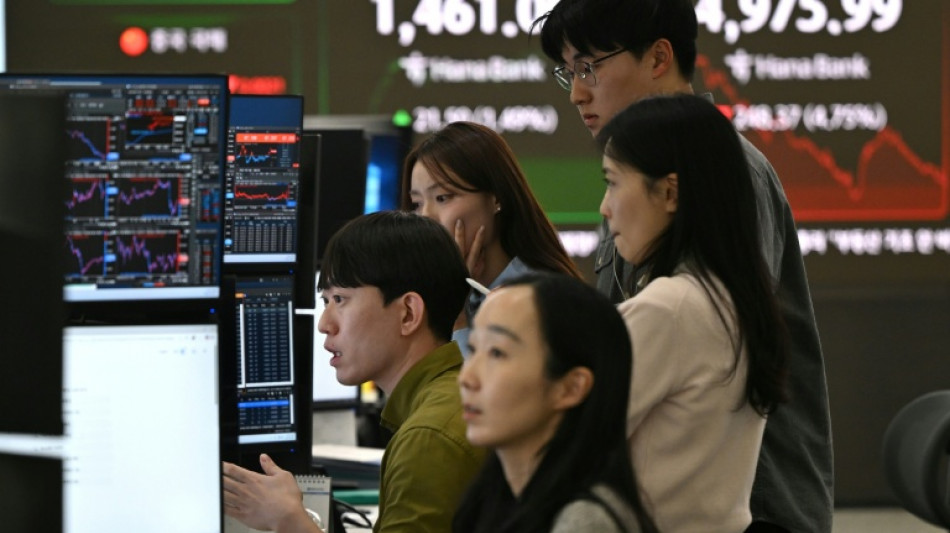
Stocks in retreat as traders reconsider tech investment / Photo: © AFP

Asian stocks fell Thursday to track more losses on Wall Street, where tech firms were again under pressure as fears over vast AI investments and extended valuations gained momentum.

Change text size:

While the extreme volatility that greeted the start of the week has calmed, traders remained on edge over the impact of artificial intelligence on companies' bottom lines.

The latest development to spook markets was news that AI startup Anthropic -- which created the Claude chatbot -- had unveiled a tool that could be used by firms to carry out legal work.

Tuesday's announcement hit firms in the software, financial services and asset management industries, though analysts said there has been a general shift by investors out of tech following years of eye-watering gains, and into other industries.

An underwhelming response to earnings from titans including Alphabet, ARM and Microsoft has aided that move, which also comes as questions are raised about the wisdom of pumping hundreds of billions into AI with little idea about the timing of returns.

"The rout reflects growing unease about how quickly AI could disrupt existing business models and whether incumbent software companies can defend their margins," wrote Chris Beauchamp, chief market analyst at IG.

"Investors are pricing in the risk that new AI-native competitors could undercut pricing and erode market share across the sector."

Fiona Cincotta at City Index said: "Investors rotating into more cyclical names as fears over AI-driven disruption weighed on the market."

And she warned that "while losses in tech continue, sentiment remains fragile".

The rotation was evident in New York, where the tech-heavy Nasdaq shed 1.5 percent while the Dow Jones Industrial Average gained 0.5 percent.

The selling extended into Asia, where Seoul -- which has cruised more than 20 percent to multiple record highs this year thanks to its strong tech presence -- sank more than two percent.

Tokyo, Hong Kong, Shanghai, Sydney, Singapore and Taipei were also down.

"Enthusiasm towards AI has notably waned in recent months, with the market becoming increasingly bifurcated, not only amid concern over how capital expenditures will be financed (with debt-laden firms such as Oracle taking a battering), but also as concerns mount over concentration," said Pepperstone's Michael Brown.

Oil prices fell around two percent after Iran and the United States said nuclear talks would go ahead in Oman this week.

The news soothed investor concerns sparked by a report earlier Wednesday that the bitter foes would not meet owing to a row about the format and the venue, which sent the price of both main contracts up more than three percent.

Bitcoin was going for $72,000 -- its lowest since November 2024 -- after being caught up in the rollercoaster ride earlier this week as investors reconsidered their risk asset holdings.

The cryptocurrency is now down more than 40 percent from its record high above $126,000 touched in October, and Bloomberg said traders are now betting on it falling below $65,000.

Japanese electronics giant Panasonic soared as much as 15 percent in Tokyo at one point after it said it would increase its job cuts to 12,000 as part of a restructuring drive, while also reporting forecast-topping quarterly operating profit.

- Key figures at around 0230 GMT -

Tokyo - Nikkei 225: DOWN 0.7 percent at 53,898.35 (break)

Hong Kong - Hang Seng Index: DOWN 1.1 percent at 26,564.38

Shanghai - Composite: DOWN 1.1 percent at 4,057.69

Euro/dollar: DOWN at $1.1794 from $1.1802 on Wednesday

Pound/dollar: DOWN at $1.3633 from $1.3648

Dollar/yen: DOWN at 156.85 yen from 156.92 yen

Euro/pound: UP at 86.51 pence from 86.47 pence

West Texas Intermediate: DOWN 2.0 percent at $63.84 per barrel

Brent North Sea Crude: DOWN 2.1 percent at $68.04 per barrel

New York - Dow: UP 0.5 percent at 49,501.30 (close)

London - FTSE 100: UP 0.9 percent at 10,402.34 (close)

E.Reid--TNT

Featured

Nearly 1,100 flights cancelled after UK air traffic control glitch

Almost 1,100 flights to and from UK airports were cancelled Tuesday due to what the country's air traffic control service called a technical issue, in the latest glitch to spark travel chaos.

Carney touts Canada 'pivot' away from US as tariffs rise

Canadian Prime Minister Mark Carney on Tuesday said reducing economic ties with the United States would come at a cost but the long-term benefits were clear, as retaliatory tariffs on US products took effect.

The "Everlasting Battery" Inside Your Joints:UConn Professor's Self-Powered Healing Material just Got Acquired

A material that turns your own movement into medicine has just landed a corporate home. PetVivo Holdings (OTCQX: PETV), a veterinary biotech and biomedical device company focused on treating osteoarthritis in dogs and horses, has acquired PiezoBioMembrane (PBM) — a startup built around a biodegradable implant that generates electricity from the everyday force of a joint in motion, and uses that charge to help regrow cartilage from the inside out. The material is the invention of Thanh Nguyen, a professor of mechanical engineering in UConn's College of Engineering, who founded PBM in 2021 to advance new implementation methods for his work with piezoelectric materials — substances that convert mechanical force into electrical energy. These materials are typically ceramics: hard, brittle, and poorly suited for medical use. But Nguyen's lab developed new forms that are so , flexible, and biodegradable, breaking down naturally within the body over time. wound healing, The materials have already shown strong potential across a range of medical applications, including tissue regeneration, implanted force sensors, and targeted drug delivery in tumor treatment. How It Works biodegradable ultrasound for In the case of arthritis, Nguyen explains, the piezoelectric materials function as an off-the-shelf product that can be implanted or injected directly into the ailing joint — with no drugs, chemicals, or cells required. The everyday force exerted on the joint generates a small electrical charge, which helps regrow healthy cartilage, mimicking the body's natural use of electricity to regenerate tissue. "The body can be electrically stimulated to regrow," Nguyen says. PBM's materials "act like a battery — an everlasting battery that works whenever there is a force applied, and vanishes safely inside the body over time." PetVivo's Vision for the Acquisition PetVivo Holdings CEO John Lai expressed enthusiasm for the merger's potential to improve the lives of companion animals globally. "PBM has developed a compelling functional biomaterials platform with the potential to support the development of multiple medical device and therapeutic product lines across both human and animal health markets," Lai said in a press release. "By combining PBM's scientific innovation with PetVivo's product development capabilities, commercialization experience, regulatory expertise, and public company infrastructure, we believe we can accelerate theadvancement of technologies that may serve as the foundation for numerous future products and strategic opportunities." For Nguyen, the deal is a chance to scale technology that could eventually benefit both animals and people. "PetVivo is an animal health company, but they do have a big passion: pushing the technology towards clinical trials for human use," Nguyen says. "That aligned perfectly with my passion for developing technology that has an impact on human life. That is why I am excited about this merger, which facilitates my passion." A Track Record of Innovation Nguyen's research sits at the intersection of medicine, micro/nanotechnology, and biomaterials. His inventions have earned him publications in prominent scientific journals and media coverage from outlets including NPR. Nguyen founded PBM during the COVID-19 pandemic, a er realizing the material he had developed could be used to create an especially effective, biodegradable face mask — one where the mechanical force of breathing generated an electrical charge that provided an extra layer of protection against viruses. PBM is not Nguyen's only venture in the acquisition pipeline. His other startup, Single-Time Microneedles (STM), is also currently undergoing an acquisition process. STM has pioneered stable, efficient vaccine delivery technology in the form of an adhesive patch. shelfNguyen's focus on biodegradable materials has translated into a remarkably diverse range of medical applications. He has received five R01 grants from the National Institutes of Health (NIH) supporting research in cartilage regeneration, bone regeneration, HIV antibody delivery systems, and biodegradable ultrasound technology to boost the effectiveness of chemotherapy for brain cancer. "Whatever we are working on, we want to show that it works very well in vitro and in vivo," Nguyen says. "Then, when we are at the point of commercialization, we set up a startup or license the technology — or maybe team up with an industry partner." Thanh Nguyen is a professor of mechanical engineering in UConn's College of Engineering. (Courtesy of Thanh Nguyen

Octrado introduces its proprietary trading offering: "Your Skill. Our Capital"

Infrastructure, transparent rules and clear legal boundaries positioned as the core of the funded-account model

Change text size: