The National Times - Bezos-led Washington Post announces 'painful' job cuts

Bezos-led Washington Post announces 'painful' job cuts


Bezos-led Washington Post announces 'painful' job cuts
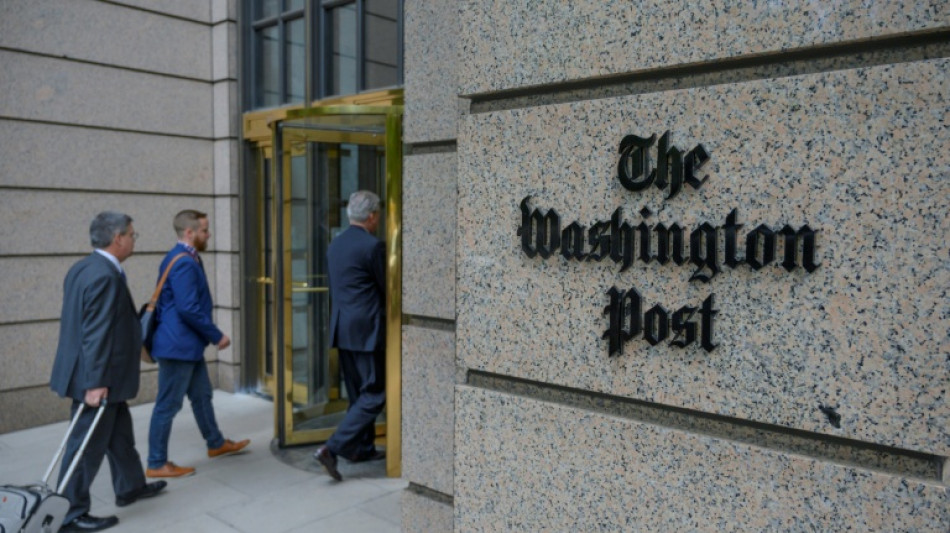
Bezos-led Washington Post announces 'painful' job cuts / Photo: © AFP

The Washington Post, owned by billionaire Amazon founder Jeff Bezos, announced major job cuts Wednesday, saying that "painful" restructuring was needed at the storied newspaper.

Change text size:

The Post, which gained legendary status when its reporting helped bring down president Richard Nixon in the Watergate scandal, will see "substantial" reductions in its newsroom, Executive Editor Matt Murray said.

The shrinking of the Post comes as major traditional media outlets in the United States face intense pressure from President Donald Trump, who routinely denigrates journalists as "fake news" and has launched multiple lawsuits over coverage of his presidency.

Bezos, one of the world's richest people, has become close to Trump in the Republican's second term. His Amazon behemoth controversially paid Trump's wife, First Lady Melania Trump, a reported $40 million for a documentary this year, along with another $35 million for marketing.

Murray said the shifts at the Post reflect the radically changing economy for news media.

This "will help to secure our future...and provide us stability moving forward," Murray said in a note to employees.

He cited changes to the news ecosystem, from individuals who "generate impact at low cost" to AI-generated content, as well as financial challenges that have already produced rounds of cost-cutting and buyouts at the Post.

"The company's structure is too rooted in a different era, when we were a dominant, local print product," he said. "And even as we produce much excellent work, we too often wrote from one perspective, for one slice of the audience."

On Facebook, Marty Baron, the Post’s executive editor until 2021, said: "This ranks among the darkest days in the history of one of the world’s greatest news organizations."

- War zone layoff -

The Post did not disclose the number of job cuts, but the New York Times reports approximately 300 of its 800 journalists were laid off.

Most of the paper's journalists overseas were let go, includings its entire Middle East roster and its Kyiv-based Ukraine correspondent.

Sports, graphics and local news departments were sharply scaled back and the paper's daily podcast, Post Reports, was suspended, local media reported.

Murray said the Post would now focus on politics, national security, technology, investigations, and business, among other topics.

But a reporter who covered Amazon -- currently valued at $2.6 trillion -- was let go.

"These layoffs are not inevitable. A newsroom cannot be hollowed out without consequences for its credibility, its reach and its future," the labor union representing many Post journalists said in a statement.

It called for supporters of the paper, acquired by Bezos in 2013, to rally outside its Washington headquarters at noon on Thursday.

The White House's communications director, Stephen Cheung, issued a typically scornful message.

"Just a reminder that printing fake news is not a profitable business model," he posted on X.

- Financial struggles -

Baron, the Post's former executive editor, said that Post owner Bezos had resisted "brutal pressure" from Trump in the past, but it was battered by "ill-conceived decisions that came from the very top."

Bezos reined in a liberal-leaning editorial page and blocked an endorsement of Democratic presidential candidate Kamala Harris days before the 2024 election -- breaking the so-called firewall of editorial independence, and seen as bowing the knee to Trump.

In response, loyal readers "fled the Post. In truth, they were driven away," Baron said.

The Wall Street Journal reported last month that 250,000 digital subscribers left the Post after it refrained from endorsing Harris and the paper lost around $100 million in 2024 as advertising and subscription revenues fell.

In May 2024, Post publisher Will Lewis told staffers the paper lost $77 million over the preceding year and lost half of its audience since 2020.

In stark contrast, The New York Times announced Wednesday that it gained more than one million digital subscribers in 2025, bringing its total to nearly 13 million and confirming its dominant position in the US media market.

A.Wood--TNT

Featured

Nearly 1,100 flights cancelled after UK air traffic control glitch

Almost 1,100 flights to and from UK airports were cancelled Tuesday due to what the country's air traffic control service called a technical issue, in the latest glitch to spark travel chaos.

Carney touts Canada 'pivot' away from US as tariffs rise

Canadian Prime Minister Mark Carney on Tuesday said reducing economic ties with the United States would come at a cost but the long-term benefits were clear, as retaliatory tariffs on US products took effect.

The "Everlasting Battery" Inside Your Joints:UConn Professor's Self-Powered Healing Material just Got Acquired

A material that turns your own movement into medicine has just landed a corporate home. PetVivo Holdings (OTCQX: PETV), a veterinary biotech and biomedical device company focused on treating osteoarthritis in dogs and horses, has acquired PiezoBioMembrane (PBM) — a startup built around a biodegradable implant that generates electricity from the everyday force of a joint in motion, and uses that charge to help regrow cartilage from the inside out. The material is the invention of Thanh Nguyen, a professor of mechanical engineering in UConn's College of Engineering, who founded PBM in 2021 to advance new implementation methods for his work with piezoelectric materials — substances that convert mechanical force into electrical energy. These materials are typically ceramics: hard, brittle, and poorly suited for medical use. But Nguyen's lab developed new forms that are so , flexible, and biodegradable, breaking down naturally within the body over time. wound healing, The materials have already shown strong potential across a range of medical applications, including tissue regeneration, implanted force sensors, and targeted drug delivery in tumor treatment. How It Works biodegradable ultrasound for In the case of arthritis, Nguyen explains, the piezoelectric materials function as an off-the-shelf product that can be implanted or injected directly into the ailing joint — with no drugs, chemicals, or cells required. The everyday force exerted on the joint generates a small electrical charge, which helps regrow healthy cartilage, mimicking the body's natural use of electricity to regenerate tissue. "The body can be electrically stimulated to regrow," Nguyen says. PBM's materials "act like a battery — an everlasting battery that works whenever there is a force applied, and vanishes safely inside the body over time." PetVivo's Vision for the Acquisition PetVivo Holdings CEO John Lai expressed enthusiasm for the merger's potential to improve the lives of companion animals globally. "PBM has developed a compelling functional biomaterials platform with the potential to support the development of multiple medical device and therapeutic product lines across both human and animal health markets," Lai said in a press release. "By combining PBM's scientific innovation with PetVivo's product development capabilities, commercialization experience, regulatory expertise, and public company infrastructure, we believe we can accelerate theadvancement of technologies that may serve as the foundation for numerous future products and strategic opportunities." For Nguyen, the deal is a chance to scale technology that could eventually benefit both animals and people. "PetVivo is an animal health company, but they do have a big passion: pushing the technology towards clinical trials for human use," Nguyen says. "That aligned perfectly with my passion for developing technology that has an impact on human life. That is why I am excited about this merger, which facilitates my passion." A Track Record of Innovation Nguyen's research sits at the intersection of medicine, micro/nanotechnology, and biomaterials. His inventions have earned him publications in prominent scientific journals and media coverage from outlets including NPR. Nguyen founded PBM during the COVID-19 pandemic, a er realizing the material he had developed could be used to create an especially effective, biodegradable face mask — one where the mechanical force of breathing generated an electrical charge that provided an extra layer of protection against viruses. PBM is not Nguyen's only venture in the acquisition pipeline. His other startup, Single-Time Microneedles (STM), is also currently undergoing an acquisition process. STM has pioneered stable, efficient vaccine delivery technology in the form of an adhesive patch. shelfNguyen's focus on biodegradable materials has translated into a remarkably diverse range of medical applications. He has received five R01 grants from the National Institutes of Health (NIH) supporting research in cartilage regeneration, bone regeneration, HIV antibody delivery systems, and biodegradable ultrasound technology to boost the effectiveness of chemotherapy for brain cancer. "Whatever we are working on, we want to show that it works very well in vitro and in vivo," Nguyen says. "Then, when we are at the point of commercialization, we set up a startup or license the technology — or maybe team up with an industry partner." Thanh Nguyen is a professor of mechanical engineering in UConn's College of Engineering. (Courtesy of Thanh Nguyen

Octrado introduces its proprietary trading offering: "Your Skill. Our Capital"

Infrastructure, transparent rules and clear legal boundaries positioned as the core of the funded-account model

Change text size: