The National Times - Air India inspects Boeing 787 fuel switches after grounding

Air India inspects Boeing 787 fuel switches after grounding


Air India inspects Boeing 787 fuel switches after grounding
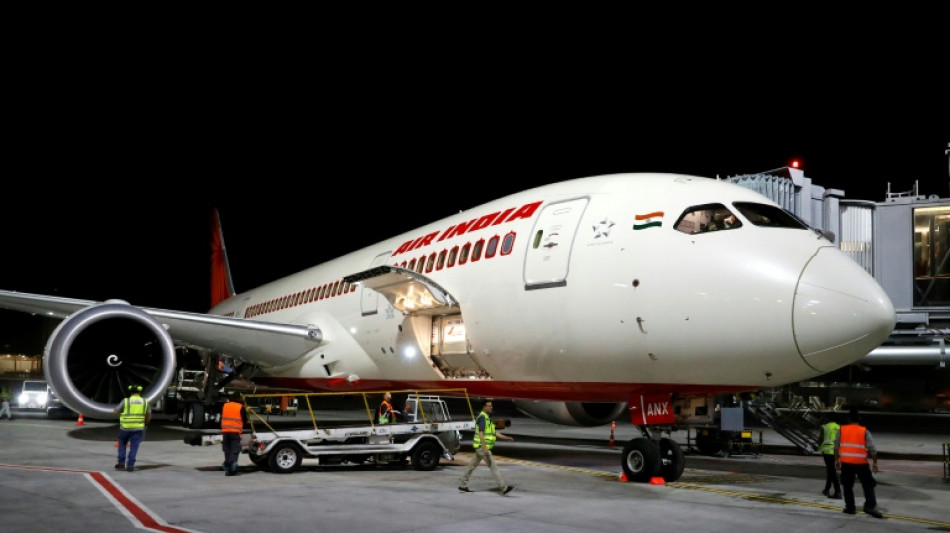
Air India inspects Boeing 787 fuel switches after grounding / Photo: © AFP

Air India has begun inspecting fuel control switches on its 33 Boeing 787 aircraft after grounding a flight over a possible defect, according to a company note seen by AFP on Tuesday.

Change text size:

The checks came as Indian authorities were probing the crash last year of a 787 Dreamliner that killed 260 people shortly after takeoff.

News of the inspection followed Air India's grounding Monday of a Boeing 787-8 Dreamliner jet after one of its pilots reported a possible defect in the fuel control switch.

"Following the reported defect... Engineering has escalated the matter to Boeing for priority evaluation," the internal company note said.

India's aviation regulator said incorrect handling of the fuel switch had caused the issue in Monday's flight, and not a mechanical fault.

The Directorate General of Civil Aviation said that twice the fuel control switch, which regulates fuel into the plane's engines, did not "remain positively latched in the run position when light vertical pressure was applied".

It was stable the third time and the flight was "completed without incident", the regulator said in a statement.

It advised the airline to reinforce crew training on Boeing's recommended procedures.

In a statement to AFP, Boeing said: "We are in contact with Air India and are supporting their review of this matter."

Air India, owned by the Tata Group conglomerate, said it had launched a precautionary fleet-wide re-inspection of the switch latch.

A source close to the company told AFP that fresh inspection of several planes had been completed, with no adverse findings yet.

A London-bound Boeing 787 Dreamliner operated by Air India crashed shortly after taking off from Ahmedabad in June, killing all but one of the 242 people on board and 19 on the ground.

An inspection of the locking feature on the fuel control switches of the aircraft after the crash found no issues.

A preliminary report by India's Aircraft Accident Investigation Bureau (AAIB) said fuel supply to the jet's engines was cut off moments before impact, raising questions about possible pilot error.

According to the AAIB, one pilot was heard asking the other why fuel had been cut off, to which the second pilot replied that he had not done so.

Two major Indian commercial pilots' associations, as well as the father of one of the dead pilots, have rejected suggestions that human error caused the crash.

Indian authorities have yet to release a final report into the crash.

A.M.Murray--TNT

Featured

Carney touts Canada 'pivot' away from US as Trump levels new threat

Canadian Prime Minister Mark Carney said Tuesday that reducing economic ties with the United States would come at a cost but the benefits were clear, as President Donald Trump threatened new penalties targeting Canada.

Nearly 1,100 flights cancelled after UK air traffic control glitch

Almost 1,100 flights to and from UK airports were cancelled Tuesday due to what the country's air traffic control service called a technical issue, in the latest glitch to spark travel chaos.

Carney touts Canada 'pivot' away from US as tariffs rise

Canadian Prime Minister Mark Carney on Tuesday said reducing economic ties with the United States would come at a cost but the long-term benefits were clear, as retaliatory tariffs on US products took effect.

The "Everlasting Battery" Inside Your Joints:UConn Professor's Self-Powered Healing Material just Got Acquired

A material that turns your own movement into medicine has just landed a corporate home. PetVivo Holdings (OTCQX: PETV), a veterinary biotech and biomedical device company focused on treating osteoarthritis in dogs and horses, has acquired PiezoBioMembrane (PBM) — a startup built around a biodegradable implant that generates electricity from the everyday force of a joint in motion, and uses that charge to help regrow cartilage from the inside out. The material is the invention of Thanh Nguyen, a professor of mechanical engineering in UConn's College of Engineering, who founded PBM in 2021 to advance new implementation methods for his work with piezoelectric materials — substances that convert mechanical force into electrical energy. These materials are typically ceramics: hard, brittle, and poorly suited for medical use. But Nguyen's lab developed new forms that are so , flexible, and biodegradable, breaking down naturally within the body over time. wound healing, The materials have already shown strong potential across a range of medical applications, including tissue regeneration, implanted force sensors, and targeted drug delivery in tumor treatment. How It Works biodegradable ultrasound for In the case of arthritis, Nguyen explains, the piezoelectric materials function as an off-the-shelf product that can be implanted or injected directly into the ailing joint — with no drugs, chemicals, or cells required. The everyday force exerted on the joint generates a small electrical charge, which helps regrow healthy cartilage, mimicking the body's natural use of electricity to regenerate tissue. "The body can be electrically stimulated to regrow," Nguyen says. PBM's materials "act like a battery — an everlasting battery that works whenever there is a force applied, and vanishes safely inside the body over time." PetVivo's Vision for the Acquisition PetVivo Holdings CEO John Lai expressed enthusiasm for the merger's potential to improve the lives of companion animals globally. "PBM has developed a compelling functional biomaterials platform with the potential to support the development of multiple medical device and therapeutic product lines across both human and animal health markets," Lai said in a press release. "By combining PBM's scientific innovation with PetVivo's product development capabilities, commercialization experience, regulatory expertise, and public company infrastructure, we believe we can accelerate theadvancement of technologies that may serve as the foundation for numerous future products and strategic opportunities." For Nguyen, the deal is a chance to scale technology that could eventually benefit both animals and people. "PetVivo is an animal health company, but they do have a big passion: pushing the technology towards clinical trials for human use," Nguyen says. "That aligned perfectly with my passion for developing technology that has an impact on human life. That is why I am excited about this merger, which facilitates my passion." A Track Record of Innovation Nguyen's research sits at the intersection of medicine, micro/nanotechnology, and biomaterials. His inventions have earned him publications in prominent scientific journals and media coverage from outlets including NPR. Nguyen founded PBM during the COVID-19 pandemic, a er realizing the material he had developed could be used to create an especially effective, biodegradable face mask — one where the mechanical force of breathing generated an electrical charge that provided an extra layer of protection against viruses. PBM is not Nguyen's only venture in the acquisition pipeline. His other startup, Single-Time Microneedles (STM), is also currently undergoing an acquisition process. STM has pioneered stable, efficient vaccine delivery technology in the form of an adhesive patch. shelfNguyen's focus on biodegradable materials has translated into a remarkably diverse range of medical applications. He has received five R01 grants from the National Institutes of Health (NIH) supporting research in cartilage regeneration, bone regeneration, HIV antibody delivery systems, and biodegradable ultrasound technology to boost the effectiveness of chemotherapy for brain cancer. "Whatever we are working on, we want to show that it works very well in vitro and in vivo," Nguyen says. "Then, when we are at the point of commercialization, we set up a startup or license the technology — or maybe team up with an industry partner." Thanh Nguyen is a professor of mechanical engineering in UConn's College of Engineering. (Courtesy of Thanh Nguyen

Change text size: