The National Times - Russian captain found guilty in fatal North Sea crash

Russian captain found guilty in fatal North Sea crash


Russian captain found guilty in fatal North Sea crash
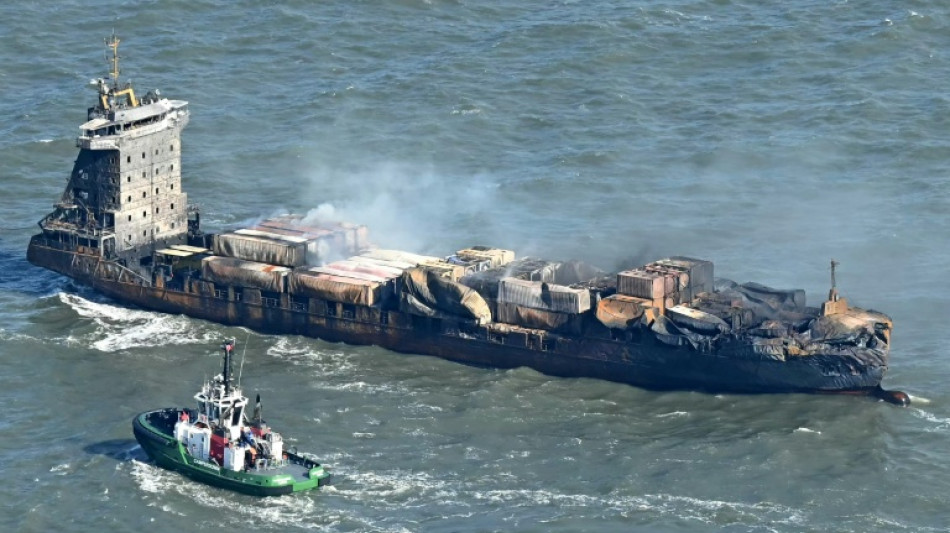
Russian captain found guilty in fatal North Sea crash / Photo: © AFP

The Russian captain of a cargo ship that hit an anchored oil tanker in the North Sea last year was on Monday found guilty by a UK court of killing a crew member.

Change text size:

After eight hours of deliberation, the jury convicted Vladimir Motin of the manslaughter by gross negligence of Filipino sailor Mark Angelo Pernia.

The seaman, 38, who was married with a young child, was lost at sea following the crash in which Motin's cargo ship, the Solong, collided with the oil-laden Stena Immaculate, triggering a fiery blaze off the eastern UK coast.

Pernia's body has never been recovered.

Motin, from Saint Petersburg, showed no emotion as he was convicted by a jury at London's Old Bailey court.

He was remanded in custody and will be sentenced on Thursday.

Speaking after the verdict, investigating officer Craig Nicholson described the crash as a "senseless tragedy".

"It's a miracle that there weren't more fatalities or serious injuries," he said.

Prosecutor Tom Little told the court Pernia's wife -- who was seven months pregnant with their second child at the time of his death -- lived in a remote area of the Philippines.

She would need to make arrangements to travel somewhere with good internet access to watch the sentencing remotely.

"This was a tragic, and entirely avoidable death of a member of crew caused by truly, exceptionally bad negligence," said prosecutor Michael Gregory.

"It is with great sadness for his family that his body has never been found," he added.

- 'Collision course' -

The collision at speed in March set both vessels ablaze and triggered a massive offshore rescue operation.

Motin's defence lawyer, James Leonard, had previously told the trial that the captain had attempted to take the Portuguese-flagged Solong out of autopilot and change course manually to avoid crashing into the Stena Immaculate, which had been chartered by the US military.

"That attempt, however, was not successful and the Solong did not change course at all," he said.

Motin told the court he had made a "mistake" and pressed the wrong button.

The jury was told Motin was a "highly trained" sailor who had captained the Solong for 15 years.

But the prosecution insisted that he "did nothing to avoid the collision".

"He could, and should, have acted differently" when his ship was on "an obvious collision course" with the tanker, Little told the trial.

The CPS said the Solong's black box showed no course or speed adjustments before the collision.

It added that Motin had disabled the alarm system, "leaving him alone to be on watch as the eyes and ears of the ship".

WhatsApp messages sent to Motin by his wife had "undermined his credibility", the CPS noted.

She had told him to "think of an alibi and advised him to say he had not seen the other vessel on the control devices".

- 'Catastrophic' -

Audio recordings from the Solong's bridge control room were played to jurors, accompanied by a visual reconstruction of the ship's trajectory towards the Stena Immaculate.

An hour before the collision, men could be heard speaking calmly in Russian about the price of cigarettes. Then a Russian folksong is heard, an apparent phone ringtone which went unanswered.

As the Solong approached the anchored oil tanker, no conversation could be heard in the control room at all. The ensuing sound of the collision's initial impact was so loud that jurors winced after being warned to decrease the volume on their listening devices.

The jury saw phone footage recorded by Joesen Mariposila, the Solong's third-in-command, showing fire at the ship's other end.

He was heard saying "Lord help us" five times as dark smoke began to fill the air.

Malcolm McHaffie, head of the Crown Prosecution Service's special crime division, said the case underlined "the gravity of a captain's duty of care while out at sea".

"If that duty of care is breached, the consequences can be catastrophic."

C.Bell--TNT

Featured

Carney touts Canada 'pivot' away from US as Trump levels new threat

Canadian Prime Minister Mark Carney said Tuesday that reducing economic ties with the United States would come at a cost but the benefits were clear, as President Donald Trump threatened new penalties targeting Canada.

Nearly 1,100 flights cancelled after UK air traffic control glitch

Almost 1,100 flights to and from UK airports were cancelled Tuesday due to what the country's air traffic control service called a technical issue, in the latest glitch to spark travel chaos.

Carney touts Canada 'pivot' away from US as tariffs rise

Canadian Prime Minister Mark Carney on Tuesday said reducing economic ties with the United States would come at a cost but the long-term benefits were clear, as retaliatory tariffs on US products took effect.

The "Everlasting Battery" Inside Your Joints:UConn Professor's Self-Powered Healing Material just Got Acquired

A material that turns your own movement into medicine has just landed a corporate home. PetVivo Holdings (OTCQX: PETV), a veterinary biotech and biomedical device company focused on treating osteoarthritis in dogs and horses, has acquired PiezoBioMembrane (PBM) — a startup built around a biodegradable implant that generates electricity from the everyday force of a joint in motion, and uses that charge to help regrow cartilage from the inside out. The material is the invention of Thanh Nguyen, a professor of mechanical engineering in UConn's College of Engineering, who founded PBM in 2021 to advance new implementation methods for his work with piezoelectric materials — substances that convert mechanical force into electrical energy. These materials are typically ceramics: hard, brittle, and poorly suited for medical use. But Nguyen's lab developed new forms that are so , flexible, and biodegradable, breaking down naturally within the body over time. wound healing, The materials have already shown strong potential across a range of medical applications, including tissue regeneration, implanted force sensors, and targeted drug delivery in tumor treatment. How It Works biodegradable ultrasound for In the case of arthritis, Nguyen explains, the piezoelectric materials function as an off-the-shelf product that can be implanted or injected directly into the ailing joint — with no drugs, chemicals, or cells required. The everyday force exerted on the joint generates a small electrical charge, which helps regrow healthy cartilage, mimicking the body's natural use of electricity to regenerate tissue. "The body can be electrically stimulated to regrow," Nguyen says. PBM's materials "act like a battery — an everlasting battery that works whenever there is a force applied, and vanishes safely inside the body over time." PetVivo's Vision for the Acquisition PetVivo Holdings CEO John Lai expressed enthusiasm for the merger's potential to improve the lives of companion animals globally. "PBM has developed a compelling functional biomaterials platform with the potential to support the development of multiple medical device and therapeutic product lines across both human and animal health markets," Lai said in a press release. "By combining PBM's scientific innovation with PetVivo's product development capabilities, commercialization experience, regulatory expertise, and public company infrastructure, we believe we can accelerate theadvancement of technologies that may serve as the foundation for numerous future products and strategic opportunities." For Nguyen, the deal is a chance to scale technology that could eventually benefit both animals and people. "PetVivo is an animal health company, but they do have a big passion: pushing the technology towards clinical trials for human use," Nguyen says. "That aligned perfectly with my passion for developing technology that has an impact on human life. That is why I am excited about this merger, which facilitates my passion." A Track Record of Innovation Nguyen's research sits at the intersection of medicine, micro/nanotechnology, and biomaterials. His inventions have earned him publications in prominent scientific journals and media coverage from outlets including NPR. Nguyen founded PBM during the COVID-19 pandemic, a er realizing the material he had developed could be used to create an especially effective, biodegradable face mask — one where the mechanical force of breathing generated an electrical charge that provided an extra layer of protection against viruses. PBM is not Nguyen's only venture in the acquisition pipeline. His other startup, Single-Time Microneedles (STM), is also currently undergoing an acquisition process. STM has pioneered stable, efficient vaccine delivery technology in the form of an adhesive patch. shelfNguyen's focus on biodegradable materials has translated into a remarkably diverse range of medical applications. He has received five R01 grants from the National Institutes of Health (NIH) supporting research in cartilage regeneration, bone regeneration, HIV antibody delivery systems, and biodegradable ultrasound technology to boost the effectiveness of chemotherapy for brain cancer. "Whatever we are working on, we want to show that it works very well in vitro and in vivo," Nguyen says. "Then, when we are at the point of commercialization, we set up a startup or license the technology — or maybe team up with an industry partner." Thanh Nguyen is a professor of mechanical engineering in UConn's College of Engineering. (Courtesy of Thanh Nguyen

Change text size: