The National Times - Afghan returnees in Bamiyan struggle despite new homes

Afghan returnees in Bamiyan struggle despite new homes


Afghan returnees in Bamiyan struggle despite new homes
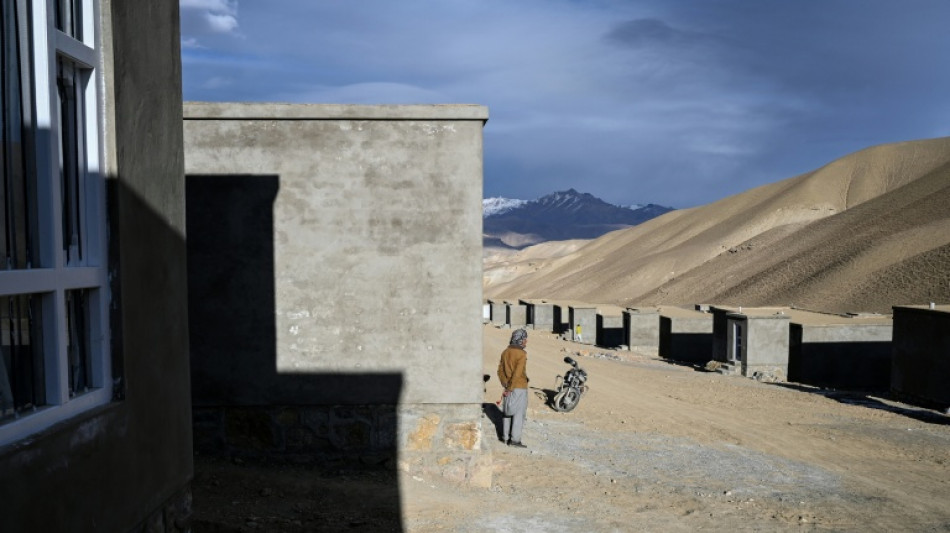
Afghan returnees in Bamiyan struggle despite new homes / Photo: © AFP

Sitting in his modest home beneath snow-dusted hills in Afghanistan's Bamiyan province, Nimatullah Rahesh expressed relief to have found somewhere to "live peacefully" after months of uncertainty.

Change text size:

Rahesh is one of millions of Afghans pushed out of Iran and Pakistan, but despite being given a brand new home in his native country, he and many of his recently returned compatriots are lacking even basic services.

"We no longer have the end-of-month stress about the rent," he told AFP after getting his house, which was financed by the UN refugee agency on land provided by the Taliban authorities.

Originally from a poor and mountainous district of Bamiyan, Rahesh worked for five years in construction in Iran, where his wife Marzia was a seamstress.

"The Iranians forced us to leave" in 2024 by "refusing to admit our son to school and asking us to pay an impossible sum to extend our documents," he said.

More than five million Afghans have returned home since September 2023, according to the International Organization for Migration (IOM), as neighbouring Iran and Pakistan stepped up deportations.

The Rahesh family is among 30 to be given a 50-square-metre (540-square-foot) home in Bamiyan, with each household in the nascent community participating in the construction and being paid by UNHCR for their work.

The families, most of whom had lived in Iran, own the building and the land.

"That was crucial for us, because property rights give these people security," said the UNHCR's Amaia Lezertua.

- Waiting for water -

Despite the homes lacking running water and being far from shops, schools or hospitals, new resident Arefa Ibrahimi said she was happy "because this house is mine, even if all the basic facilities aren't there".

Ibrahimi, whose four children huddled around the stove in her spartan living room, is one of 10 single mothers living in the new community.

The 45-year-old said she feared ending up on the street after her husband left her.

She showed AFP journalists her two just-finished rooms and an empty hallway with a counter intended to serve as a kitchen.

"But there's no bathroom," she said. These new houses have only basic outdoor toilets, too small to add even a simple shower.

Ajay Singh, the UNHCR project manager, said the home design came from the local authorities, and families could build a bathroom themselves.

There is currently no piped water nor wells in the area, which is dubbed "the dry slope" (Jar-e-Khushk).

Ten litres of drinking water bought when a tanker truck passes every three days costs more than in the capital Kabul, residents told AFP.

Fazil Omar Rahmani, the provincial head of the Ministry of Refugees and Repatriation Affairs, said there were plans to expand the water supply network.

"But for now these families must secure their own supply," he told AFP.

- Two hours on foot -

The plots allocated by the government for the new neighbourhood lie far from Bamiyan city, which is home to more than 70,000 people.

The city grabbed international attention in 2001, when the Sunni Pashtun Taliban authorities destroyed two large Buddha statues cherished by the predominantly Shia Hazara community in the region.

Since the Taliban government came back to power in 2021, around 7,000 Afghans have returned to Bamiyan according to Rahmani.

The new project provides housing for 174 of them. At its inauguration, resident Rahesh stood before his new neighbours and addressed their supporters.

"Thank you for the homes, we are grateful, but please don't forget us for water, a school, clinics, the mobile network," which is currently nonexistent, he said.

Rahmani, the ministry official, insisted there were plans to build schools and clinics.

"There is a direct order from our supreme leader," Hibatullah Akhundzada, he said, without specifying when these projects will start.

In the meantime, to get to work at the market, Rahesh must walk for two hours along a rutted dirt road between barren mountains before he can catch a ride.

Only 11 percent of adults found full-time work after returning to Afghanistan, according to an IOM survey.

Ibrahimi, meanwhile, is contending with a four-kilometre (2.5-mile) walk to the nearest school when the winter break ends.

"I will have to wake my children very early, in the cold. I am worried," she said.

A.Parker--TNT

Featured

Carney touts Canada 'pivot' away from US as Trump levels new threat

Canadian Prime Minister Mark Carney said Tuesday that reducing economic ties with the United States would come at a cost but the benefits were clear, as President Donald Trump threatened new penalties targeting Canada.

Nearly 1,100 flights cancelled after UK air traffic control glitch

Almost 1,100 flights to and from UK airports were cancelled Tuesday due to what the country's air traffic control service called a technical issue, in the latest glitch to spark travel chaos.

Carney touts Canada 'pivot' away from US as tariffs rise

Canadian Prime Minister Mark Carney on Tuesday said reducing economic ties with the United States would come at a cost but the long-term benefits were clear, as retaliatory tariffs on US products took effect.

The "Everlasting Battery" Inside Your Joints:UConn Professor's Self-Powered Healing Material just Got Acquired

A material that turns your own movement into medicine has just landed a corporate home. PetVivo Holdings (OTCQX: PETV), a veterinary biotech and biomedical device company focused on treating osteoarthritis in dogs and horses, has acquired PiezoBioMembrane (PBM) — a startup built around a biodegradable implant that generates electricity from the everyday force of a joint in motion, and uses that charge to help regrow cartilage from the inside out. The material is the invention of Thanh Nguyen, a professor of mechanical engineering in UConn's College of Engineering, who founded PBM in 2021 to advance new implementation methods for his work with piezoelectric materials — substances that convert mechanical force into electrical energy. These materials are typically ceramics: hard, brittle, and poorly suited for medical use. But Nguyen's lab developed new forms that are so , flexible, and biodegradable, breaking down naturally within the body over time. wound healing, The materials have already shown strong potential across a range of medical applications, including tissue regeneration, implanted force sensors, and targeted drug delivery in tumor treatment. How It Works biodegradable ultrasound for In the case of arthritis, Nguyen explains, the piezoelectric materials function as an off-the-shelf product that can be implanted or injected directly into the ailing joint — with no drugs, chemicals, or cells required. The everyday force exerted on the joint generates a small electrical charge, which helps regrow healthy cartilage, mimicking the body's natural use of electricity to regenerate tissue. "The body can be electrically stimulated to regrow," Nguyen says. PBM's materials "act like a battery — an everlasting battery that works whenever there is a force applied, and vanishes safely inside the body over time." PetVivo's Vision for the Acquisition PetVivo Holdings CEO John Lai expressed enthusiasm for the merger's potential to improve the lives of companion animals globally. "PBM has developed a compelling functional biomaterials platform with the potential to support the development of multiple medical device and therapeutic product lines across both human and animal health markets," Lai said in a press release. "By combining PBM's scientific innovation with PetVivo's product development capabilities, commercialization experience, regulatory expertise, and public company infrastructure, we believe we can accelerate theadvancement of technologies that may serve as the foundation for numerous future products and strategic opportunities." For Nguyen, the deal is a chance to scale technology that could eventually benefit both animals and people. "PetVivo is an animal health company, but they do have a big passion: pushing the technology towards clinical trials for human use," Nguyen says. "That aligned perfectly with my passion for developing technology that has an impact on human life. That is why I am excited about this merger, which facilitates my passion." A Track Record of Innovation Nguyen's research sits at the intersection of medicine, micro/nanotechnology, and biomaterials. His inventions have earned him publications in prominent scientific journals and media coverage from outlets including NPR. Nguyen founded PBM during the COVID-19 pandemic, a er realizing the material he had developed could be used to create an especially effective, biodegradable face mask — one where the mechanical force of breathing generated an electrical charge that provided an extra layer of protection against viruses. PBM is not Nguyen's only venture in the acquisition pipeline. His other startup, Single-Time Microneedles (STM), is also currently undergoing an acquisition process. STM has pioneered stable, efficient vaccine delivery technology in the form of an adhesive patch. shelfNguyen's focus on biodegradable materials has translated into a remarkably diverse range of medical applications. He has received five R01 grants from the National Institutes of Health (NIH) supporting research in cartilage regeneration, bone regeneration, HIV antibody delivery systems, and biodegradable ultrasound technology to boost the effectiveness of chemotherapy for brain cancer. "Whatever we are working on, we want to show that it works very well in vitro and in vivo," Nguyen says. "Then, when we are at the point of commercialization, we set up a startup or license the technology — or maybe team up with an industry partner." Thanh Nguyen is a professor of mechanical engineering in UConn's College of Engineering. (Courtesy of Thanh Nguyen

Change text size: