The National Times - Artist chains up thrashing robot dog to expose AI fears

Artist chains up thrashing robot dog to expose AI fears


Artist chains up thrashing robot dog to expose AI fears
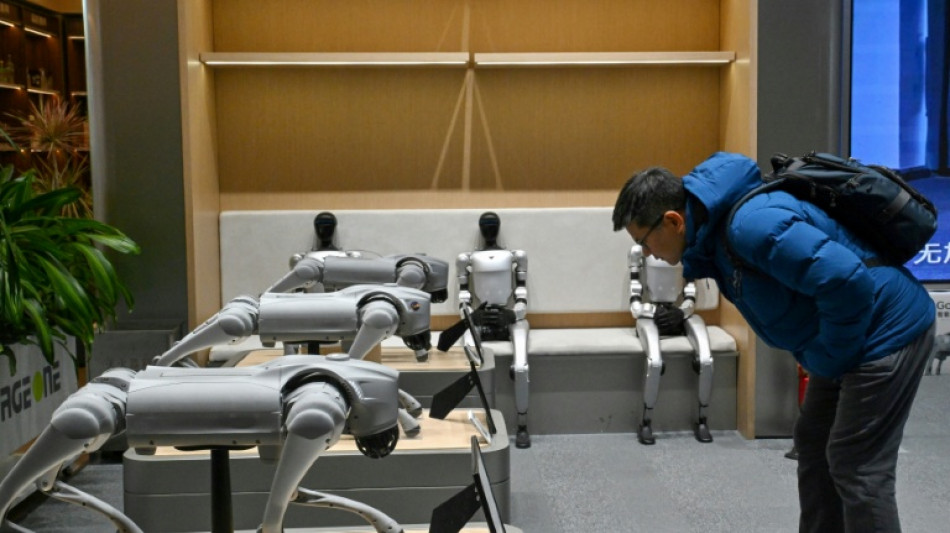
Artist chains up thrashing robot dog to expose AI fears / Photo: © AFP/File

The agile robot dog springs up on all fours, takes a step forward and charges at the tense crowd at a Tokyo exhibit, held back by a simple yet strong metal chain.

Change text size:

The silver mechanical creature then starts thrashing around violently, to gasps and exclamations from spectators at the installation, designed to probe humanity's relationship with increasingly realistic machines.

The Japanese media artist behind it told AFP he hoped the audience would consider the dangers posed by artificial intelligence but also feel "pity" for the struggling robot.

"Our future is going to be stressful, because people treat robots as objects, but we feel empathetic stress with these movements and reactions," said Takayuki Todo, 40.

Global tech giants are investing vast sums into humanoid and other lifelike robots, with grand plans for factory automation, home help and other futuristic "physical AI" services.

But so far actual use cases remain scarce and fully automated robots are still a rare sight, with most impressive displays -- including Todo's -- relying on remote operators to control the robot's movements.

For the artist, the point of the three-day installation at the Tokyo Prototype festival is to provoke thought.

Like the metal leash, "we are protected by an unreliable, thin chain of ethics. And if it's cut off, we will be killed by this technology," said Todo.

- 'Robot abuser' -

For his installation, titled "Dynamics of a Dog on a Leash" and first shown last year, Todo purchased three robot canines made by Chinese startup Unitree, costing thousands of dollars each.

One is already broken and repairs are needed for another, as the dogs often get tangled in the chain and end up crashing onto the floor.

Todo, who said he had been attacked online "as a robot abuser", visited Unitree in China last year to excuse himself for the unconventional treatment of their device.

The short hourly display, on show through Saturday in a business district skyscraper, is drawing large crowds, with many spectators including children curious to see a robot of this kind for the first time.

"It gave me the chills," said 34-year-old student and food service worker Kimie Furuta.

"Imagining it actually attacking like that... it could be terrifying to face."

On the brighter side, robots and AI could one day help ease staff shortages, including in the catering sector, she said.

Anatol Ward, a Tokyo resident in his 50s, said the robot reminded him of a guard dog.

"In some sense it was scary. But also it was fascinating -- like, what the robot was capable of."

Todo said that "of course" he was afraid of military uses for such robots, but noted it is not just a future concern.

"Robots and drones are killing soldiers in Ukraine or Palestine," he said.

"We feel it's a distant place, but as an artist we have to imagine it's in front of us."

T.F.Russell--TNT

Featured

Carney touts Canada 'pivot' away from US as Trump levels new threat

Canadian Prime Minister Mark Carney said Tuesday that reducing economic ties with the United States would come at a cost but the benefits were clear, as President Donald Trump threatened new penalties targeting Canada.

Nearly 1,100 flights cancelled after UK air traffic control glitch

Almost 1,100 flights to and from UK airports were cancelled Tuesday due to what the country's air traffic control service called a technical issue, in the latest glitch to spark travel chaos.

Carney touts Canada 'pivot' away from US as tariffs rise

Canadian Prime Minister Mark Carney on Tuesday said reducing economic ties with the United States would come at a cost but the long-term benefits were clear, as retaliatory tariffs on US products took effect.

The "Everlasting Battery" Inside Your Joints:UConn Professor's Self-Powered Healing Material just Got Acquired

A material that turns your own movement into medicine has just landed a corporate home. PetVivo Holdings (OTCQX: PETV), a veterinary biotech and biomedical device company focused on treating osteoarthritis in dogs and horses, has acquired PiezoBioMembrane (PBM) — a startup built around a biodegradable implant that generates electricity from the everyday force of a joint in motion, and uses that charge to help regrow cartilage from the inside out. The material is the invention of Thanh Nguyen, a professor of mechanical engineering in UConn's College of Engineering, who founded PBM in 2021 to advance new implementation methods for his work with piezoelectric materials — substances that convert mechanical force into electrical energy. These materials are typically ceramics: hard, brittle, and poorly suited for medical use. But Nguyen's lab developed new forms that are so , flexible, and biodegradable, breaking down naturally within the body over time. wound healing, The materials have already shown strong potential across a range of medical applications, including tissue regeneration, implanted force sensors, and targeted drug delivery in tumor treatment. How It Works biodegradable ultrasound for In the case of arthritis, Nguyen explains, the piezoelectric materials function as an off-the-shelf product that can be implanted or injected directly into the ailing joint — with no drugs, chemicals, or cells required. The everyday force exerted on the joint generates a small electrical charge, which helps regrow healthy cartilage, mimicking the body's natural use of electricity to regenerate tissue. "The body can be electrically stimulated to regrow," Nguyen says. PBM's materials "act like a battery — an everlasting battery that works whenever there is a force applied, and vanishes safely inside the body over time." PetVivo's Vision for the Acquisition PetVivo Holdings CEO John Lai expressed enthusiasm for the merger's potential to improve the lives of companion animals globally. "PBM has developed a compelling functional biomaterials platform with the potential to support the development of multiple medical device and therapeutic product lines across both human and animal health markets," Lai said in a press release. "By combining PBM's scientific innovation with PetVivo's product development capabilities, commercialization experience, regulatory expertise, and public company infrastructure, we believe we can accelerate theadvancement of technologies that may serve as the foundation for numerous future products and strategic opportunities." For Nguyen, the deal is a chance to scale technology that could eventually benefit both animals and people. "PetVivo is an animal health company, but they do have a big passion: pushing the technology towards clinical trials for human use," Nguyen says. "That aligned perfectly with my passion for developing technology that has an impact on human life. That is why I am excited about this merger, which facilitates my passion." A Track Record of Innovation Nguyen's research sits at the intersection of medicine, micro/nanotechnology, and biomaterials. His inventions have earned him publications in prominent scientific journals and media coverage from outlets including NPR. Nguyen founded PBM during the COVID-19 pandemic, a er realizing the material he had developed could be used to create an especially effective, biodegradable face mask — one where the mechanical force of breathing generated an electrical charge that provided an extra layer of protection against viruses. PBM is not Nguyen's only venture in the acquisition pipeline. His other startup, Single-Time Microneedles (STM), is also currently undergoing an acquisition process. STM has pioneered stable, efficient vaccine delivery technology in the form of an adhesive patch. shelfNguyen's focus on biodegradable materials has translated into a remarkably diverse range of medical applications. He has received five R01 grants from the National Institutes of Health (NIH) supporting research in cartilage regeneration, bone regeneration, HIV antibody delivery systems, and biodegradable ultrasound technology to boost the effectiveness of chemotherapy for brain cancer. "Whatever we are working on, we want to show that it works very well in vitro and in vivo," Nguyen says. "Then, when we are at the point of commercialization, we set up a startup or license the technology — or maybe team up with an industry partner." Thanh Nguyen is a professor of mechanical engineering in UConn's College of Engineering. (Courtesy of Thanh Nguyen

Change text size: