The National Times - Venezuelans eye economic revival with hoped-for oil resurgence

Venezuelans eye economic revival with hoped-for oil resurgence


Venezuelans eye economic revival with hoped-for oil resurgence
Venezuelans eye economic revival with hoped-for oil resurgence / Photo: © AFP/File

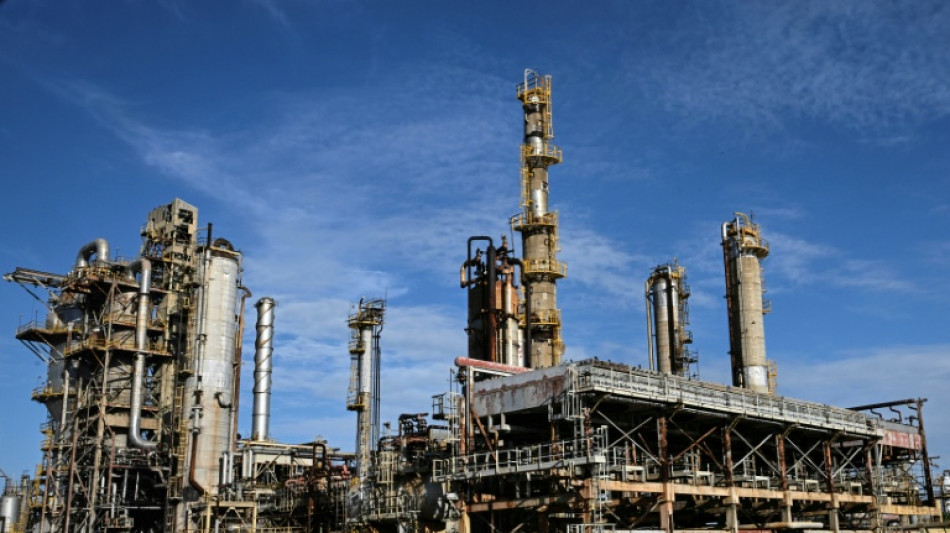
Ronald Herrera remembered the prosperity that Puerto Cabello enjoyed decades ago as home to the El Palito refinery -- once a symbol of Venezuela's oil boom.

Change text size:

Now, the ex-refinery worker said, he hoped to see his coastal city rise again through a relaunch of the Latin American country's oil industry by the United States, after Washington forcibly removed Nicolas Maduro from power on January 3.

"We're looking at a very promising outlook because, since we live next to the refinery, we believe the flow of work is going to improve," Herrera told AFP.

Delcy Rodriguez replaced Maduro as Venezuela's interim president after US forces seized and took him to the United States during a military raid in Caracas.

She quickly signed oil agreements with US President Donald Trump, who has declared that his administration now controls the sector -- the main engine of the Venezuelan economy.

Nowadays, Herrera sells coffee and cigarettes from a street stall in El Palito -- a district by the refinery in the port city located on Venezuela's Caribbean coast.

Five of his seven children live abroad -- part of a Venezuelan diaspora of around eight million, according to UN estimates.

Herrera favorably views Rodriguez's stance on the oil sector, which has reeled from years of underinvestment, allegations of corruption and US sanctions.

Since taking office, Rodriguez has pushed a reform of a hydrocarbons law to open the country's petroleum industry to foreign firms.

"It's going to give us a big boost because, with jobs available, we have work to do," he said.

The acting president is under pressure from the Trump administration to comply with its demands to overhaul the state-run oil industry and open it up to US companies.

- 'Always full' -

At night, the refinery's lights and its tongues of fire soften the gloom.

This network of pipes and huge storage tanks connects to a port where ships unload crude to be refined into gasoline and diesel for the Venezuelan market.

At the intersection where Herrera works, a dilapidated hotel waits for buyers.

A "for sale" sign is barely legible at the top, its letters faded by sun and salt air.

With four floors and 147 rooms, it's the tallest building in El Palito. Outside in the street, a row of colorful shops offers refreshments to tourists visiting a local surfing beach.

Jonathan Guarire, a 35-year-old employee at the hotel, said he believed the establishment could regain its past glory through a resurgence of the oil industry that would attract buyers.

"It was always full...and I hope it becomes like it was before," he said.

"All of that was always full of keys," he recalled, showing the small wooden cubbies where they used to be kept.

- 'Blackmail' -

The refinery is the area's most prominent landmark.

Its huge white storage tanks serve as canvases for slogans evoking Chavismo, the political ideology that governed Venezuela for the past 27 years and is named after late former leftist leader Hugo Chavez.

One slogan read: "Fatherland, socialism or death."

On a beach near the refinery, fishermen arrived at dawn with their night's catch.

Sergio Espina, a retired sailor in his 60s, was waiting to buy fish, which he would then sell.

The situation "is a little tough," he said. "I'm hoping things will get completely better to see what happens from here on out."

Another local, Gilberto Herrera, 67, works as a public employee and earns a paltry salary of less than one dollar a month. He attributes Venezuela's economic crisis to the sanctions that the United States slapped on country's oil industry in 2019.

The sanctions "did us a lot of harm," he said, questioning the military strike that Trump ordered on Venezuela.

"It's all blackmail, if you ask me. Why are they only now opening things up, as they say, to allow investment?"

D.Cook--TNT

Featured

Carney touts Canada 'pivot' away from US as Trump levels new threat

Canadian Prime Minister Mark Carney said Tuesday that reducing economic ties with the United States would come at a cost but the benefits were clear, as President Donald Trump threatened new penalties targeting Canada.

Nearly 1,100 flights cancelled after UK air traffic control glitch

Almost 1,100 flights to and from UK airports were cancelled Tuesday due to what the country's air traffic control service called a technical issue, in the latest glitch to spark travel chaos.

Carney touts Canada 'pivot' away from US as tariffs rise

Canadian Prime Minister Mark Carney on Tuesday said reducing economic ties with the United States would come at a cost but the long-term benefits were clear, as retaliatory tariffs on US products took effect.

The "Everlasting Battery" Inside Your Joints:UConn Professor's Self-Powered Healing Material just Got Acquired

A material that turns your own movement into medicine has just landed a corporate home. PetVivo Holdings (OTCQX: PETV), a veterinary biotech and biomedical device company focused on treating osteoarthritis in dogs and horses, has acquired PiezoBioMembrane (PBM) — a startup built around a biodegradable implant that generates electricity from the everyday force of a joint in motion, and uses that charge to help regrow cartilage from the inside out. The material is the invention of Thanh Nguyen, a professor of mechanical engineering in UConn's College of Engineering, who founded PBM in 2021 to advance new implementation methods for his work with piezoelectric materials — substances that convert mechanical force into electrical energy. These materials are typically ceramics: hard, brittle, and poorly suited for medical use. But Nguyen's lab developed new forms that are so , flexible, and biodegradable, breaking down naturally within the body over time. wound healing, The materials have already shown strong potential across a range of medical applications, including tissue regeneration, implanted force sensors, and targeted drug delivery in tumor treatment. How It Works biodegradable ultrasound for In the case of arthritis, Nguyen explains, the piezoelectric materials function as an off-the-shelf product that can be implanted or injected directly into the ailing joint — with no drugs, chemicals, or cells required. The everyday force exerted on the joint generates a small electrical charge, which helps regrow healthy cartilage, mimicking the body's natural use of electricity to regenerate tissue. "The body can be electrically stimulated to regrow," Nguyen says. PBM's materials "act like a battery — an everlasting battery that works whenever there is a force applied, and vanishes safely inside the body over time." PetVivo's Vision for the Acquisition PetVivo Holdings CEO John Lai expressed enthusiasm for the merger's potential to improve the lives of companion animals globally. "PBM has developed a compelling functional biomaterials platform with the potential to support the development of multiple medical device and therapeutic product lines across both human and animal health markets," Lai said in a press release. "By combining PBM's scientific innovation with PetVivo's product development capabilities, commercialization experience, regulatory expertise, and public company infrastructure, we believe we can accelerate theadvancement of technologies that may serve as the foundation for numerous future products and strategic opportunities." For Nguyen, the deal is a chance to scale technology that could eventually benefit both animals and people. "PetVivo is an animal health company, but they do have a big passion: pushing the technology towards clinical trials for human use," Nguyen says. "That aligned perfectly with my passion for developing technology that has an impact on human life. That is why I am excited about this merger, which facilitates my passion." A Track Record of Innovation Nguyen's research sits at the intersection of medicine, micro/nanotechnology, and biomaterials. His inventions have earned him publications in prominent scientific journals and media coverage from outlets including NPR. Nguyen founded PBM during the COVID-19 pandemic, a er realizing the material he had developed could be used to create an especially effective, biodegradable face mask — one where the mechanical force of breathing generated an electrical charge that provided an extra layer of protection against viruses. PBM is not Nguyen's only venture in the acquisition pipeline. His other startup, Single-Time Microneedles (STM), is also currently undergoing an acquisition process. STM has pioneered stable, efficient vaccine delivery technology in the form of an adhesive patch. shelfNguyen's focus on biodegradable materials has translated into a remarkably diverse range of medical applications. He has received five R01 grants from the National Institutes of Health (NIH) supporting research in cartilage regeneration, bone regeneration, HIV antibody delivery systems, and biodegradable ultrasound technology to boost the effectiveness of chemotherapy for brain cancer. "Whatever we are working on, we want to show that it works very well in vitro and in vivo," Nguyen says. "Then, when we are at the point of commercialization, we set up a startup or license the technology — or maybe team up with an industry partner." Thanh Nguyen is a professor of mechanical engineering in UConn's College of Engineering. (Courtesy of Thanh Nguyen

Change text size: