The National Times - Anti-immigration protesters force climbdown in Sundance documentary

Anti-immigration protesters force climbdown in Sundance documentary


Anti-immigration protesters force climbdown in Sundance documentary
Anti-immigration protesters force climbdown in Sundance documentary / Photo: © AFP

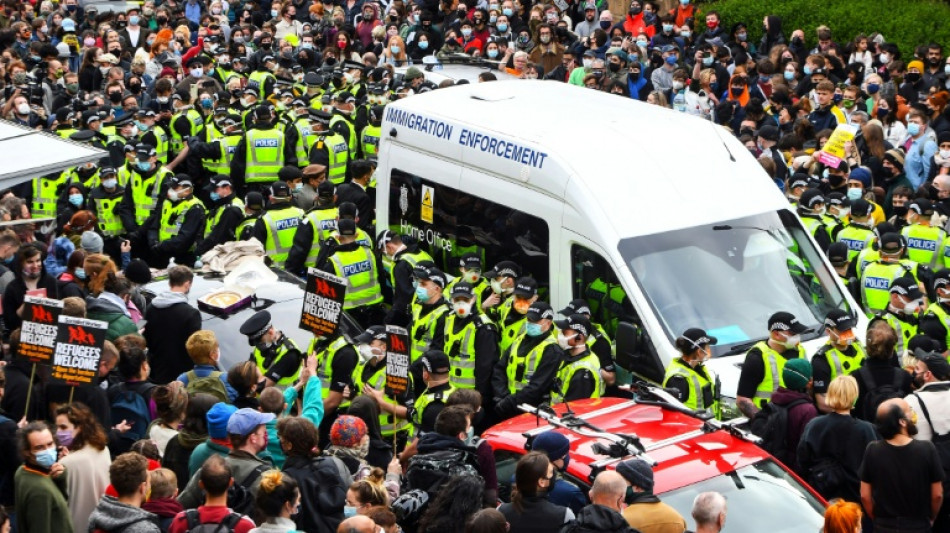
When immigration officials came to arrest two men targeted for deportation, a community sprang into action to protest what they said was a brutal policy by an inhumane government.

Change text size:

With little more than cellphones and a righteous sense of injustice, a handful of people spread the word that they needed to take a stand.

Dozens, then hundreds, then thousands more arrived to confront the authorities to stop their neighbors being taken away.

But this was not Minneapolis in 2026 -- it was Scotland's Glasgow in 2021. The community effort worked; the men were released.

"Everybody to Kenmure Street" was perhaps the most timely documentary at this year's Sundance Film Festival.

Director Felipe Bustos Sierra pieced together the events using cellphone footage from some of the estimated 2,500 people who answered the call from WhatsApp groups, book club text message circles or Facebook livestreams.

What emerged was an uplifting portrait of a spontaneous, organic and leaderless protest in Pollockshields, an ethnically diverse suburb of Glasgow.

- 'Drip, drip, drip' -

Tabassum Niamat had been up all night preparing a family feast for Eid al-Fitr, the celebration that marks the end of the Muslim holy month of Ramadan.

"Suddenly, I got these text messages," she told AFP. "I made my way to Kenmure Street, and lo and behold, what was in front of me was a big immigration van."

A dawn raid on the first day of Eid by a team from Britain's Home Office (interior ministry) seemed designed to inflame tensions in an area with a large South Asian population.

One quick-thinking campaigner crawled underneath the van as the arrests were happening inside a home -- a place he would remain for over eight hours to prevent the van moving.

"It was just maybe five of us at that point. And soon after, there was 10, then it was 20...just like drip, drip, drip, until there were so many of us I couldn't see one end of Kenmure Street to the other," said Niamat.

A growing police presence did not deter the protesters, who set up a makeshift pantry in a bus stop offering food and drinks.

The local mosque also threw open its doors to allow anyone -- police officers or protesters -- to use the toilets.

"What do you do when guests arrive at your doorstep? You feed them, you look after them," Niamat said.

As news of the protest spread, a local human rights lawyer arrived and was able to negotiate the detainees' unconditional release. No one was seriously injured in the spontaneous protest.

- Van man -

Many of the locals who told the story of the protest appeared on camera, but some key characters did not.

Among them was the figure dubbed simply "Van Man," whose name was not revealed, but whose words were spoken by actress Emma Thompson, appearing to be lying under a van.

Partly, explained Bustos Sierra, this was to safeguard a person who became something of a legend around Glasgow after the protest.

But it was also an effort to emphasize that this protest was a collective action, and a victory for everyone.

"Van Man had the opportunity," Bustos Sierra told AFP.

"Anybody could have done this. Anybody should do this. It's the only way we move forward."

The documentary premiered at Sundance two days before 37-year-old protester Alex Pretti was shot dead by US federal agents in Minneapolis as he demonstrated against a military-style immigration crackdown in the city.

While the context was different -- UK police are not routinely armed, and there were no signs in the film that pepper spray or batons were used on protesters -- Niamat saw parallels with Minnesota.

"If you come out for your fellow man, if you come out for the sake of humanity, if you come out because you believe what's happening is wrong, you're instantly going to feel connected, and you'll want to stand together."

The Sundance Film Festival runs until February 1.

M.Wilson--TNT

Featured

Carney touts Canada 'pivot' away from US as Trump levels new threat

Canadian Prime Minister Mark Carney said Tuesday that reducing economic ties with the United States would come at a cost but the benefits were clear, as President Donald Trump threatened new penalties targeting Canada.

Nearly 1,100 flights cancelled after UK air traffic control glitch

Almost 1,100 flights to and from UK airports were cancelled Tuesday due to what the country's air traffic control service called a technical issue, in the latest glitch to spark travel chaos.

Carney touts Canada 'pivot' away from US as tariffs rise

Canadian Prime Minister Mark Carney on Tuesday said reducing economic ties with the United States would come at a cost but the long-term benefits were clear, as retaliatory tariffs on US products took effect.

The "Everlasting Battery" Inside Your Joints:UConn Professor's Self-Powered Healing Material just Got Acquired

A material that turns your own movement into medicine has just landed a corporate home. PetVivo Holdings (OTCQX: PETV), a veterinary biotech and biomedical device company focused on treating osteoarthritis in dogs and horses, has acquired PiezoBioMembrane (PBM) — a startup built around a biodegradable implant that generates electricity from the everyday force of a joint in motion, and uses that charge to help regrow cartilage from the inside out. The material is the invention of Thanh Nguyen, a professor of mechanical engineering in UConn's College of Engineering, who founded PBM in 2021 to advance new implementation methods for his work with piezoelectric materials — substances that convert mechanical force into electrical energy. These materials are typically ceramics: hard, brittle, and poorly suited for medical use. But Nguyen's lab developed new forms that are so , flexible, and biodegradable, breaking down naturally within the body over time. wound healing, The materials have already shown strong potential across a range of medical applications, including tissue regeneration, implanted force sensors, and targeted drug delivery in tumor treatment. How It Works biodegradable ultrasound for In the case of arthritis, Nguyen explains, the piezoelectric materials function as an off-the-shelf product that can be implanted or injected directly into the ailing joint — with no drugs, chemicals, or cells required. The everyday force exerted on the joint generates a small electrical charge, which helps regrow healthy cartilage, mimicking the body's natural use of electricity to regenerate tissue. "The body can be electrically stimulated to regrow," Nguyen says. PBM's materials "act like a battery — an everlasting battery that works whenever there is a force applied, and vanishes safely inside the body over time." PetVivo's Vision for the Acquisition PetVivo Holdings CEO John Lai expressed enthusiasm for the merger's potential to improve the lives of companion animals globally. "PBM has developed a compelling functional biomaterials platform with the potential to support the development of multiple medical device and therapeutic product lines across both human and animal health markets," Lai said in a press release. "By combining PBM's scientific innovation with PetVivo's product development capabilities, commercialization experience, regulatory expertise, and public company infrastructure, we believe we can accelerate theadvancement of technologies that may serve as the foundation for numerous future products and strategic opportunities." For Nguyen, the deal is a chance to scale technology that could eventually benefit both animals and people. "PetVivo is an animal health company, but they do have a big passion: pushing the technology towards clinical trials for human use," Nguyen says. "That aligned perfectly with my passion for developing technology that has an impact on human life. That is why I am excited about this merger, which facilitates my passion." A Track Record of Innovation Nguyen's research sits at the intersection of medicine, micro/nanotechnology, and biomaterials. His inventions have earned him publications in prominent scientific journals and media coverage from outlets including NPR. Nguyen founded PBM during the COVID-19 pandemic, a er realizing the material he had developed could be used to create an especially effective, biodegradable face mask — one where the mechanical force of breathing generated an electrical charge that provided an extra layer of protection against viruses. PBM is not Nguyen's only venture in the acquisition pipeline. His other startup, Single-Time Microneedles (STM), is also currently undergoing an acquisition process. STM has pioneered stable, efficient vaccine delivery technology in the form of an adhesive patch. shelfNguyen's focus on biodegradable materials has translated into a remarkably diverse range of medical applications. He has received five R01 grants from the National Institutes of Health (NIH) supporting research in cartilage regeneration, bone regeneration, HIV antibody delivery systems, and biodegradable ultrasound technology to boost the effectiveness of chemotherapy for brain cancer. "Whatever we are working on, we want to show that it works very well in vitro and in vivo," Nguyen says. "Then, when we are at the point of commercialization, we set up a startup or license the technology — or maybe team up with an industry partner." Thanh Nguyen is a professor of mechanical engineering in UConn's College of Engineering. (Courtesy of Thanh Nguyen

Change text size: