The National Times - CERN chief upbeat on funding for new particle collider

CERN chief upbeat on funding for new particle collider


CERN chief upbeat on funding for new particle collider
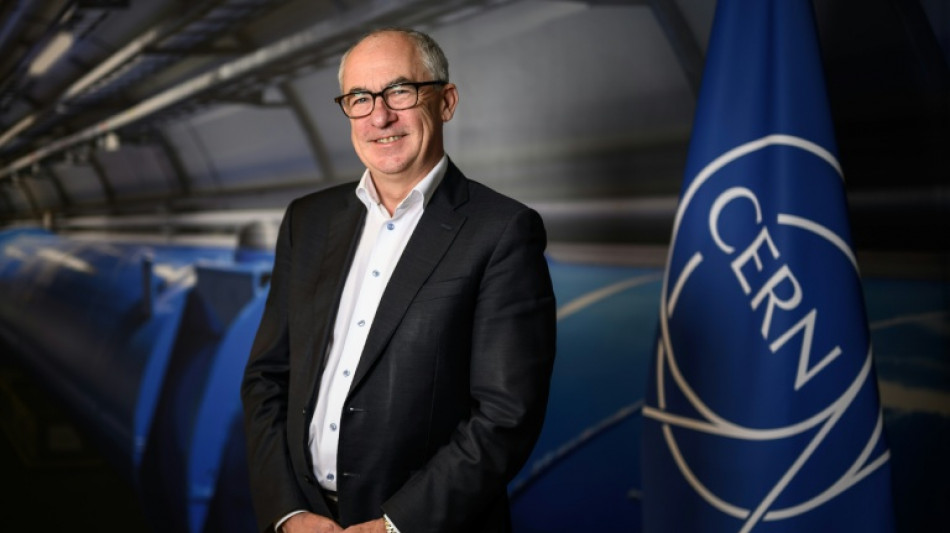
CERN chief upbeat on funding for new particle collider / Photo: © AFP

Mark Thomson, the new head of Europe's physics laboratory CERN, voiced confidence Tuesday about raising the billions of dollars needed to build by far the world's biggest particle accelerator.

Change text size:

CERN, the European Organization for Nuclear Research, seeks to unravel what the universe is made of and how it works.

The planned Future Circular Collider (FCC) would be a proton-smashing ring with a circumference of 91 kilometres and an average depth of 200 metres.

Scientists believe that ordinary matter -- such as stars, gases, dust, planets and everything on them -- accounts for just five percent of the universe.

The FCC will try to reveal what makes up the other 95 percent, the so-called dark matter and dark energy that scientists have yet to observe directly.

"That project would start operation in the second half of the 2040s," Thomson told reporters.

The British particle physicist took over as CERN's director-general on January 1.

He said the gigantic collider would cost around $19.5 billion.

"About half of that comes out of the existing ongoing budget, and we have to find the resources for the other half," he said.

"I'm very optimistic personally, but it's not going to be straightforward."

In December, in a first for the laboratory, private donors pledged $1 billion towards the construction of the FCC.

"They're not expecting anything in return. This is really for the good of science," said Thomson.

- 'Giant leap forward' -

Based on the outskirts of Geneva, CERN has 25 member states and its council is set to take a decision in 2028 on whether to go ahead with the FCC.

For now, CERN's Large Hadron Collider (LHC) is currently the world's biggest particle accelerator, whizzing particles into each other at phenomenal speeds.

The 27-kilometre proton-smashing ring, running about 100 metres below France and Switzerland, has, among other things, been used to prove the existence of the Higgs boson.

Dubbed "the God particle", its discovery in 2012 broadened science's understanding of how particles acquire mass and earned physicists Peter Higgs and Francois Englert the 2013 Nobel Prize for Physics.

The LHC is expected to have fully run its course by around 2040.

It is set to resume operations in February after a winter break, before shutting down again in June.

It will then undergo upgrades, including more powerful focusing magnets and new optics, becoming the High Luminosity LHC (HL-LHC), aimed at conducting more detailed studies thanks to an increased number of collisions.

"This is technology we just didn't have when we designed the LHC," said Thomson.

"We're going to have a brighter machine, so we get much, much more data, and every bit of data we get, we have a clearer image of what's going on.

"This is really an opportunity for discovery. And I'm not sure what we will discover.

"Sometimes you make small steps in science. This is not a small step. This is a giant, giant leap forward."

F.Lim--TNT

Featured

Carney touts Canada 'pivot' away from US as Trump levels new threat

Canadian Prime Minister Mark Carney said Tuesday that reducing economic ties with the United States would come at a cost but the benefits were clear, as President Donald Trump threatened new penalties targeting Canada.

Nearly 1,100 flights cancelled after UK air traffic control glitch

Almost 1,100 flights to and from UK airports were cancelled Tuesday due to what the country's air traffic control service called a technical issue, in the latest glitch to spark travel chaos.

Carney touts Canada 'pivot' away from US as tariffs rise

Canadian Prime Minister Mark Carney on Tuesday said reducing economic ties with the United States would come at a cost but the long-term benefits were clear, as retaliatory tariffs on US products took effect.

The "Everlasting Battery" Inside Your Joints:UConn Professor's Self-Powered Healing Material just Got Acquired

A material that turns your own movement into medicine has just landed a corporate home. PetVivo Holdings (OTCQX: PETV), a veterinary biotech and biomedical device company focused on treating osteoarthritis in dogs and horses, has acquired PiezoBioMembrane (PBM) — a startup built around a biodegradable implant that generates electricity from the everyday force of a joint in motion, and uses that charge to help regrow cartilage from the inside out. The material is the invention of Thanh Nguyen, a professor of mechanical engineering in UConn's College of Engineering, who founded PBM in 2021 to advance new implementation methods for his work with piezoelectric materials — substances that convert mechanical force into electrical energy. These materials are typically ceramics: hard, brittle, and poorly suited for medical use. But Nguyen's lab developed new forms that are so , flexible, and biodegradable, breaking down naturally within the body over time. wound healing, The materials have already shown strong potential across a range of medical applications, including tissue regeneration, implanted force sensors, and targeted drug delivery in tumor treatment. How It Works biodegradable ultrasound for In the case of arthritis, Nguyen explains, the piezoelectric materials function as an off-the-shelf product that can be implanted or injected directly into the ailing joint — with no drugs, chemicals, or cells required. The everyday force exerted on the joint generates a small electrical charge, which helps regrow healthy cartilage, mimicking the body's natural use of electricity to regenerate tissue. "The body can be electrically stimulated to regrow," Nguyen says. PBM's materials "act like a battery — an everlasting battery that works whenever there is a force applied, and vanishes safely inside the body over time." PetVivo's Vision for the Acquisition PetVivo Holdings CEO John Lai expressed enthusiasm for the merger's potential to improve the lives of companion animals globally. "PBM has developed a compelling functional biomaterials platform with the potential to support the development of multiple medical device and therapeutic product lines across both human and animal health markets," Lai said in a press release. "By combining PBM's scientific innovation with PetVivo's product development capabilities, commercialization experience, regulatory expertise, and public company infrastructure, we believe we can accelerate theadvancement of technologies that may serve as the foundation for numerous future products and strategic opportunities." For Nguyen, the deal is a chance to scale technology that could eventually benefit both animals and people. "PetVivo is an animal health company, but they do have a big passion: pushing the technology towards clinical trials for human use," Nguyen says. "That aligned perfectly with my passion for developing technology that has an impact on human life. That is why I am excited about this merger, which facilitates my passion." A Track Record of Innovation Nguyen's research sits at the intersection of medicine, micro/nanotechnology, and biomaterials. His inventions have earned him publications in prominent scientific journals and media coverage from outlets including NPR. Nguyen founded PBM during the COVID-19 pandemic, a er realizing the material he had developed could be used to create an especially effective, biodegradable face mask — one where the mechanical force of breathing generated an electrical charge that provided an extra layer of protection against viruses. PBM is not Nguyen's only venture in the acquisition pipeline. His other startup, Single-Time Microneedles (STM), is also currently undergoing an acquisition process. STM has pioneered stable, efficient vaccine delivery technology in the form of an adhesive patch. shelfNguyen's focus on biodegradable materials has translated into a remarkably diverse range of medical applications. He has received five R01 grants from the National Institutes of Health (NIH) supporting research in cartilage regeneration, bone regeneration, HIV antibody delivery systems, and biodegradable ultrasound technology to boost the effectiveness of chemotherapy for brain cancer. "Whatever we are working on, we want to show that it works very well in vitro and in vivo," Nguyen says. "Then, when we are at the point of commercialization, we set up a startup or license the technology — or maybe team up with an industry partner." Thanh Nguyen is a professor of mechanical engineering in UConn's College of Engineering. (Courtesy of Thanh Nguyen

Change text size: