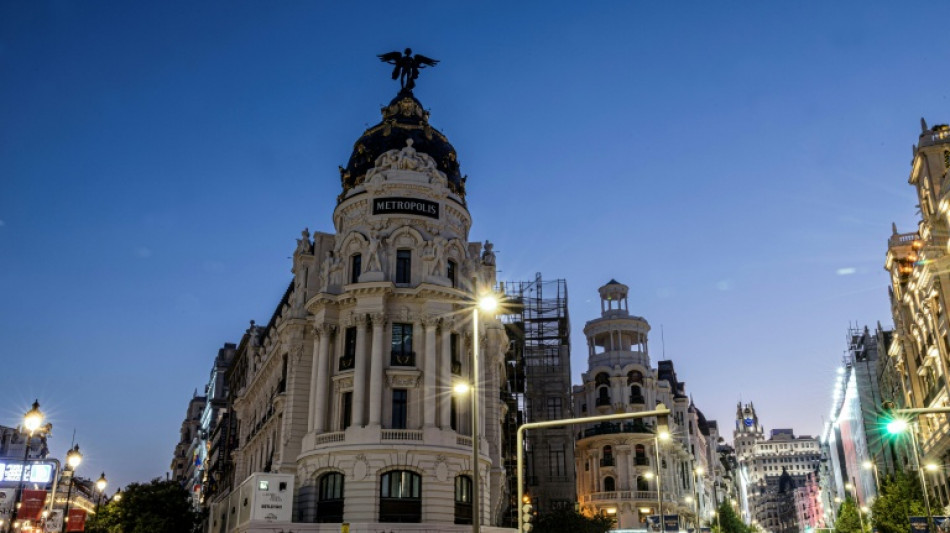
'Oasis of stability': Madrid becomes luxury housing haven / Photo: © AFP
Madrid has emerged as a coveted global luxury housing destination as Latin American and US investors fuel a real estate boom, seduced by competitive prices and high living standards.
The Spanish capital "is on fire", said Edoardo Corda, founder of estate agency Mi Piso en Madrid, which specialises in high-end properties.
Madrid has become "a leading city to invest and live in", and house hunters with deep pockets want "to be a part of this boom", Corda told AFP.
The city has topped for the second year running an annual index by the real estate firm Barnes, considered a reference to measure investor appetite in luxury properties.
"Cosmopolitan, joyful and vibrant," Madrid "has emerged as one of the leading destinations" for the world's "ultra-high net worth individuals", those possessing at least $30 million of wealth, Barnes wrote in its latest report released on Thursday.
"No other European capital offers such easy daily life," with quick access to an international airport, security, "a pleasant climate, efficient public services, first-class health services, quality education and an excellent transport system", Barnes said.
A "large share" of luxury house purchasers are foreign, among whom 60 percent are South American, followed by British, French and US investors.
- 'Richard Gere effect' -
Martha Lucia Pereira, chief executive of luxury real estate agency PresVip, has witnessed the influx of foreign capital at first hand, saying 99 percent of her clients are Latin American.
Pereira said droves of Latin Americans have arrived in the past decade to invest, starting with Venezuelans and Colombians, joined later by Argentines and Mexicans.
Antonio de la Fuente, an expert at real estate consultancy Colliers, said political upheaval back home explained why Madrid has leapfrogged Miami as the number one destination for Latin American wealth.
"Whenever there was a movement with populist tendencies in their countries, people with the highest purchasing power sought to leave their country, fearing for their savings," he said.
An increase in US investment is another standout trend in recent times, which De la Fuente called the "Richard Gere effect".
The Hollywood star moved to Madrid with his Spanish wife Alejandra Silva in 2024 and has lavished praised on the city in interviews.
According to Barnes, purchasers seek "large apartments with beautiful high ceilings, on upper floors", particularly in the select Salamanca district, defined by broad avenues and stately buildings from the 19th and 20th centuries that host luxury stores and restaurants.
Other central neighbourhoods in high demand include Jeronimos, surrounding the UNESCO-listed Paseo del Prado thoroughfare and Retiro park, as well as the emblematic Puerta del Sol square.
- 'Oasis of stability' -
The average price per square metre in the most sought-after blocks lies between 23,000 and 25,000 euros, according to De la Fuente, meaning that a 100-square-metre home typically costs at least 2.3 million euros (around $2.7 million).
Although an eye-watering sum for most Spaniards, who struggle to rent or buy in a housing crisis that is consistently a top concern for the population, the numbers attract luxury capital.
The price per square metre in other European capitals such as Paris or London can exceed 30,000 euros, real estate agents say.
The Spanish capital has benefited from the pro-investment stance of the Madrid region's conservative leader Isabel Diaz Ayuso, who seeks to make the city "the Florida of Europe".
"Madrid is an oasis of social and regulatory stability," said the consultant De la Fuente, even as the leftist government strives to solve the housing crisis with measures targeting the wealthiest.
The government has scrapped the so-called "Golden Visa", which granted residency to non-Europeans who invested at least 500,000 euros in real estate, and proposed a 100-percent tax on all purchases of homes by non-EU citizens who do not live in Spain.
As the minority coalition struggles to pass legislation in parliament, the latter proposal is unlikely to become law -- "fortunately for this country and for Madrid", in De la Fuente's opinion.
T.Bailey--TNT