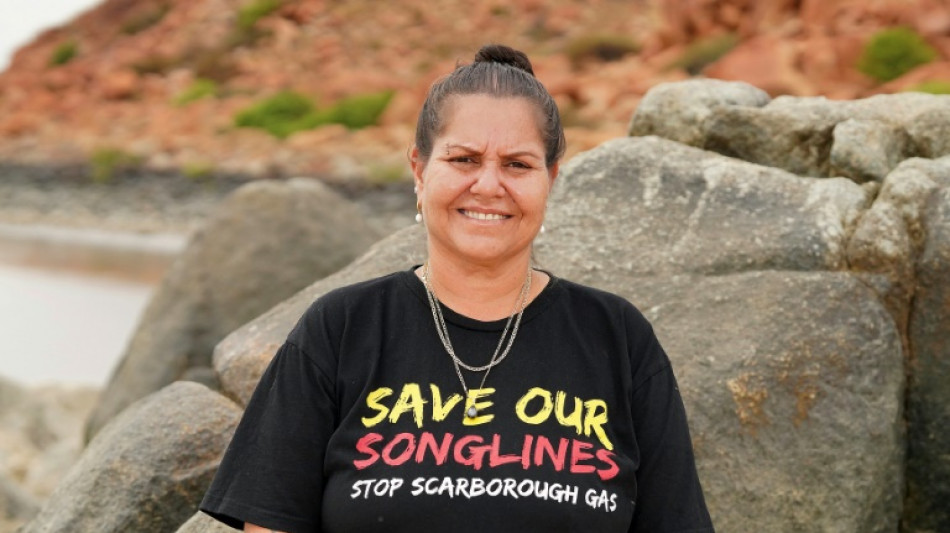
Indigenous Australian activists fight for ancient rock art / Photo: © WOOP WOOP PICTURES/AFP
Two Indigenous Australian activists are fighting to save 40,000-year-old sacred rock art in Western Australia from pollution and plans for a major gas project.
Destruction in 2020 of Aboriginal rock shelters at Juukan Gorge by mining company Rio Tinto shocked the world, sparking condemnation, resignations, inquiries and promised reforms.
Now, First Nations women Raelene Cooper and Josie Alec warn the same could happen "in slow motion" at Murujuga, which lies about 1,300 kilometres north of Perth.
Alec and Cooper hope to garner global support by travelling this week from Australia's remote Pilbara region to Geneva to address the United Nations about their concerns -- particularly if gas giant Woodside's Scarborough project goes ahead.
Cooper told AFP that decay was already visible in the Murujuga rock art, which is sacred to the Indigenous custodians of the land and contains their traditional lore.
Alec said that due to industrial pollution "the rock art will disappear. We will have no rock art to show the world."
Woodside's Aus$16 billion (US$11 billion) Scarborough gas project would see 13 wells drilled off the coast of Western Australia to tap into a huge underwater reserve.
The company predicts that at full capacity, Scarborough will produce eight million tonnes of liquefied natural gas annually -- prompting a backlash from green groups over its carbon emissions potential.
Last month the Australian Conservation Fund launched a legal challenge against the Scarborough project, claiming it would create emissions extensive enough to harm the World Heritage-listed Great Barrier Reef.
Cooper and Alec point out that Murujuga has also been nominated for a World Heritage listing, in part because of the cultural value of its estimated one million petroglyphs, or rock carvings.
Destruction of the rock art, Alec said, "will kill our stories. And it kills a very part of who we are."
"We already visibly see the decay... the patina on the rock art itself flaking away, and the images are starting to wear," Cooper said.
Save Our Songlines, a campaign launched by both women, links the degradation of the art to pollution from industrial production on the resource-rich Burrup Peninsula.
- 'Run out of time' -
Chemicals such as nitrous oxide settle on the art, the campaign says, rendering it vulnerable to degradation when rain falls.
Woodside said in a statement that "peer-reviewed research has not demonstrated any impacts on Burrup rock art from emissions associated with Woodside's operations".
But Save Our Songlines points to a 2021 study from the University of Western Australia, which concluded that "with the currently recorded acidity levels, the rock patina and associated art will degrade and disappear over time".
Woodside dismissed that study as not including "any original research and consequently (it) does not enhance or expand the existing science".
But Alec and Cooper say they can see Murujuga, the land they have sworn to protect and care for, changing before their eyes -- from the rock art to the disappearance of plants and animals.
"There's something critically wrong," Alec said.
"And there's only one explanation for that, and that is the chemicals, the mining, the gas, the oil... they are creating destruction."
The pair hope that speaking to the UN's Expert Mechanism on the Rights of Indigenous Peoples, which provides expertise to the Human Rights Council, will see industry and government in Australia held to account.
They want First Nations custodians to be better consulted about new industry on their land -- noting that women have been sidelined in the approvals process.
They have also called for Murujuga to receive World Heritage listing next year, an acknowledgement that would grant more leverage to argue for the region's protection.
"The time is now, we've already run out of time," Alec said.
A.M.Murray--TNT