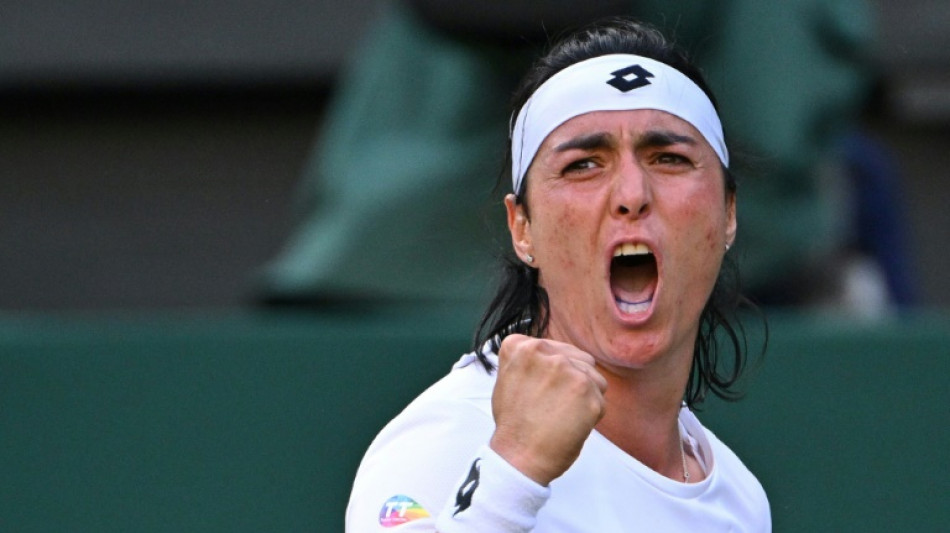
Tunisia's 'Roger Federer': How Ons Jabeur became a tennis star / Photo: © AFP
Fifteen years ago, Ons Jabeur's young tennis sparring partner could see the Tunisian was destined for glory -- even if he suffered a broken arm in the process.
Omar Laabidi remembers being repeatedly beaten by a 12-year-old Jabeur, who will Thursday become the first Arab to play in a Grand Slam semi-final, at Wimbledon.
"We used to call her 'Roger Federer'," Laabidi said.
He was talking at the tennis club where it all began, in the North African country's coastal town of Hammam Sousse.
"One time during a training match she hit a drop shot that I tried so hard to return that I broke my arm," he said.
Jabeur had started by playing on courts belonging to local hotels but she soon joined the Tennis Club Hammam Sousse, which now bears a huge portrait of its most famous graduate.
Coach Nabil Mlika recalls training a talented girl "determined to stand out" against both female and male peers.
It is a determination that has taken her all the way to the world number two spot -- one place behind Poland's Iga Swiatek.
But Mlika, who trained a young Jabeur for 10 years, said there was a moment where she almost quit the sport.
"She had great ball control, to the point where other coaches tried to attract her to handball," said the 55-year-old.
"Ons thought seriously about switching sports -- but decided to stick to tennis."
- 'Queen of the drop shot' -
The 27-year-old Tunisian's fighting spirit has been on show throughout her career.
Despite crashing out in the first round of the French Open in May, she surged back to win the Berlin WTA singles title a few weeks later.
Her appearance in the Wimbledon semis -- against close friend and "barbecue buddy" Tatjana Maria -- comes just two weeks after she was forced to withdraw from the Eastbourne tournament, where she was partnering Serena Williams in the doubles, with a knee injury.
Jabeur, known to many Tunisians as "the minister for happiness", was born in the southern coastal town of Ksar Hellal, one of four siblings.
She moved to the capital, Tunis, at the age of 12 to train at a highly rated state-backed sports club.
She has been married to her physical trainer, and former fencer, Karim Kamoun, since 2015.
The right-hander is known for her stamina and the variety of her play.
"She hates playing at one pace," said Mlika. "She's always trying to create a spectacle by switching up the game with shots that surprise her opponents, especially with drop shots.
"She's really the queen of the drop shot."
- 'An example of hope' -
Jabeur made a splash on the global scene in 2011, winning the girls' singles at the French Open at the age of 16.
Laabidi also moved to Tunis around the same time as the adolescent Jabeur and joined the same academy, where they continued sparring.
"She was always fun and quickly got to know strangers," he said.
"But she was always provocative and competitively debating on all subjects."
Those who knew her as a teenager say she has changed little despite her growing fame.
"She still runs around gathering up all the balls during training, which she's been doing since she started playing," said Mlika.
Unsurprisingly, as her fame has spiralled membership levels have skyrocketed at her home club, from 320 in 2018 to more than 700 today.
For Yousra Koubaa, the mother of eight-year-old student Yasmine, Jabeur is "an example of hope, one we're always showing to our children".
Mlika says he uses photos of a young Jabeur to inspire his students today.
"She was a spark of enthusiasm, always moving and wanting to show that she was the best," he said.
"She always put me in a difficult position because I had to balance between taking the training up a level, or waiting for her peers to catch up with her level and her pace."
A.Wood--TNT