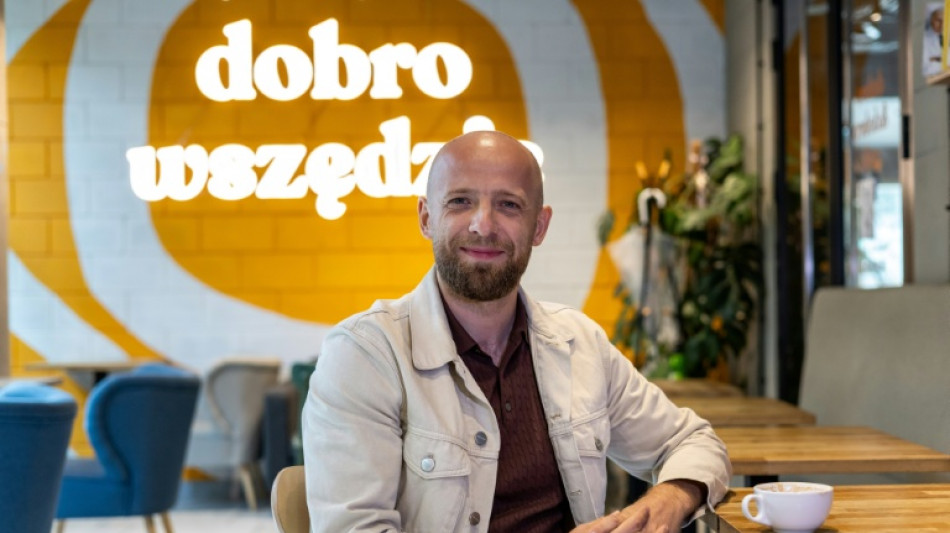
Poland cools on Ukrainians despite their economic success / Photo: © AFP
Warsaw's central business district is booming alongside Poland's economy, but those teaching yoga and taking coffee orders in bustling premises under glass and steel office towers are often Ukrainian.
Economists and entrepreneurs agree: Refugees from the Russian invasion of Ukraine have proven a huge boost to Poland's economy -- but now their contribution may be at risk.
A law governing Ukrainians' protected status expires at the end of the month and President Karol Nawrocki has yet to sign off on a bill to renew it, threatening a million people with legal limbo.
At the ElFlex yoga and fitness centre, the young women stretching and balancing in complicated poses under the coloured lights maintain their poise, but concern is rippling through the community.
Gym owner Lisa Kolesnikova, 28, grew up in the Ukrainian city Zaporizhzhia, but she built her business in Poland.
She now owns two yoga studios and has franchised two more. Two years ago most of the customers and all of her staff were from Ukraine or Belarus. Now, that's changing.
"Polish clients come to us, and the girls now conduct training in Polish. They like us and, in fact, I have never encountered any negativity," she told AFP.
- Economic success story -
For Kolesnikova, who employs eight people, the idea that Poland might call into question the residency rights of hundreds of thousands of hard-working Ukrainians is absurd -- but not for nationalist politicians like Nawrocki.
In March 2022, in the immediate aftermath of Russia's full-scale invasion, Poland's parliament passed a law granting protected status to Ukrainians. It has since been amended and extended.
Last month the newly-elected nationalist president refused to approve the latest version, demanding it be changed to prevent Ukrainians from receiving Poland's 800-zloty (190-euro) per child monthly benefit.
A new draft is ready, but Nawrocki is still keeping the Ukrainians and their employers guessing. If he doesn't sign off by September 30, Ukrainians will see their legal residency expire.
On Thursday the president said he was still studying the amended bill. "If it hasn't been changed, I'll reject it again," he said, in an interview with the new site Fakt.
At the parliament in Warsaw, lawmaker Michal Wawer of the right-wing Confederation party, which sits in the opposition in parliament, told AFP his movement hopes the president will indeed stop the bill.
"I don't think it would be a social catastrophe," he said. "Each of these Ukrainian citizens will be entitled to apply for legal residence as an immigrant or as a refugee.
"They will be just treated in the way that every other foreigner in Poland is treated."
Entrepreneur Oleg Yarovi, a 37-year-old Ukrainian who owns a chain of coffee shops, does not agree.
"As someone who understands how much the Ukrainian community spends investing in the Polish market, these are very illogical steps being taken. It is simply something political, populist," he said.
"The Ukrainians who came here invested millions in Poland. We are currently selling one of our premises and every day if I take seven calls from people who are interested, six are Ukrainians."
- 'Real concern' -
In June, consultants Deloitte estimated in a report to the UN refugee agency that the work of Ukrainian refugees now accounts for 2.7 percent of Poland's GDP.
Ukrainians are more likely to be employed than Poles, and native workers are moving into higher-paid roles.
Since Russia's 2022 invasion, Poland's Ukrainian population has topped one million. Yet Poland's total population is shrinking and unemployment in July was just 3.1 percent, the fourth lowest in the European Union.
"They integrated into the labour market in Poland very quickly. They managed, found work," said Nadia Winiarska, an employment expert from the Lewiatan Confederation business association.
"It is not true that Ukrainian citizens in Poland primarily rely on welfare," she told AFP, complaining that the political debate in Poland does not take into account the scale of Ukrainians' input.
But anti-refugee politicians say they are speaking up for ordinary Polish opinion.
"I don't agree that they are well integrated," Wawer told AFP. "There is a problem of building entire companies, an entire society that does not require its citizens to use Polish language or to accept Polish cultural norms."
Some business leaders accuse Russia's online propaganda networks of boosting anti-refugee sentiment.
"I hope the Polish people won't buy it," said Andrzej Korkus, CEO of the EWL Group, a major employment agency. Referring to the law, he said "we're coming to the end of September and still it's not signed. There's real concern."
A.M.James--TNT