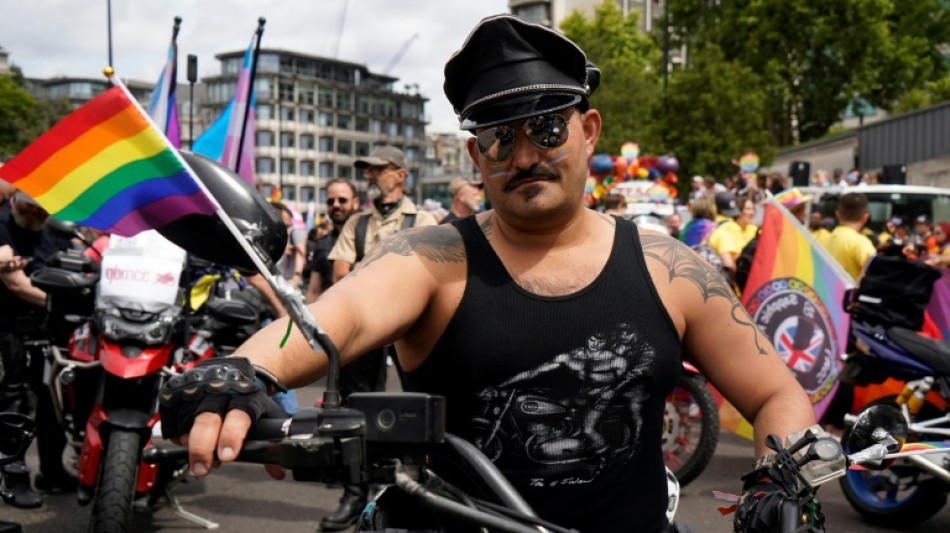
London marks 50 years of Pride / Photo: © AFP
London on Saturday celebrated the 50th anniversary of its first Pride parade, marking half a century of progress in the fight for equality and tolerance but with warnings that more still needs to be done.
Several hundred people took part in the first march on July 1, 1972, just five years after homosexuality was decriminalised in the UK.
Fifty years on, more than 600 LGBTQ+ groups danced, sang and rode floats along a similar route to the original protest, in the first Pride since the coronavirus pandemic, watched by huge cheering crowds.
London Mayor Sadiq Khan told reporters the event, which organisers said was the "biggest and most inclusive" in its history, was a celebration of community, unity and progress.
But he said it was also a reminder of the need to "campaign and never be complacent" and the need for "an open, inclusive, accepting world".
"We saw this time last week an attack in Oslo just hours before that parade, where two people lost their lives and more than 20 were injured," he said.
"So, we've got to be conscious of the fact that there's still a danger to this community of discrimination, bias and violence."
Khan's predecessor as mayor, Prime Minister Boris Johnson, said it gave him "the greatest pride to lead a country where you can love whomever you choose to love and where you can be free to be whoever you want to be".
The 50th anniversary was a "milestone", he said, paying tribute to the bravery of those who did it first.
Peter Tatchell, a veteran gay rights campaigner who took part in the 1972 march, said some from the original event have boycotted the modern-day sponsored version as "depoliticised and commercialised".
- Campaigning -
In 1972, "Gay Pride", as it was then known, was a demand for visibility and equality against a backdrop of lingering prejudice, discrimination and fear among many gay men and women about coming out.
In the 1980s, Pride became a focal point for campaigning against legislation by prime minister Margaret Thatcher's Conservative government against the "promotion of homosexuality" in schools.
It also helped to raise awareness and support for people with HIV/Aids.
Now, with the rainbow flag of inclusion and tolerance spread ever more widely over the spectrum of human sexuality and gender, Pride in London is more celebration than protest.
Tatchell said that despite victories such as same-sex marriage, "we are still fighting to ban LGBT+ conversion practices which seek to change a person's sexual orientation or gender identity".
"We're still fighting to secure trans people's right to change their legal documents with ease by a simple statutory declaration. And of course, we are standing in solidarity with a global LGBT+ movement," he told AFP.
Julian Hows, now 67, was at the first march. He said "progress is always incremental", criticising curbs on LGBTQ+ rights around the world.
"We have to be vigilant. The price of liberation and to keeping people's human rights intact is vigilance," he added.
- Visibility -
Padraigin Ni Raghillig, president of Dykes on Bikes London, a motorcycle club for gay women, said the event retained part of its original campaigning spirit.
"It's still important, I think, to at least once a year to be out and about, and to say 'we're here, we're queer, and we're not going shopping'," said Ni Raghillig, astride a Harley Davidson.
Among those marching was a contingent from Ukraine, who criticised homophobia in Russia.
This year's Pride saw warnings for people with monkeypox symptoms to stay away, after public health officials said many cases in the UK were reported among gay and bisexual men.
LGBTQ+ campaign group Stonewall said everyone had a part to play to stop the spread of monkeypox, which is passed through close contact regardless of sexual orientation.
T.Hancock--TNT