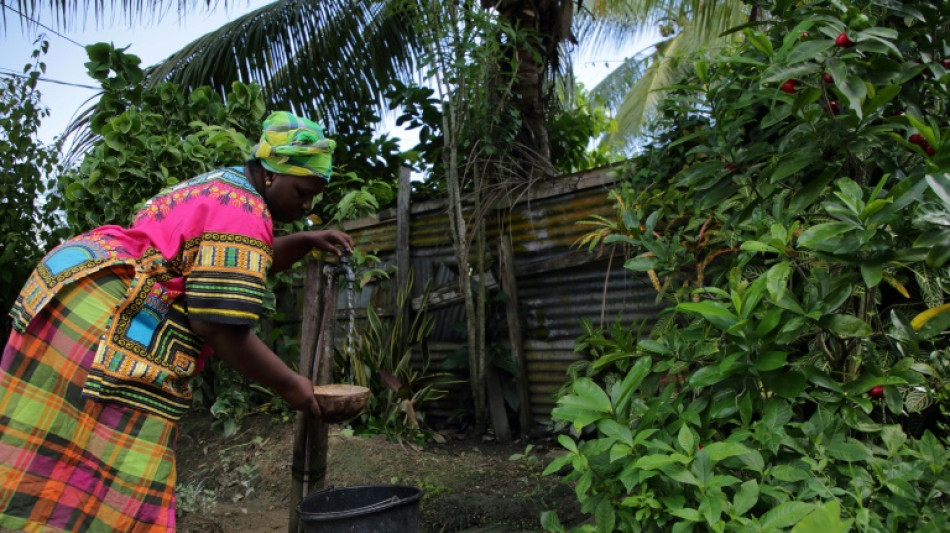
Dozens of Suriname villages await aid following unprecedented floods / Photo: © AFP
A boat meanders between the sheet metal roofs of houses in Baling Sula, one of numerous villages in central Suriname hit by devastating flooding.
Heavy rainfall since January led rivers to burst their banks in the small South American nation, forcing the state energy firm, Staatsolie Power Company Suriname, to open scuppers at a hydroelectric power station in early March to avoid an even greater catastrophe.
That, in turn, resulted in the flooding of several villages in Brokopondo district, around 100 kilometers south of the capital Paramaribo.
The waters have yet to recede.
More than 3,000 households in seven districts have been affected, but also businesses, farms and schools.
On a recent day, Elsy Poeketie, 48, who fled to the capital to stay with her daughter, showed her granddaughter pictures and videos of her hotel, the Bonanza River holiday resort that until three months ago had a nice sandy beach, cabins and an outdoor recreation hall.
"Now, all flooded, at some places two to three meters high. No beach, just water everywhere you look," she sighed.
"It really hurts and stresses me. Where will I find the money to renovate?"
In the flooded village of Asigron, Patricia Menig has put up her brother, while their sister is living with an aunt after both their houses were submerged.
"The water started to rise on April 12 and within a week their house was filled with water, four to five meters high," she told AFP by telephone.
And Menig lost all the crops at her 1.5 hectare agricultural plot, leaving her without income.
"Many of us depend on government aid now," she said.
- Waiting for the dry season -
Last month, Suriname President Chan Santokhi declared seven of the country's 10 districts to be disaster areas and asked international partners for help.
China donated $50,000 on Tuesday and the Netherlands, Suriname's former colonial power, pledged 200,000 euros through UNICEF.
Nearby Venezuela, which has been ravaged by years of economic crisis, nonetheless delivered 40,000 tons of goods, including food and medicines, and distribution will begin this week.
Dry season isn't expected until August and authorities proposed evacuating the area. But many residents chose to remain, with the government providing short-term shelter for them.
Remote villages in the interior have been cut off from road transport and are only reachable by boat or helicopter, making distribution of relief goods extra challenging, according to Colonel Jerry Slijngard from the National Disaster Management Coordination Center (NCCR).
A flight from Paramaribo to Kwamalasamutu, an Indigenous village near the Brazilian border, costs roughly $3,900.
"Per flight, I can only bring 40 food parcels and there are 400 households," said Slijngard.
- 'I need money, not food' -
Some former villagers now living in the capital set up an educational project to help children that cannot make it to school, with funding from a Canadian mining firm digging for gold in the area.
The project produces online videos in Dutch and the Aucan and Saramaccan Indigenous languages.
They also provide USB sticks for those without internet access.
The flooding has created other problems, not least a mosquito infestation.
And along the border with French Guiana, Indigenous Wayana villages that have not been flooded still have lost 60 percent of crops, after heavy rainfall has soaked the ground, causing vegetables to rot, said Jupta Itoewaki from the Wayana Mulokot Kawemhakan foundation, an advocacy group.
Some residents of Brokopondo complain that they are not receiving the help they need.
"I don't need food parcels, my machines can't eat. I need money," said furniture maker Amania Nelthan.
Now he sees no other solution than to move.
"Climate change is a fact. Rains and floods will come. Renovating after the floods is not an option. I need to move to higher ground."
I.Paterson--TNT