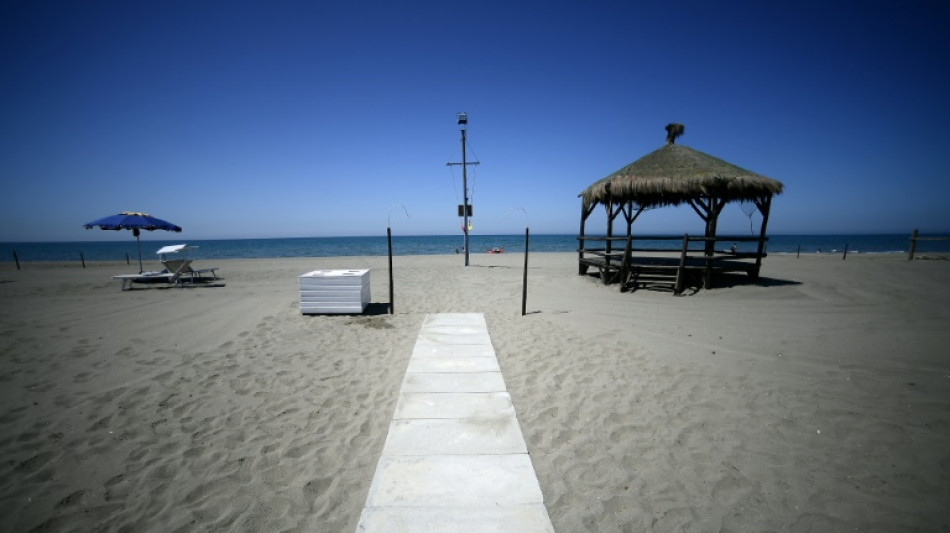
Open season: Italy to allow public tenders to manage beaches / Photo: © AFP
Italy has some spectacular beaches but the majority are private, run in an opaque and sometimes shady manner that the government has finally decided to bring into the light.
Up and down Italy's 7,500-kilometre (4,660-mile) coastline, rows of parasols and matching sunbeds fill the sand, with only a few so-called "free beaches" dotted between them.
They provide comfort and shade from the blazing heat, but are also money-making operations, with a set of two loungers and a parasol costing up to 100 euros ($108) a day at peak periods.
Yet the concessions for the beaches have since 1992 been automatically renewed, with the result that they often pay a pittance and are subject to very little oversight -- opening the door to tax fraud, mismanagement and even criminal elements.
Following years of pressure from the European Union, Prime Minister Mario Draghi's government has finally agreed to bring in a public tender system, to take effect from 2024.
Everyone who owns a concession will have to reapply, but details of how to compensate the losers for past investments in parasols, shower units and restaurants are still being ironed out.
Maurizio Rustignoli, head of the Fiba-Confesercenti, a trade union that represents beach managers, says the uncertainty is "unacceptable".
In Fregene, a popular beach resort north of Rome, Fabio Di Vilio is the third generation of his family to run the La Scialuppa restaurant and resort.
"I think it's fair if it's done seriously," he said of the reform, as he prepared the tropical-style straw parasols for the start of the season last month.
He noted the need "to ensure -- if we were to go to auction -- that there were no irregularities".
But the 38-year-old is frustrated at the lack of thought for concession-holders like him.
"You have to give security to those who have a whole history behind them, it's not only an economic investment, it's also a sentimental question," he told AFP.
- 'Not always legal' -
Although the idea of paying to sit by the sea is an unwelcome surprise for many tourists, most Italians are used to the idea, as long as the facilities and the beach are kept clean.
"It would certainly be a good thing if there were more free beaches, provided they do not become, as we often see, a dump," noted Luca Siciliano, 71, sunbathing on the Fregene beach.
He said it was a "good thing" to introduce more competition into the private establishments.
"Because as we know, and I'm sorry to say, behind all this sometimes there are things that are not always legal," he said.
As often occurs in Italy, the mafia have got in on the act.
Last month, the Italian agency that manages assets seized from organised crime groups launched a public call for tenders for a concession in Calabria, home of the 'Ndrangheta.
And there is also the matter of undeclared revenues. Despite their number -- there were just over 12,000 concessions in May 2021, according to official figures -- the state only takes in 100 million euros a year from such establishments.
Beaches are managed by local authorities, and there are vast regional differences.
In 2020, 59 concessions in Arzachena, on Sardinia's exclusive Costa Smeralda, brought in just 19,000 euros -- an average of 322 euros paid by each per year, according to daily Il Fatto Quotidiano.
The government has already moved to regularise the system by introducing a minimum annual payment of 2,500 euros.
Even with this, many beach concessions are big business.
According to Il Fatto, almost 6,000 concessions monitored by the finance ministry declared average revenues of 180,000 euros a year -- and two thirds failed to declare the full amount.
N.Taylor--TNT