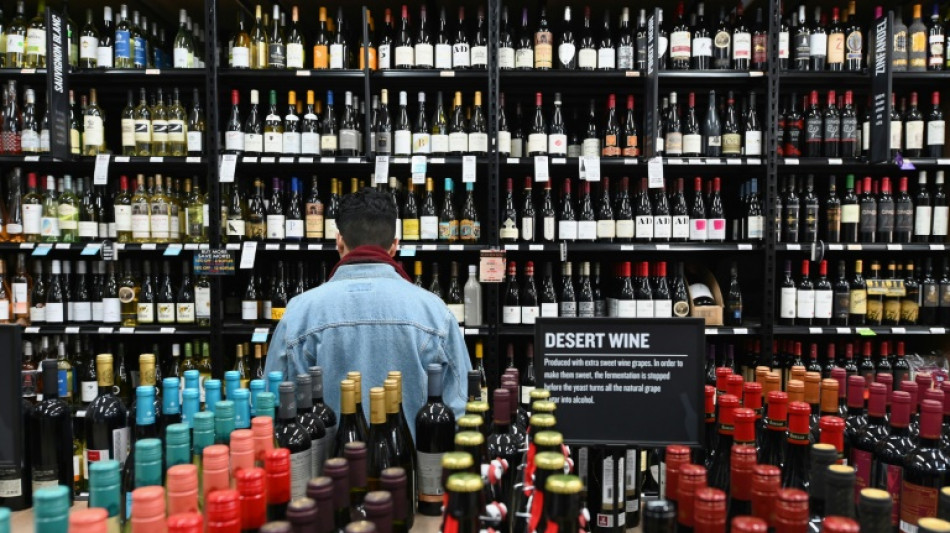
US wine merchants urge exclusions from blanket tariffs / Photo: © AFP/File
As President-elect Donald Trump vows sweeping tariffs on even America's close partners once in office, US wine merchants and restaurateurs are watching with trepidation -- and pushing for exclusions they say will protect small businesses.
"A lot of our concern is that he could flip the switch on EU tariffs. They were suspended, but not eliminated," said chef DeWayne Schaaf, owner of Celebrations Restaurant in Missouri.
On the campaign trail, Trump threatened blanket tariffs of at least 10 percent on all imports, but the shadow of even higher levies from US-Europe disputes during his first term hangs over businesses.
Either scenario would likely thin their profits and force them to raise prices.
In 2019, Trump imposed a 25 percent tariff on popular European food, drinks and other products as Washington and Brussels clashed over European Union subsidies to aircraft maker Airbus.
"We were absolutely shocked," US Wine Trade Alliance president Ben Aneff told AFP.
The tariffs were suspended after President Joe Biden and the EU in 2021 reached a five-year truce.
EU Ambassador to the US Jovita Neliupsiene told reporters this month that she did not see interest from the bloc in threatening this truce, and that its future is very much in the US's hands.
Now, US wine traders and restaurant owners are waiting with bated breath for Trump's new plans.
"We hope that there would be exclusions for products that are especially important to American small businesses," Aneff said.
- 'Crippling' -
Businesses say a 10 percent universal tariff could be absorbed by industries initially, but would eventually increase consumer prices and weigh heavily on smaller establishments, including many restaurants.
If across-the-board tariffs on imports were imposed over a long period, Schaaf anticipates having to cut staff hours, pull back on wine offerings, or reduce business hours.
Should Washington reintroduce 25 percent levies on European food and wines, the situation would be "crippling to many, myself included," added the chef, who employs two dozen staff.
Noah Bush, proprietor of GB Provisions in Oklahoma, told AFP: "Eventually, in order to stay open, those tariffs are going to have to move on to the guests."
For now, he said he would stock up on European wines.
Schaaf said one of his business partners bought 10 containers of wine in anticipation of Trump's possible tariffs -- hoping to get them to US shores before new levies hit.
"Wine and alcohol are big, big moneymakers in the restaurant business," Bush said.
Due to 2019 tariffs, he lost some 10 percent in European wine sales and reduced staff hours to sustain operations.
Schaaf said restaurants like his had no involvement in the trade dispute that triggered duties -- "yet we were the ones who bore the brunt."
- 'Ineffective' -
On the campaign trail, Trump took aim at US-EU trade imbalances, particularly in autos and agriculture.
"They don't take our cars. They don't take our farm products. They sell millions and millions of cars in the United States," he said, warning that the bloc would "have to pay a big price."
Analysts expect the eurozone would be hit hard if Trump followed through on sweeping tariff hikes.
Aneff, who is also managing partner of retailer Tribeca Wine Merchants, argues that targeting imported wine would be an "incredibly ineffective way" to remedy trade with Europe.
He said tariffs on wine imports do more harm to US firms, impacting profits along the import and distribution supply chains.
And there is "zero possibility that producers in Europe would offset tariffs" by lowering prices, he added.
Dartmouth College economics professor Douglas Irwin said US president Richard Nixon imposed a 10 percent across-the-board tariff in the 1970s, but it caused little disruption as Japan and Europe were willing to negotiate and did not retaliate.
This may not be the case for Trump, he added. Based on precedent, other countries could strike back, sparking a trade war.
S.Arnold--TNT