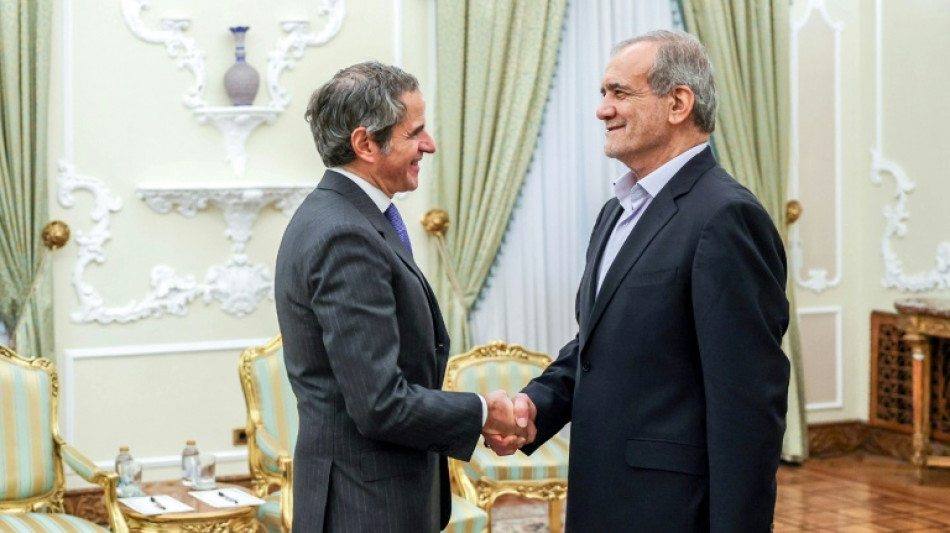
European powers, US seek to censure Iran at UN nuclear watchdog board / Photo: © Iranian Presidency/AFP/File
European powers and the United States are moving ahead with a plan to censure Iran for its poor cooperation with the UN nuclear watchdog at this week's board meeting, despite an offer by Tehran to cap its highly enriched uranium stock, diplomats told AFP.
Tensions between Iran and Western powers have repeatedly flared since a 2015 deal curbing Tehran's nuclear programme in exchange for sanctions relief fell apart.
In recent years, Tehran has decreased its cooperation with the International Atomic Energy Agency (IAEA) by ramping up its nuclear activities, deactivating surveillance devices to monitor the nuclear programme and barring UN inspectors.
A plan by Britain, France, Germany and the United States to submit a new resolution against Iran comes as concerns over the rapid expansion of its nuclear programme heightened fears that Tehran might be seeking to develop a nuclear weapon.
According to the IAEA, Iran is the only non-nuclear weapon state to enrich uranium to 60 percent, a short step from the 90 percent level needed for atomic weapons.
Iran has always denied seeking a nuclear weapon.
A confidential agency report seen by AFP on Tuesday showed that Tehran has further increased its stock of highly enriched uranium in recent months.
Iran's total stockpile of enriched uranium also grew to an estimated 6,604.4 kilogrammes as of October 26.
However, Iran pledged to halt the expansion of its highly enriched uranium stock during recent talks with the IAEA, and has since implemented preparatory steps to achieve that, the report added.
- 'Comprehensive report' -
Following the report, a senior diplomat voiced "scepticism" about Iran's last-minute offer to freeze its sensitive stockpile, saying it was "pretty disingenuous" as it did not require much effort and could be reversed.
Another senior diplomat said "based on past experience" the recent offer by Iran will probably "not stand" anymore once a resolution is tabled.
With the planned censure, diplomats aim to raise diplomatic pressure on Iran to come back into compliance and address the IAEA's long-standing concerns.
A similar resolution was passed by the agency board in June.
According to a version of the censure motion seen by AFP, Western powers this time ask for a "comprehensive report" to be issued by IAEA head Rafael Grossi.
The report would seek to shed more light on Iran's nuclear activities, including "a full account" of Tehran's cooperation with the agency on uranium traces found at undeclared sites.
The planned resolution comes after Grossi travelled to Tehran last week for talks with President Masoud Pezeshkian and other high-ranking officials.
While Grossi's visit marked "a positive step toward establishing a better relationship" with Iran's new government, it nonetheless was "too little and too late to stave off a censure from the board", Kelsey Davenport, an expert with the Arms Control Association, told AFP.
For months, Western powers have been demanding tangible steps from Iran to improve cooperation.
Nonetheless, Tehran has ramped up its nuclear activities, which have "no credible civilian purpose", said US State Department spokesman Matthew Miller on Tuesday, adding that Iran must be "held accountable".
- Trump's return -
Earlier this month, Iran expressed hope that talks on its nuclear programme would be conducted "away from political pressure and considerations", but warned it would retaliate if a resolution is adopted.
Grossi's visit was seen as one of the last chances for diplomacy before Donald Trump returns as US president in January.
During his first term between 2017 and 2021, Trump imposed a "maximum pressure" policy against Iran.
This included Washington tearing up a deal on Iran's nuclear programme that had been reached under his predecessor, Barack Obama in 2015.
The landmark deal struck with the United States, China, Russia, France, Germany and Britain provided Iran sanctions relief in exchange for curbs on its atomic programme.
Efforts to revive the deal have so far failed.
V.Allen--TNT