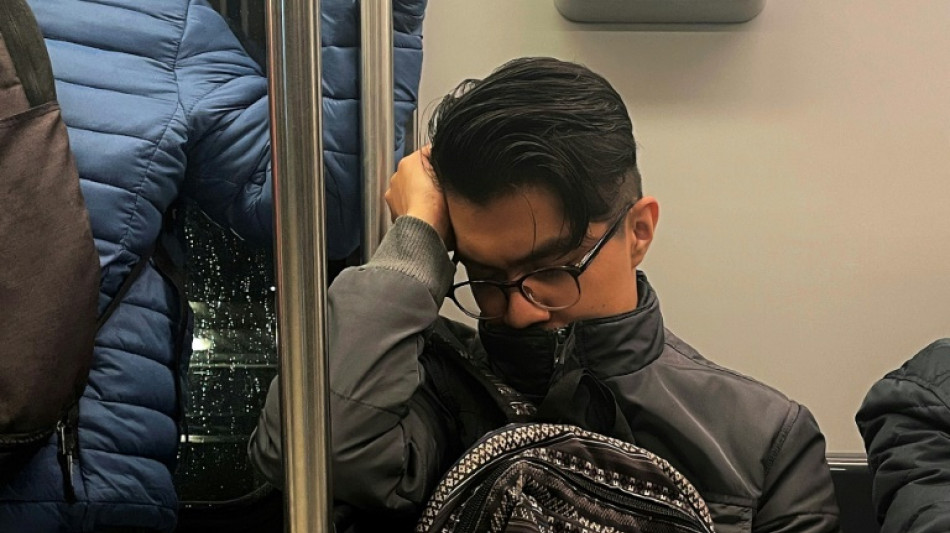
Mexico City youth grapple with growing housing crisis / Photo: © AFP
Political science student Saul Lara awakes around 4:00 am to begin his long journey -- over two hours by motorcycle taxi and crowded metro -- from the outskirts of Mexico City to school.
The tiring commute illustrates the hardships brought by a crippling housing crisis in the Mexican capital, which has particularly impacted young people.
As well as studying, 20-year-old Lara works 30 hours a week in a pharmacy for a monthly salary of just 7,600 pesos, equivalent to around $370.
"Due to poor sleep, waking up early, and not getting enough rest, I started noticing my hair falling out in the shower," he said.
Lara tried to find somewhere to live closer to his school, the National Autonomous University of Mexico.
"But the cost of rent would be my entire salary," he says.
It is far from being an isolated case in Mexico City and its sprawling metropolitan area, home to 20 million people.
The capital's new mayor Clara Brugada has vowed to address the housing crisis, and promised to open up rental housing to young people with the option to buy.
But the challenge is enormous.
The capital faces a "serious situation" that "forces 100,000 people to leave each year because they cannot afford housing," says Federico Taboada, head of the city's urban planning institute.
"Mexico City has a shortage of 800,000 homes," says Leopoldo Hirschhorn of the National Chamber of the Housing Development and Promotion Industry.
In addition, house prices in the Mexico City metropolitan area rose 6.6 percent in the first half of the year, according to official figures.
- Rising rents -
In recent decades, officials have considered housing "only as an economic good," leading to an "excessive increase in rents," says Daniela Sanchez, a lawyer specialized in housing.
The average rent for an apartment in the hip central neighborhoods of Roma and Condesa exceeds $1,000 a month, according to the website propiedades.com -- four times more than the average salary in the capital.
"The pandemic, gentrification and touristification" have played a role in the rise in rents, Sanchez says.
Mexico City recently capped rent increases at the level of inflation, and put a limit of 182 days a year on renting accommodation on the Airbnb platform.
Whether it will be enough is an open question.
"We need a subsidized housing market for the less fortunate in addition to the traditional market," says Marcela Heredia of the Mexican Chamber of Construction Industry.
Hirschhorn thinks the problem is also caused by the lower density of the earthquake-prone city compared with some other world capitals.
"Forty percent of Mexico City buildings have one or two floors. We need to build taller buildings to increase the housing supply," he says.
The capital's City Hall wants to be inspired by cities like Paris or New York, building rental properties for people "that the market will never serve," according to Taboada.
This year, authorities began construction of the first 270 social housing units for students, in two central districts that are usually too expensive for people on low incomes.
"In this case, rents will not exceed 30 percent of students' income," Taboada says.
"There will be others in which housing is fully subsidized," he adds.
Given the level of rents, "I'm starting to understand why so many young people resort to shared accommodation," says graphic designer Ale Razo.
A small room in the city center can cost 10,000 pesos (nearly $500), "as if it were Harry Potter's attic," the 28-year-old adds.
For young Mexicans, according to Raxo, the plan for more affordable housing at least offers a "ray of hope."
E.Reid--TNT