Nintendo courts non-gamers in 'about-turn' strategy / Photo: © AFP/File
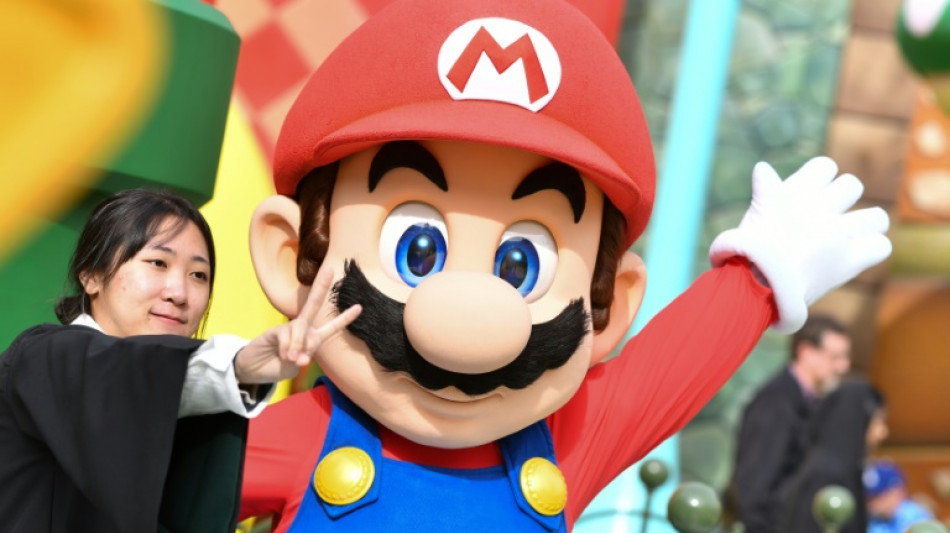
Once confined to rectangular screens, chirpy plumber Mario and pointy-eared Princess Zelda are popping up in theme parks and toy stores as Nintendo goes all out to win non-gamer fans.
It wasn't always this way: for many years, the Japanese company shied away from promoting products or creating media other than video games.
But its push for broader brand recognition over the past decade has reached the point where even Mario creator Shigeru Miyamoto describes Nintendo as something of a "talent agency" for its colourful characters.
A new area based on the "Donkey Kong" games was unveiled at the Universal Studios Japan amusement park on Tuesday, expanding Nintendo's zone there -- already a major tourist draw.
Its doors open on December 11, following last month's launch of the first ever Nintendo museum in a renovated factory in Kyoto.
At the box office, "The Super Mario Bros. Movie" was 2023's second-highest grossing title, with a sequel due in 2026 and a film based on Nintendo's "The Legend of Zelda" also on the way.
"Over the past decade, there has really been an about-turn" in Nintendo's strategy, said Florent Gorges, an expert on the company's history.
- 'Reclusive' -
The gaming giant started life in Japan's traditional former capital of Kyoto in 1889, producing playing cards.
For a long time, it took a "conservative" and "somewhat reclusive" approach to cashing in on its intellectual property, said Gorges.
"There was a certain culture of secrecy, taken to extremes within Nintendo, that made it very squeamish about trying new things," he told AFP.
Hiroshi Yamauchi, company president for over half a century between 1949 and 2002, "hated" the idea of any kind of company mascot, Gorges added.
An early foray outside of the gaming world also proved tricky.
In the 1990s, Nintendo entrusted its Mario IP to a Hollywood production team who made a live-action movie that was roundly panned.
The flop may have contributed to its cautious approach, until disappointing sales of the Nintendo 64 and GameCube consoles in the following decade forced a re-think.
- Wii success -
The two next consoles -- the portable DS with two screens, and the remote-controlled Wii -- were designed to attract non-gamers.
Each sold more than 100 million units and remain among Nintendo's biggest commercial hits.
But when updated versions of these two consoles did not perform so well, the company decided to again venture beyond video games.
Fast-forward to today, and Nintendo is "selling soft toys and sweets, allowing its characters into consumers' everyday lives", said Hideki Yasuda of Toyo Securities.
Nintendo is sometimes compared to Disney, but its business model differs from that of the US giant, which acquires and develops existing franchises, such as Star Wars, said Kensaku Namera of Nomura Securities.
Instead the Japanese company "is focused on what it can do on its own", and so collaborates with external studios and creators for its films and other projects.
Going forward the firm may draw inspiration from the success of Pokemon, which began as a Nintendo game but now spans movies, playing cards, and a merchandise empire controlled by several entities.
That has "really pushed Nintendo to further exploit its franchises", Namera told AFP.
"Many children love Pikachu, and buy soft toys even if they have never played the game," he said, referring to Pokemon's famous electric mouse.
Game and console sales account for over 90 percent of Nintendo's revenues, so exposure to characters such as Mario or friendly dinosaur Yoshi could be "a trigger" to attract more people to consoles, Namera said.
K.M.Thompson--TNT