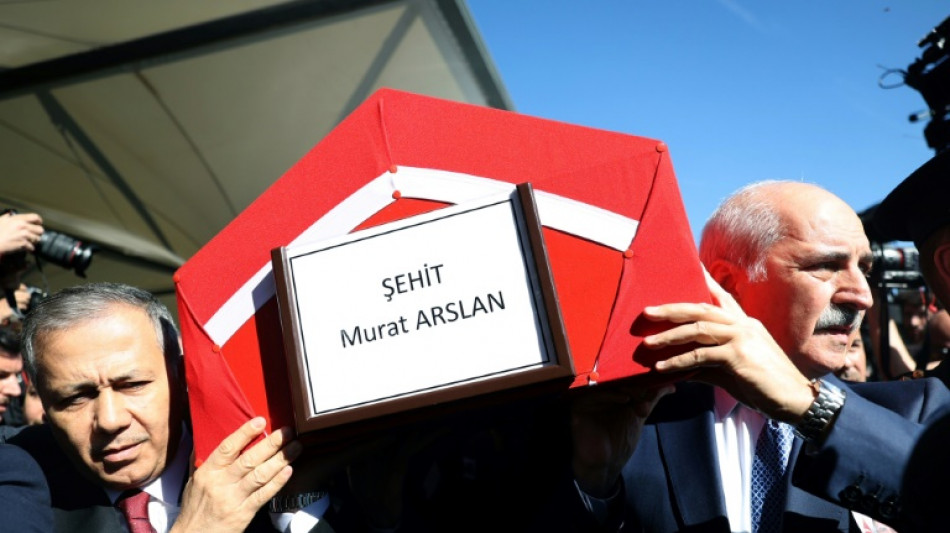
Turkey buries attack victims after striking PKK / Photo: © AFP
The first Ankara attack victims were being buried Thursday, just hours after Turkey struck PKK militants in Iraq and Syria whom it blames for the assault on a defence firm that killed five.
As the dust settled after Wednesday's deadly attack on the state-run Turkish Aerospace Industries (TAI) that also left 22 injured, Turkey pointed the finger at Kurdish militants as "very likely" responsible.
Turkish investigators said both attackers were "PKK terrorists", identifying them as a man called Ali Orek, codename "Rojger", and a woman called Mine Sevjin Alcicek, Interior Minister Ali Yerlikaya wrote on X.
Both appeared in CCTV images posted on X in which they are seen emerging from a taxi then firing assault rifles before entering the building.
The taxi driver, whom they killed, was buried on Thursday at a funeral attended by Yerlikaya and parliamentary speaker Numan Kurtulmus.
Of the 22 people hurt in the attack, eight had been discharged, while the other 14 remained in hospital, Turkey's health ministry said.
- Security stepped up -
Istanbul's two main airports have since stepped up security, the DHA news agency and private NTV channel reported.
Sabiha Gokcen airport, which is located on the Asian side of the city, told passengers to arrive "at least three hours" early to avoid delays due to increased security.
Overnight, the defence ministry said the military struck "47 terrorist targets" in Syria and northern Iraq and pledged the raids would continue.
Kurdish sources in northern Syria said the strikes had killed 12 civilians and wounded 25 others.
President Recep Tayyip Erdogan, who is in Russia attending the BRICS summit of major emerging economy nations, said the attack had "further strengthened Turkey's determination and resolve to eliminate terrorism".
The attack happened amid growing signs of a political thaw between Ankara and Kurdish militants.
Just hours beforehand, PKK leader Abdullah Ocalan -- who has been jailed on a Turkish prison island in solitary confinement since 1999 -- received his first family visit in years.
- Ready to lay down arms? -
His nephew, Omer Ocalan, who is a lawmaker for the main pro-Kurdish DEM party, confirmed the visit on X, and said the family had last seen him "on March 3, 2020".
The only other contact was a brief phone call in March 2021.
His uncle was "in good health" and had sent a message about the ongoing "political developments", saying: "If the conditions allow, I have the necessary theoretical and practical power to shift this process from an arena of conflict and violence to one of law and politics."
According to Abdulkadir Selvi, a columnist for the Hurriyet daily which is close to the government, during the two-hour meeting "Ocalan said he was ready to lay down his arms".
On Tuesday, Devlet Bahceli, head of the far-right MHP, which is fiercely hostile to the PKK and belongs to Erdogan's ruling coalition, sparked shockwaves by inviting Ocalan to parliament to renounce terror and dissolve his movement.
After the attack, DEM -- the third largest party in parliament -- condemned the violence but said it was "noteworthy" it happened "just as Turkish society was talking about a solution and the possibility of dialogue".
- Years of solitude -
Arrested on February 15, 1999 in the Kenyan capital Nairobi following a Hollywood-style operation by Turkish security forces after years on the run, Ocalan was brought to Turkey for trial and sentenced to death.
He escaped the gallows when Turkey abolished capital punishment in 2004 but has spent his remaining years in an isolation cell on Imrali prison island in the Sea of Marmara.
Now 75, the former guerrilla is a hero for many Kurds, who call him "Apo" -- Kurdish for "uncle".
He founded the PKK in 1978 which went on to spearhead a brutal insurgency that has killed tens of thousands in its fight for independence.
He first called for dialogue and a ceasefire in 2012 and again in 2013, before the bloody conflict resumed in 2015 in the mainly-Kurdish southeastern city of Diyarbakir.
Following these clashes, which left hundreds of Kurds dead, the militants retreated to the mountains on the borders of Syria and Iraq.
M.A.Walters--TNT