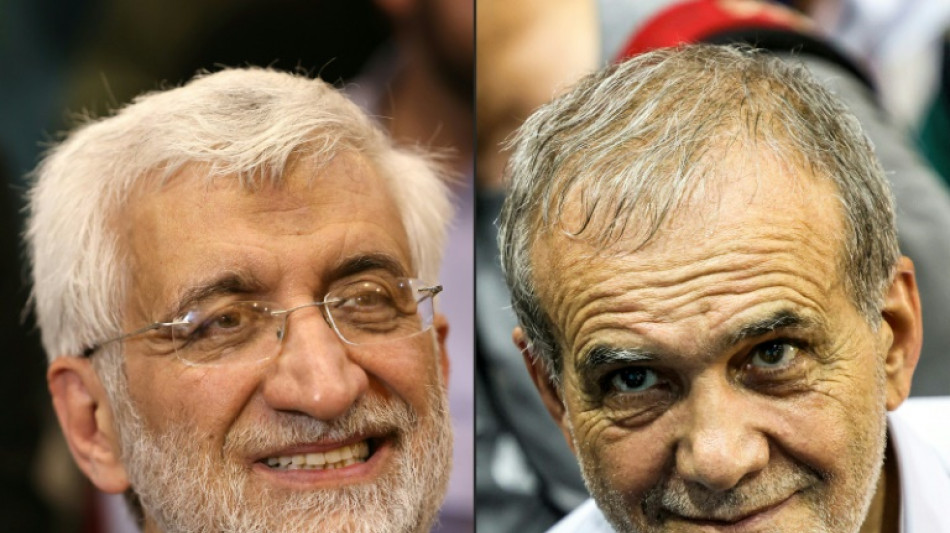
Reformist faces ultraconservative as Iran votes for president / Photo: © AFP/File
Iranians voted on Friday in a presidential runoff election where the choice is between a reformist advocating improved ties with the West and an ultraconservative former nuclear negotiator.
The election, called early after the death of ultraconservative president Ebrahim Raisi in a helicopter crash, follows last week's first round that was marked by a historically low voter turnout.
In a contest between reformist Masoud Pezeshkian and ultraconservative Saeed Jalili, the election unfolds amid heightened regional tensions over the Gaza war, Iran's nuclear dispute with the West and widespread economic discontent exacerbated by sanctions.
Supreme leader Ayatollah Ali Khamenei, who has final say in all state matters in the Islamic republic, cast his ballot when polling opened in the morning.
"I heard that the enthusiasm and interest of the people is more than before, praise to God that it will be like this, and if it is like this, it will be gratifying," he said.
State television showed voters queing outside polling stations in Saveh in central Iran and Kerman in the south, while AFP correspondents said voting venues seemed less busy in Tehran.
In last week's first round, Pezeshkian, who was the only reformist permitted to stand, won the largest number of ballots, around 42 percent, while Jalili came second with 39 percent, according to figures from Iran's elections authority.
Only 40 percent of Iran's 61 million eligible voters cast their ballot -- the lowest turnout in any presidential election since the 1979 Islamic Revolution.
- Low turnout -
On Wednesday, Khamenei called for a higher turnout in the runoff.
"The second round of the presidential election is very important," he said on state television.
He said participation was "not as expected" in the first round but that it was not an act "against the system".
The presidential election was originally scheduled for 2025 but was brought forward by Raisi's death in a helicopter crash in May.
Pezeshkian and Jalili have held two televised debates during which they discussed Iran's economic woes, international relations, the low voter turnout and internet restrictions.
The candidacy of Pezeshkian, a relative unknown until recently, has revived cautious hopes for Iran's reformist wing after years of dominance by the conservative and ultraconservative camps.
Jalili, noted for his uncompromising anti-West position, rallied a substantial base of hardline supporters and received backing from other ultraconservative candidates who dropped out of the race.
During campaigning, the 58-year-old criticised moderates for having signed the 2015 deal which promised Iran sanctions relief in return for curbs on the country's nuclear programme.
Jalili said the accord, which the United States withdrew from in 2018 under then-president Donald Trump, "did not benefit Iran at all".
He said the agreement violated all the Islamic republic's "red lines" by allowing inspections of its nuclear sites.
Pezeshkian called for efforts to salvage the nuclear agreement and lift crippling sanctions on the Iranian economy.
The 69-year-old heart surgeon has called for "constructive relations" with Washington and European countries in order to "get Iran out of its isolation".
A member of parliament representing the northwestern city of Tabriz since 2008, he has earned the support of Iran's reformists, with former presidents Mohammad Khatami and Hassan Rouhani backing his bid.
- 'Fed up' -
Casting his ballot on Friday, Khatami urged Iranians to vote "for the future and good of the country".
During one of their debates, the two rivals voiced dismay over turnout in the first round.
Pezeshkian said people were "fed up with their living conditions... and dissatisfied with the government's management of affairs."
Ali, a 24-year-old university student who asked that only his first name be used, voiced backing for Pezeshkian, saying he would work on "opening the country to the rest of the world".
At a campaign event late Wednesday, 40-year-old Maryam Naroui said she believed Jalili was "the best option for the country's security".
Jalili has held several senior positions in the Islamic republic, including in Khamenei's office in the early 2000s.
He is currently one of Khamenei's representatives in the Supreme National Security Council, Iran's highest security body.
Regardless of the result, Iran's next president will be in charge of applying state policy outlined by the supreme leader, who wields ultimate authority in the country.
R.T.Gilbert--TNT