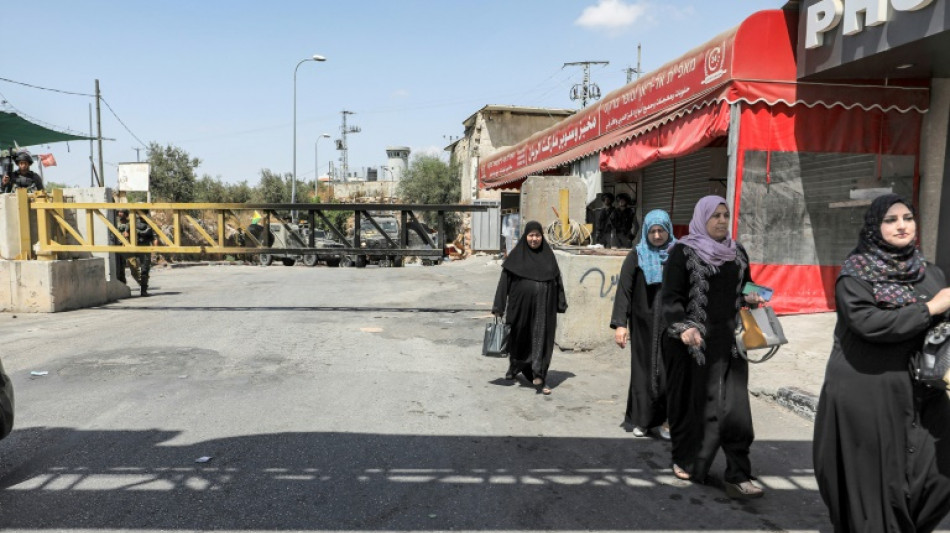
Despite unrest, it's business before politics in West Bank town / Photo: © AFP/File
Violence may rage elsewhere, but it's business before politics in the occupied West Bank town of Nilin where Palestinian merchants do a brisk trade with passing Israelis.
Every day, hundreds of people from Israel and nearby West Bank settlements visit the town to take advantage of low prices on everything from groceries to car parts.
Nilin is no stranger to the realities of occupation -- a number of the town's residents have been killed in past clashes with Israeli forces.
The Jewish state's separation barrier cuts through its western edge, and Israeli settlements, regarded as illegal under international law, dominate the surrounding hilltops.
Yet despite a recent spike in violence elsewhere, in Nilin, about 20 kilometres (12 miles) west of Ramallah, it's business as usual.
"The majority of my clients are Israelis and from nearby Kiryat Sefer," a district of the Modiin Illit settlement, said Hassan Salim, 51, a mechanic for the past 30 years.
"I can say that 80 percent of my clients are Israelis."
With a cigarette hanging from his mouth, he threw his arm around Yossi -- a loyal customer from a nearby settlement, who asked not to be named in full.
"I've known him for 25 years," said Salim.
The Israeli, who wore a yarmulke on his head, confirmed that "I've been coming here for 25 years, because the quality of work is better and it's cheaper.
"During all this time, I've been able to befriend Hassan and his brother Said," he told AFP as four Palestinian mechanics were busy working on his vehicle.
- 475,000 settlers -
Nilin mayor Yousef al-Khawaja said that on an average day, about 1,000 Israelis visit Nilin for commercial reasons, though on Saturdays -- the Jewish day of rest -- this can reach 1,500.
The delicate local balance has been put to the test as a wave of attacks in the Jewish state by Palestinians and Israeli Arabs, alongside deadly raids in response, have killed 14 in Israel, and 25 Palestinians including assailants since late March.
Violent clashes have also rocked east Jerusalem's Al-Aqsa Mosque compound and its environs, wounding more than 250 -- mainly Palestinian demonstrators at the hands of Israeli security forces.
Despite Nilin's generally good relations with Israelis, it still faces the grim reality of occupation.
Israeli forces have recently issued demolition orders for two buildings in the town, much of which sits in the Israeli-controlled Area C where Palestinians often build "illegally" as they find it almost impossible to get permits.
Khawaja adds that much of Nilin's market lies in Area C, beyond his jurisdiction.
Israel captured the West Bank in the Six Day War of 1967 and later started encouraging its citizens to live there, a policy seen as illegal under the fourth Geneva Convention.
Today, around 475,000 settlers live in communities across the West Bank, which often cut off Palestinian towns and villages from each other.
Palestinians argue that the settlements are one of the biggest hurdles to a peace deal giving them their own state.
Israeli Prime Minister Naftali Bennett is the former head of a settler lobbying group, and has unapologetically advocated settlement expansion -- as did his predecessor, veteran premier Benjamin Netanyahu.
- 'Never talk politics' -
Nilin residents are divided over the presence of Israelis in the town, even if the settlers are an important source of revenue.
Husni al-Khawaja, 22, told AFP that he didn't like seeing them, but Nilin's reliance on their trade meant there was nothing he could do.
"If we demonstrate and protest against the entry of the Israelis, the shop owners themselves will confront us before the Israelis will," he said.
"The economy here depends on the Israelis -- no Arabs come shopping here."
Others are less concerned about politics, and happy to do business with whoever comes to their shop.
Mohammed Bitlo, 30, runs a car parts outlet and says business is only possible because he and his clients don't talk about politics.
"Settlers and (other) Israelis come here because prices are cheaper than inside Israel," he said.
"For example, painting a car here costs about 2,000 shekels ($607), while inside Israel the price may reach 4,000 or 5,000 shekels."
"We never talk about politics."
T.Ward--TNT