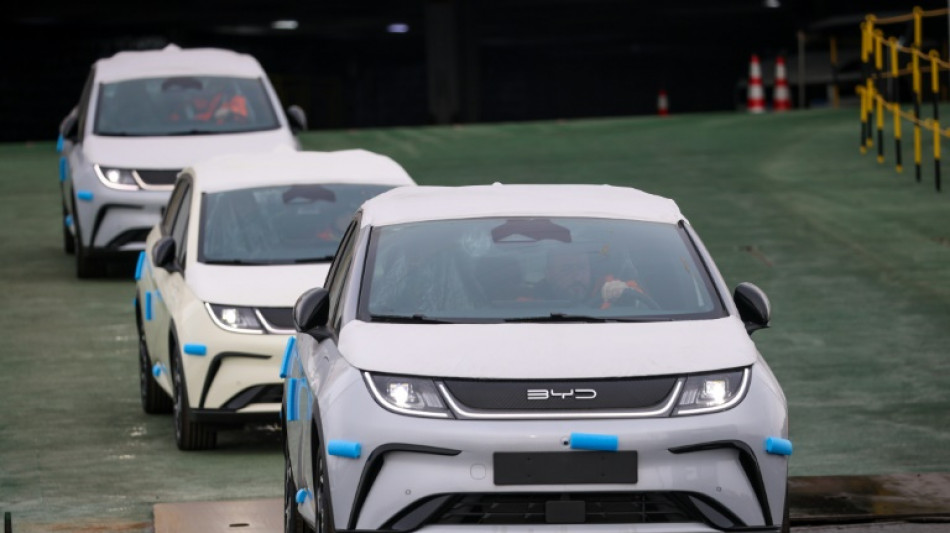
US sharply hikes tariffs on Chinese EVs and chips / Photo: © AFP/File
US President Joe Biden took aim at China on Tuesday, saying Beijing is "cheating" rather than competing on trade as Washington unveiled steep tariff hikes on Chinese imports like electric vehicles and semiconductors.
The move -- which drew strong opposition from Beijing -- comes as Biden gears up for a rerun of his 2020 contest with Republican rival Donald Trump in November's election, with officials criticizing Trump's record on trade as they made the announcement.
"We're not going to let China flood our market, making it impossible for American auto manufacturers to compete fairly," Biden said in a speech after the announcement.
"We're never going to allow China to unfairly control the market for these cars," he added.
The tariff hikes hit $18 billion worth of Chinese imports, targeting strategic sectors like EVs, batteries, critical minerals and medical products, the White House said.
The tariff rate on EVs is set to quadruple to 100 percent this year while the tariff for semiconductors will surge from 25 percent to 50 percent by next year.
This is aimed at encouraging China to "eliminate its unfair trade practices," the White House added.
It follows a review of tariffs imposed during the US-China trade war when then-president Trump introduced levies on some $300 billion in goods from China.
China's commerce ministry warned that the new moves would "severely affect the atmosphere for bilateral cooperation," decrying what it said was a politicization of economic issues.
A so-called Section 301 investigation was the primary tool the Trump administration used to justify tariffs, and the US Trade Representative is required to look into the impact of the levies after four years.
Tuesday's actions are also taken under Section 301 of the Trade Act.
Beyond EVs, Washington is roughly tripling tariffs on some steel and aluminum products, and on lithium-ion EV batteries and battery parts.
The tariff rate on natural graphite and some other critical minerals will surge from zero to 25 percent, and that on solar cells doubles to 50 percent.
But some hikes, such as on non-EV lithium-ion batteries, take effect later to provide a transitional period as the country builds up its domestic battery production, a senior US official said, on condition of anonymity.
Beijing's foreign ministry earlier said it "opposes unilateral tariff hikes in violation of WTO rules."
China "will take all necessary measures to safeguard its legitimate rights and interests," spokesperson Wang Wenbin added.
- Excess capacity -
The latest moves impact both products already targeted by the Trump tariffs as well as additional ones.
A USTR spokesperson confirmed there were no tariff reductions.
The levies will ensure investments in jobs, spurred by Biden's domestic policies, are not undercut by "underpriced exports from China," National Economic Advisor Lael Brainard said.
The Biden administration has pumped massive funding into areas like semiconductor manufacturing and research, alongside efforts to boost green investments.
But Brainard accused Beijing of powering its growth "at the expense of others."
Brainard also took aim at the Trump administration, saying it "failed to follow through" with investments, and to ensure China complied with a deal marking a truce in the trade war.
Trump hit back Tuesday, saying Biden should have gone further and acted years ago.
"China is eating our lunch right now," he told reporters.
Asked about these remarks, Biden replied that Trump has been "feeding them a long time."
- 'Pre-emptive strike'-
Hiking tariffs on Chinese EVs would be "a pre-emptive strike" given that few such cars are imported, said Paul Triolo, partner for China at Albright Stonebridge Group.
"It is really a signal to US automakers that the Biden administration is protecting the industry from Chinese EVs," he told AFP.
But tariffs covering EV batteries and supply chains would be "a much bigger issue, because of the dominance of Chinese companies in the finished battery space and for critical minerals across the battery supply space," he said.
China is likely to retaliate with tariff increases of its own, Triolo said.
But Beijing's retaliation is likely to be stronger if Washington takes measures seen as suppressing Chinese companies, like imposing more trade restrictions on semiconductor firms.
US Treasury Secretary Janet Yellen said in a statement that issues like overcapacity "will not be solved in a day," and that she would continue to directly address concerns with Chinese counterparts.
D.Kelly--TNT