The National Times - Challenges ahead: Key issues facing Pakistan's next leader

Challenges ahead: Key issues facing Pakistan's next leader


Challenges ahead: Key issues facing Pakistan's next leader

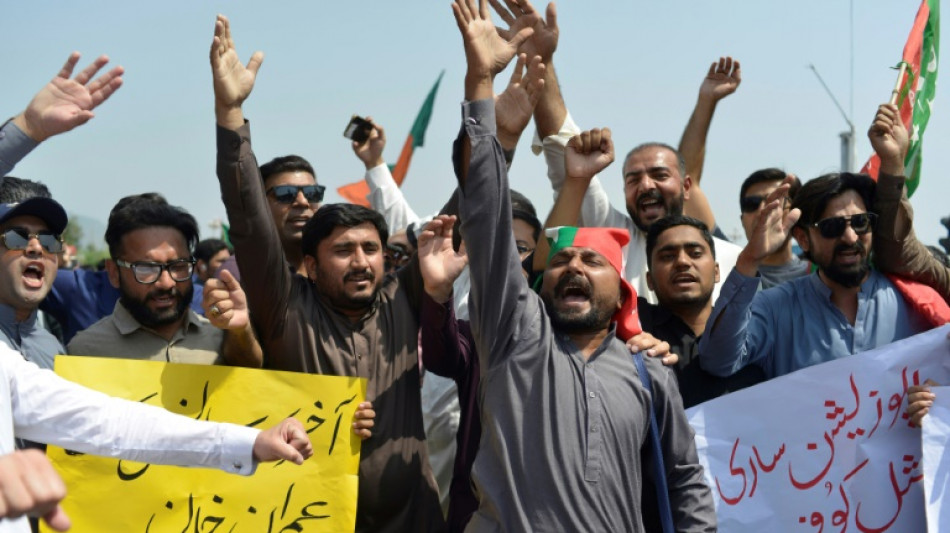
Whoever becomes Pakistan's next prime minister following the dismissal of Imran Khan Sunday will inherit the same issues that bedevilled the former international cricket star.

Change text size:

A poorly performing economy, rising militancy and shaky relations with former allies will be top of the agenda for the next administration.

The incoming government will need to stave off "multiple challenges on domestic and foreign relations levels", said Professor Jaffar Ahmed, director of the Institute of Historical and Social Research.

Following are the key issues ahead for the incoming premier of the country of 220 million people:

- The economy -

Crippling debt, galloping inflation and a feeble currency have combined to keep growth stagnant for the past three years with little prospect of genuine improvement.

"We don't have any direction," said Nadeem ul Haque, vice-chancellor of the Pakistan Institute of Development Economics (PIDE), a research organisation in Islamabad.

"Radical policy reforms are needed to turn around the economy."

Inflation is ticking along at over 12 percent, foreign debt is at $130 billion -- or 43 percent of GDP -- and the rupee has dipped to 190 to the dollar, a decline of nearly a third since Khan took power.

A $6 billion International Monetary Fund (IMF) bailout package signed by Khan in 2019 has never been fully implemented because the government reneged on agreements to cut or end subsidies on certain goods and improve revenue and tax collection.

"The IMF package must go on," said Ehsan Malik, head of the Pakistan Business Council.

On the bright side, remittances from Pakistan's vast diaspora have never been higher, although the cash flows have put Pakistan on the radar of the Financial Action Task Force, the global money-laundering and terrorist-funding watchdog.

"This is a hanging sword which could fall on the country any time," Jaffar said.

- Rise of militancy -

Pakistan's Taliban, a separate movement that shares common roots with the militants who took power in Afghanistan last year, have stepped up attacks in recent months.

They have threatened an offensive against government forces during Ramadan -- which started Sunday -- and in the past have been blamed for a string of murderous attacks.

Khan attempted to bring militants back into the mainstream, but talks with the Tehreek-e-Taliban Pakistan (TTP) militants got nowhere last year before a month-long truce collapsed.

Afghanistan's Taliban say they will not allow the country to be used as a base for foreign militants, but it remains to be seen if they will genuinely put a stop to the activities of thousands of Pakistani Islamists based there -- or where they will go if they are kicked out.

There are no easy solutions even for the incoming government, experts say.

"The insurgency challenge would remain as big and crucial for the new government," said political analyst Rafiullah Kakar.

In mineral-rich Balochistan, Pakistan's largest province, separatists have been demanding more autonomy and a greater share of the wealth for years, and the region is riven by sectarian strife and Islamist violence.

Kakar suggested a two-pronged approach -- "confidence-building measures and political reconciliation" in Balochistan, but taking off the kid gloves for the Taliban "once and all".

- Foreign relations -

Khan claims the United States orchestrated his removal by conspiring with the opposition, and the next government will have to work hard to patch up relations with Washington -- a key arms supplier countering Russia's trade with India.

Khan angered the West by continuing with a visit to Moscow on the day Russia invaded Ukraine, and was also one of the few world leaders to attend the opening of the Beijing Winter Olympics when others boycotted in protest at China's human rights record.

Still, army chief General Qamar Javed Bajwa allayed some fears last weekend by saying good relations with the United States remain high on Pakistan's agenda -- and the military holds huge sway regardless of which civilian administration is in power.

"The incoming government... needs to put in hard effort to undo the damage," said Tauseef Ahmed Khan, a political analyst and journalism teacher.

P.Johnston--TNT

Featured

Carney touts Canada 'pivot' away from US as tariffs rise

Canadian Prime Minister Mark Carney on Tuesday said reducing economic ties with the United States would come at a cost but the long-term benefits were clear, as retaliatory tariffs on US products took effect.

The "Everlasting Battery" Inside Your Joints:UConn Professor's Self-Powered Healing Material just Got Acquired

A material that turns your own movement into medicine has just landed a corporate home. PetVivo Holdings (OTCQX: PETV), a veterinary biotech and biomedical device company focused on treating osteoarthritis in dogs and horses, has acquired PiezoBioMembrane (PBM) — a startup built around a biodegradable implant that generates electricity from the everyday force of a joint in motion, and uses that charge to help regrow cartilage from the inside out. The material is the invention of Thanh Nguyen, a professor of mechanical engineering in UConn's College of Engineering, who founded PBM in 2021 to advance new implementation methods for his work with piezoelectric materials — substances that convert mechanical force into electrical energy. These materials are typically ceramics: hard, brittle, and poorly suited for medical use. But Nguyen's lab developed new forms that are so , flexible, and biodegradable, breaking down naturally within the body over time. wound healing, The materials have already shown strong potential across a range of medical applications, including tissue regeneration, implanted force sensors, and targeted drug delivery in tumor treatment. How It Works biodegradable ultrasound for In the case of arthritis, Nguyen explains, the piezoelectric materials function as an off-the-shelf product that can be implanted or injected directly into the ailing joint — with no drugs, chemicals, or cells required. The everyday force exerted on the joint generates a small electrical charge, which helps regrow healthy cartilage, mimicking the body's natural use of electricity to regenerate tissue. "The body can be electrically stimulated to regrow," Nguyen says. PBM's materials "act like a battery — an everlasting battery that works whenever there is a force applied, and vanishes safely inside the body over time." PetVivo's Vision for the Acquisition PetVivo Holdings CEO John Lai expressed enthusiasm for the merger's potential to improve the lives of companion animals globally. "PBM has developed a compelling functional biomaterials platform with the potential to support the development of multiple medical device and therapeutic product lines across both human and animal health markets," Lai said in a press release. "By combining PBM's scientific innovation with PetVivo's product development capabilities, commercialization experience, regulatory expertise, and public company infrastructure, we believe we can accelerate theadvancement of technologies that may serve as the foundation for numerous future products and strategic opportunities." For Nguyen, the deal is a chance to scale technology that could eventually benefit both animals and people. "PetVivo is an animal health company, but they do have a big passion: pushing the technology towards clinical trials for human use," Nguyen says. "That aligned perfectly with my passion for developing technology that has an impact on human life. That is why I am excited about this merger, which facilitates my passion." A Track Record of Innovation Nguyen's research sits at the intersection of medicine, micro/nanotechnology, and biomaterials. His inventions have earned him publications in prominent scientific journals and media coverage from outlets including NPR. Nguyen founded PBM during the COVID-19 pandemic, a er realizing the material he had developed could be used to create an especially effective, biodegradable face mask — one where the mechanical force of breathing generated an electrical charge that provided an extra layer of protection against viruses. PBM is not Nguyen's only venture in the acquisition pipeline. His other startup, Single-Time Microneedles (STM), is also currently undergoing an acquisition process. STM has pioneered stable, efficient vaccine delivery technology in the form of an adhesive patch. shelfNguyen's focus on biodegradable materials has translated into a remarkably diverse range of medical applications. He has received five R01 grants from the National Institutes of Health (NIH) supporting research in cartilage regeneration, bone regeneration, HIV antibody delivery systems, and biodegradable ultrasound technology to boost the effectiveness of chemotherapy for brain cancer. "Whatever we are working on, we want to show that it works very well in vitro and in vivo," Nguyen says. "Then, when we are at the point of commercialization, we set up a startup or license the technology — or maybe team up with an industry partner." Thanh Nguyen is a professor of mechanical engineering in UConn's College of Engineering. (Courtesy of Thanh Nguyen

Octrado introduces its proprietary trading offering: "Your Skill. Our Capital"

Infrastructure, transparent rules and clear legal boundaries positioned as the core of the funded-account model

Could gas prices return to 2022 highs on US-Iran war?

European gas prices have more than doubled owing to the US-Iran war, just as Europe needs to replenish its reserves ahead of winter.

Change text size: