No longer a last resort: Pulling CO2 from the air
To save the world from the worst ravages of climate change, slashing carbon pollution is no longer enough -- CO2 will also need to be sucked out of the atmosphere and buried, a landmark UN report is expected to say on Monday.
If humanity had started to curb greenhouse gas emissions 20 years ago, an annual decrease of two percent out to 2030 would have put us on the right path. Challenging, but doable.
Instead, the emissions climbed another 20 percent to more than 40 billion tonnes of CO2 in 2021.
This means an abrupt drop in emissions of six or seven percent a year is needed to avoid breaching the Paris climate treaty's goal of capping global warming at "well below" two degrees Celsius compared to pre-industrial levels.
Staying under the safer aspirational threshold of 1.5C would mean an even steeper decline.
To put that in perspective, the painful 2020 shutdown of the global economy due to Covid saw "only" a 5.6 percent decrease in CO2 emissions.
Hence the need for carbon dioxide removal (CDR), or "negative emissions", likely to figure prominently in the UN Intergovernmental Panel on Climate Change (IPCC) report.
Even under the most aggressive carbon-cutting scenarios, several billion tonnes of CO2 will need to be extracted each year from the atmosphere by 2050, and an accumulated total of hundreds of billions of tonnes by 2100.
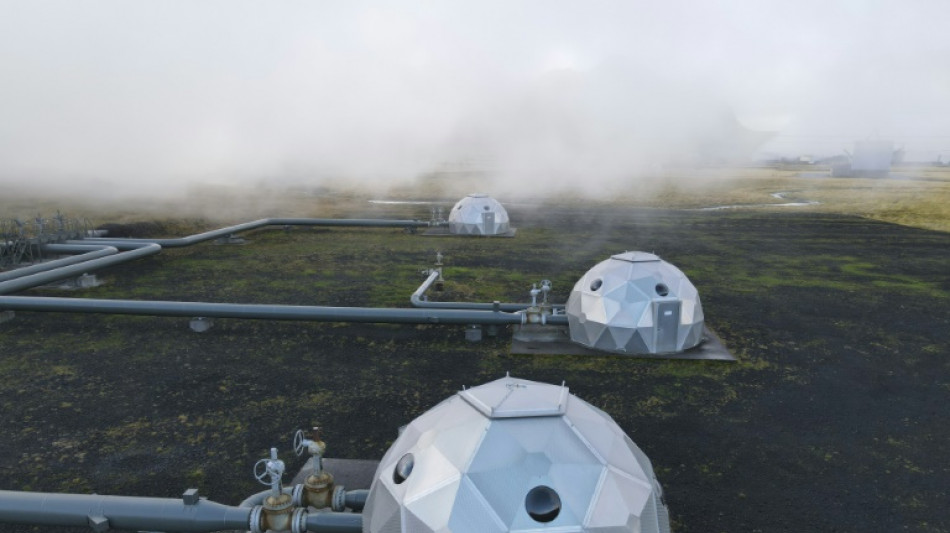
As of today, however, CO2 removal is nowhere near these levels. The largest direct air capture facility in the world removes in a year what humanity emits in three or four seconds.
There are at least a dozen CDR techniques on the table, with different potentials and costs.
- Using bioenergy -
Most of the hundreds of models laying out a game plan for a liveable future reserve an important role for a negative emissions solution called BECCS, or bioenergy with carbon capture and storage.
In a nutshell, this is the recipe: grow trees, burn them for energy, and bury the CO2 underground, in an abandoned mineshaft, for example.
But what works on paper (or in so-called integrated assessment models), has not materialised in reality.
One of the few commercial-scale BECCS facilities in the world, in Britain, was dropped last year from the S&P Clean Energy Index because it failed to meet sustainability criteria.
"I don't see a BECCS boom," said Oliver Geden, a senior fellow at the German Institute for International and Security Affairs and an expert on CDR.
- Planting trees -
Restoring forests and planting trees that absorb and stock CO2 as they grow also figure prominently in development scenarios achieving net-zero emissions, whether in 2050 or later.
Many businesses, including fossil fuel companies, rely heavily on carbon offset schemes based on afforestation to compensate for continuing carbon pollution.
But the amount of land needed to put a serious dent in CO2 levels through tree planting -- up to twice the size of India -- could clash with other priorities, such as growing food and biofuel crops.
Biodiversity could suffer as well, especially in savannahs converted to monoculture tree farms.
Newly planted forests could also fall victim to wildfires made more frequent and intense by rising temperatures, resulting in the release of all their stored CO2.
- 'DACCS' -
One of the youngest CDR technologies is also one of the hottest: direct air carbon capture and storage.
With variations, DACCS is a chemical process that extracts carbon dioxide directly from the atmosphere, converting it into solid form or locking it away underground.
Because CO2 in the air is so sparse -- a few hundred parts per million -- it is a very energy-intensive and expensive process.
DACCS has benefited from a wave of corporate backing.
Last year, Tesla CEO Elon Musk launched the $100-million X-Prize for an innovative CO2 removal technology, and Breakthrough Energy founder Bill Gates unveiled a corporate partnership to turbocharge its development.
How quickly it can scale up, and at what cost, remain open questions.
- Enhanced weathering -
Enhanced weathering involves mining and crushing rocks rich in minerals that naturally absorb CO2, and then spreading them over land or sea.
It aims to vastly accelerate a process that normally unfolds on geological timescales of tens of thousands of years.
Silicate rocks with minerals rich in calcium and magnesium but lacking metal ions such as nickel and chromium are the best raw material for the job.
But, again, it's unclear if enhanced weathering can be scaled up enough, and at what cost.
- Ocean-based methods -
Oceans already take up more than 30 percent of humanity's carbon emissions, and scientists are experimenting with ways to boost that capacity.
One approach is to enhance marine alkalinity, either by directly adding natural or synthetic alkaline minerals, or the electrochemical processing of seawater.
Another approach, known as ocean fertilisation, increases the density of tiny phytoplankton that produce and sequester organic carbon through photosynthesis, like plants on land. Adding nitrogen or iron stimulate phytoplankton growth.
The main concerns here include unintended consequences on ecosystems.
H.Davies--TNT