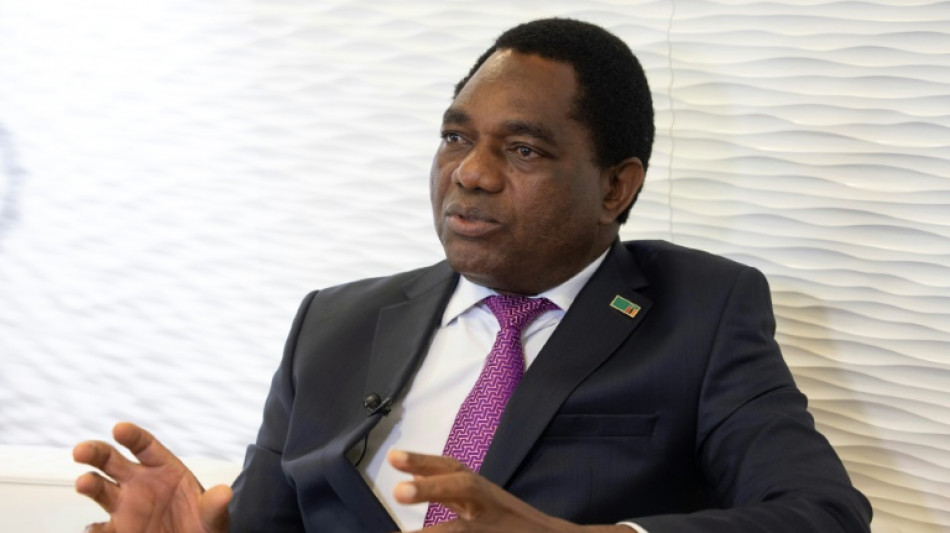
Zambia president blames private creditors for debt deal delays / Photo: © AFP/File
Zambia's President Hakainde Hichilema on Friday blamed private creditors for holding up a long-sought debt restructuring deal for the first African nation to default after the Covid pandemic.
Zambia, which had $18.6 billion in debt when it defaulted in 2020, struck an agreement in principle in October with foreign lenders.
Hichilema said about 98 percent of official creditors have now signed a memorandum of understanding to restructure Zambia's debt which was estimated at $32.8 billion at the end of 2022.
"That is a great milestone," he told a press conference in the capital Lusaka.
But talks with private creditors have become deadlocked, he said.
"We are still negotiating," Hichilema said.
The dispute is over a "comparability of treatment" rule under a debt restructuring framework for the poorest countries agreed by the G20 group in 2020, he said.
This requires all creditors to take similar losses in any debt restructuring deal.
"Official creditors want to review and say yes to the content of what we are negotiating with the private creditors," the president added.
"In this case some official creditors felt that the private creditors were not yet at par with them," Hichilema said.
He urged official and private creditors to meet to "work out the numbers" and resolve the impasse.
Following the October accord, some official creditors including China initially rejected it complaining about the more favourable conditions granted to some private landers.
This week, the International Monetary Fund (IMF) said prompt implementation of the October deal and an agreement with private creditors were critical to restoring Zambia's "debt sustainability".
Revising Zambia's 2023 economic growth outlook up to 4.3 percent, the IMF approved a second review of its loan agreement so that almost $200 million can be unlocked for Zambia.
The drawn-out negotiations are seen as a test case for the G20 common framework at a time where there are rising concerns over debt in low-income nations.
The framework has been criticised as many African nations are either already in, or on the edge of, debt distress.
Ghana followed Zambia in defaulting and is also in talks with creditors and the IMF.
F.Adams--TNT