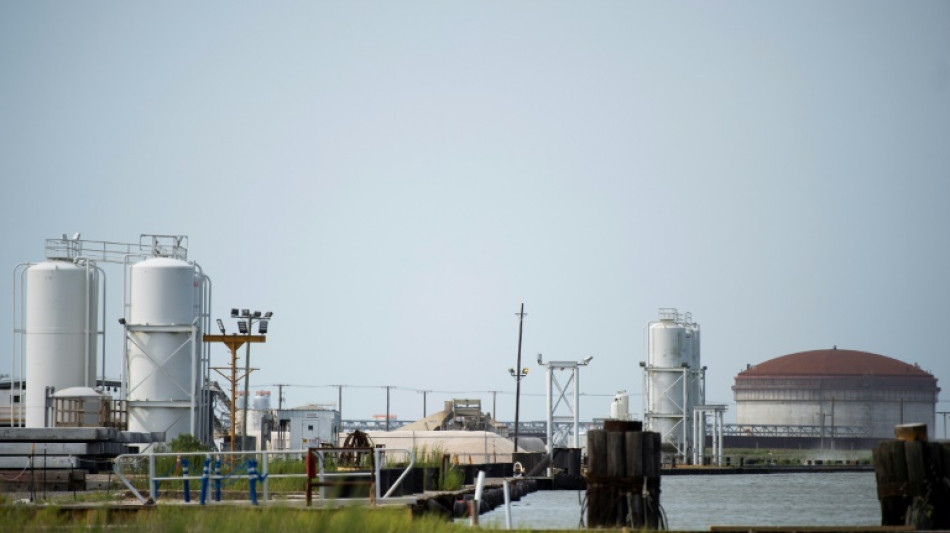
LNG projects in the Gulf of Mexico boosted as Russian gas alternative
Two years ago, the American liquified natural gas (LNG) company Tellurian was in free fall: Its stock price collapsed, it laid off 40 percent of its staff, and suspended a key project in Louisiana.
Now, executive chairman Charif Souki says investors "are lining up at the door to ask me: 'Can we finance your project?'"
At the annual CERAWeek energy conference in Houston, Souki told AFP that LNG projects have been boosted by the renewed emphasis on energy independence after Russia's invasion of Ukraine.
"Global market demand and the desire of the Europeans to divest from their reliance on Russian gas... those are all positive market signals, which will obviously help stimulate those projects and get them moving towards final investment decisions," said Charlie Riedl, vice president of the natural gas industry's advocacy group.
On March 8, the United States banned all imports of LNG, petroleum and coal from Russia, and has for years encouraged its European allies to decrease their dependence on their eastern neighbor.
The White House, in a statement, also argued that "federal policies are not limiting the production of oil and gas."
"To the contrary, the Biden administration has been clear that in the short-term, supply must keep up with demand," it added.
Eight LNG terminals operate in the United States, pumping out 14 billion cubic feet (400 million cubic meters) per day, and fourteen other terminals have already been approved by the Federal Energy Regulatory Commission (FERC).
That's the case for Driftwood LNG, Tellurian's future liquefaction plant and export terminal, south of Lake Charles, Louisiana.
Stalled for a year and a half, the company will finally break ground on the massive project next month. Once completed, the site will be able to export 3.6 billion cubic feet per day.
Charif said that "in principle, we should be able to provide LNG in 2026" to the oil companies Shell, Vitol and Gunvor.
The Gulf Coast will see plant construction accelerate in the coming months: Five projects have already been approved by FERC in Louisiana, with seven more in Texas and Mississippi.
- Faster regulatory approvals -
Since its first exports in 2016, the Gulf Coast has become a key hub for global LNG shipments.
A network of pipelines connects the states' ports to gas fields across the country, from the Permian and Haynesville basins in the south to the Marcellus, the country's largest onshore reserve, in the northeast.
Once the gas arrives on the coast, it is liquified and transferred onto LNG tankers, most of which head off to Europe.
Earlier this month, not far from the future Tellurian site, Venture Global LNG saw its first tanker depart from its brand new Calcasieu Pass terminal.
The export terminal and its accompanying liquefaction plant were built off the coast of Louisiana in just 29 months -- a record time for such a project, according to the company's CEO, Mike Sabel.
He added that, in his estimation, the government's regulatory approvals for both Calcasieu and another project near New Orleans have been "faster than they were before" the war in Ukraine.
"They're being very supportive, so I'm very optimistic that they're going to approve projects more quickly," he said.
- 'A lose-lose-lose proposition' -
In a room reserved for him at the CERAWeek convention, Sabel shows a few journalists a video of tugboats, which he said were named after his children, maneuvering near the new plant.
He notes another reason for the sector to celebrate: In early February, the European Commission ruled that gas could, under certain conditions, contribute to the fight against climate change.
"That's a big deal for banks that are sensitive to policy pressure, and public pressure, to support the infrastructure investments," he said.
According to the Natural Gas Supply Association, each liquefaction plant requires an investment of $10 to $20 billion. Only nuclear power plants require more up-front capital.
However, not everyone is so happy about the gas sector's bright future.
"Expanding gas production in the US is a lose-lose-lose proposition for communities in the Gulf (of Mexico), Europe, and the climate," Nikki Reisch of the Center for International Environmental Law (CIEL) told AFP.
"LNG has all the climate impacts of fracked gas plus the added emissions from energy-intensive liquefaction, cooling and transportation. What's more, it puts the health and livelihoods of people on the fencelines of extraction and export at risk," she added.
"The war should be an impetus for increasing investments in renewables, electrification and efficiency, not doubling down on dirty energy sources," she said.
S.Mitchell--TNT