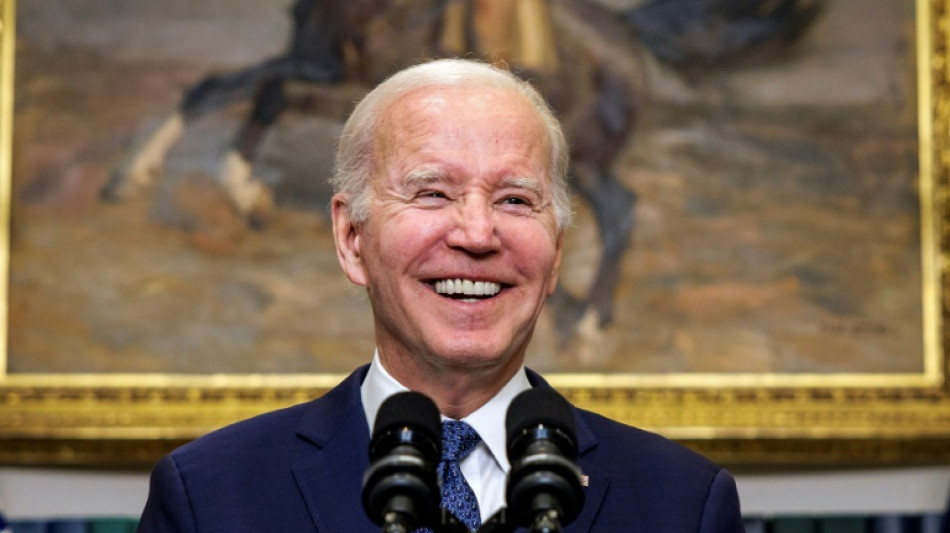
Race against time for US debt crisis bill in Congress / Photo: © AFP
Republican and Democratic leaders scrambled Monday to secure congressional support for a bill aimed at avoiding a catastrophic US debt default -– with just one week left before the government starts running out of money.
The bill, finalized on Sunday by President Joe Biden and House Speaker Kevin McCarthy after weeks of frantic negotiations, faces opposition from the progressive and hard-right wings of their respective parties.
Ultra-conservative Republicans feel McCarthy should have secured far deeper spending cuts in exchange for raising the debt ceiling and allowing the government to keep borrowing money.
The left wing of the Democratic Party is equally unhappy that Biden agreed to any spending limits at all.
-- Delay tactics --
Biden and McCarthy both say they are confident the bill will pass a House vote scheduled for Wednesday and then move swiftly to the Senate, but organized dissent could force some nerve-shredding delays.
The key deadline is June 5 -- when, according to Treasury estimates, the government will no longer have the funds required to pay all its debts and bills.
If that scenario morphs into a full-fledged default, the repercussions would be disastrous for the US and wider global economy.
The basic framework of the deal lifts the federal debt ceiling, which is currently $31.4 trillion, for two years — enough to get past the next presidential election in 2024.
The timing was critical for Biden, who does not want another debt ceiling showdown hanging over his re-election campaign.
In return, the Republicans secured some limits on federal spending over the same period.
As they finalized the text of the bill on Sunday, Biden and McCarthy both went into hard-sell mode to shore up support in their parties.
-- Win, win --
Both were backed by vocal spin operations insisting that the agreement clearly represented a victory for their side.
"You want to try to make it look like I made some compromise on the debt ceiling — I didn't," Biden told reporters.
McCarthy, for his part, touted the agreement as a "historic series of wins."
In reality, the agreement represents a mutual climb down of sorts.
Biden had initially refused to negotiate over spending issues as a condition for raising the debt ceiling, accusing the Republicans of taking the economy hostage.
And the big cuts that Republicans wanted are not there, although non-defense spending will remain effectively flat next year, and only rise nominally in 2025.
The release of the final text on Sunday gives House members the requisite 72-hours to scrutinies the bill in detail before the vote on Wednesday.
McCarthy's wafer-thin majority in the House will require significant Democratic backing to balance out Republican dissent.
Democrats hold the majority in the Senate, but individual senators could try and hold up the bill with amendment votes that would bring the process perilously close to the June 5 deadline.
A number of hard-right House Republicans have already vowed to vote against the bill, with one tweeting a vomit emoji in response to the deal and another calling it "an insult to the American people."
At the same time, a member of the House Progressive Caucus, Ro Khanna, said a large number of Democrats were still "in flux as to where they’re going to be on this."
One element likely to rile Democratic environmental hawks was the surprise inclusion in the bill of a measure to accelerate completion of an oil pipeline project that has been stalled by green concerns.
Both the House and Senate are expected to return on Tuesday, after a long holiday weekend, and the White House and Republican leadership have already held a series of conference briefing calls with their members from both chambers to push the final deal.
B.Cooper--TNT