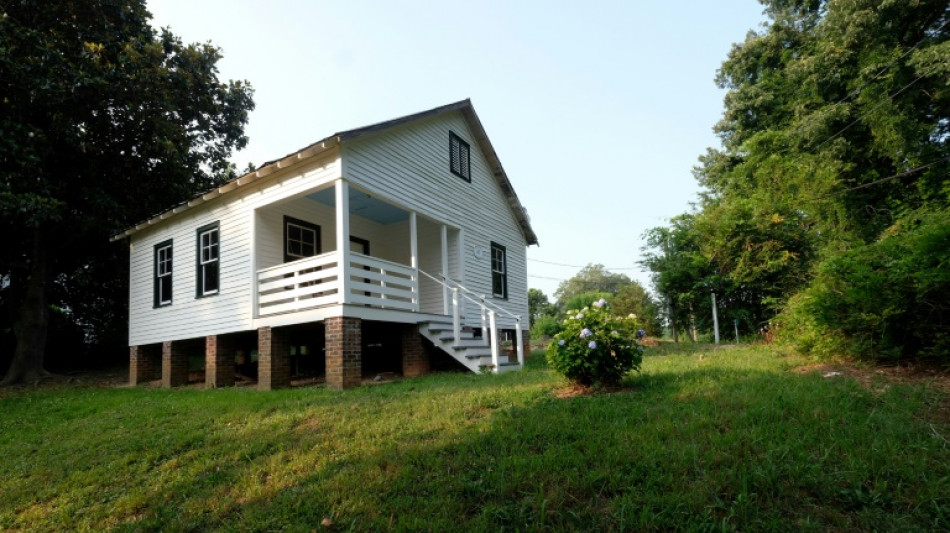
$6 mn raised to preserve Nina Simone's childhood home / Photo: © National Trust for Historic Preservation/AFP
An art auction and New York gala have raised nearly $6 million to preserve and restore the childhood home of soul music legend and civil rights activist Nina Simone, organizers said Tuesday.
The twin events brought in some $5.88 million -- far more than the original $2 million organizers hoped to raise to restore the rural North Carolina abode.
"The new funding will meaningfully advance our project goals to complete the full restoration of the house and landscape," said Brent Leggs, executive director of the African American Cultural Heritage Action Fund.
"With this investment, we are well on our way to opening the doors to visitors in 2024."
Four US artists -- Julie Mehretu, Ellen Gallagher, Rashid Johnson and Adam Pendleton -- bought the dilapidated rural home in 2017 for $95,000. They've since worked with Leggs' organization, as well as tennis star Venus Williams, to raise money to turn the house into a cultural and historic site.
The online auction, with works donated by British painter Cecily Brown and American artist Sarah Sze, was organized by Pace and Sotheby's.
Among the 11 works for sale, Mehretu's ink-and-acrylic "New Dawn, Sing (for Nina)" fetched $1.6 million.
Simone, whose songs found renewed resonance during the Black Lives Matter protests of recent years, had a complex, often difficult relationship with the United States, where she was born in 1933, during the era of racial segregation.
Born Eunice Waymon, she spent the first years of her life in the three-room house in Tryon, in the rural southeastern state of North Carolina, with her parents and siblings, and began playing the piano at age three.
But her dream of becoming a classical concert performer was shattered when she was rejected by Philadelphia's prestigious Curtis Institute of Music, an ordeal she attributed to racism.
In the 1960s, Simone was active in the civil rights movement, including through rousing speeches and song.
Her "Mississippi Goddam," was a response to a 1963 fire in an Alabama church started by members of the Ku Klux Klan. Three days after the assassination of Martin Luther King in 1968, she performed "Why? (The king of love is dead)."
Simone eventually left the United States and lived her last years in the south of France, where she died in 2003.
B.Cooper--TNT