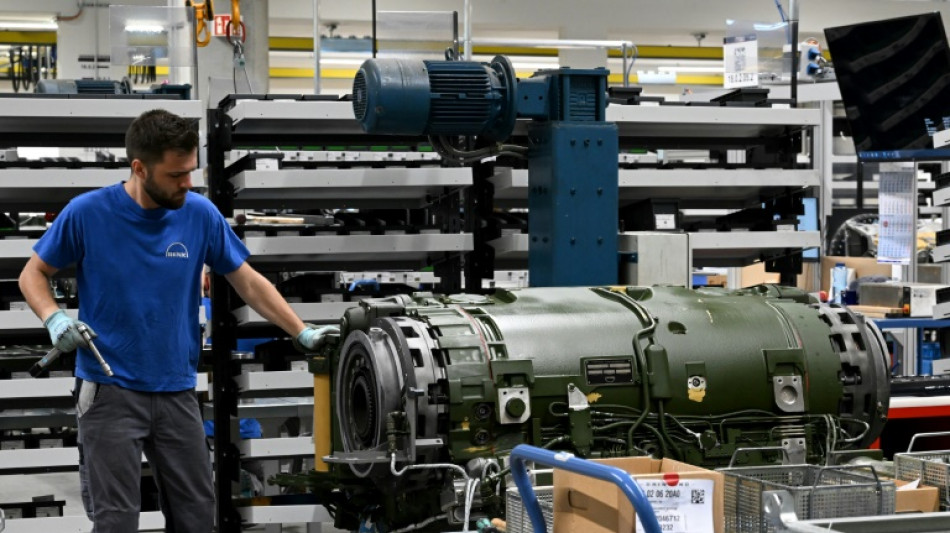
Eurozone economic growth slows in May / Photo: © AFP/File
Economic growth in the eurozone edged down in May to a three-month low because of a drop in industrial production, according to a closely watched survey published on Tuesday.
For the fifth month in a row, growth in the 20-country single currency zone remained in positive territory, but growth is now at its lowest level since February.
Meanwhile, inflation remains stubbornly high, maintaining pressure on the ECB to raise rates.
Data from the flash Eurozone purchasing managers' index (PMI) survey published by S&P Global fell to 53.3 in May from 54.1 in April. A figure above 50 indicates growth.
Cyrus de la Rubia, chief economist at Hamburg Commercial Bank (HCOB), said the eurozone's gross domestic product seems to have grown in the second quarter of 2023 "thanks to the healthy state of the services sector".
"However, the manufacturing sector is a powerful drag on the momentum of the economy as a whole," the economist added. HCOB partners with S&P Global to put out the PMI survey.
Services' strong showing came even as inflation in the eurozone bubbles far above the European Central Bank's two-percent target.
Official EU data earlier this month showed annual inflation in the eurozone rising to seven percent in April, the first increase after five consecutive months of falls.
The services sector in eurozone heavyweight Germany led the region's growth in May. Private sector activity there posted its strongest expansion for 13 months while manufacturing suffered a sharp fall.
"German companies from the sector are particularly hard on the brakes," said de la Rubia.
France, the eurozone's second-largest economy, saw growth in overall activity slow to its lowest level in four months, weakening in both services and manufacturing.
Andrew Kenningham, analyst for Capital Economics, said that for the overall eurozone, "growth is being supported almost exclusively by the services sector, where the expansion may have lost a little momentum but remains very strong by historical standards.
"In contrast, the manufacturing sector appears to be contracting at an accelerating pace, as new orders and the backlog of work both declined sharply, suggesting that the post-pandemic surge in activity has now ended."
H.Davies--TNT