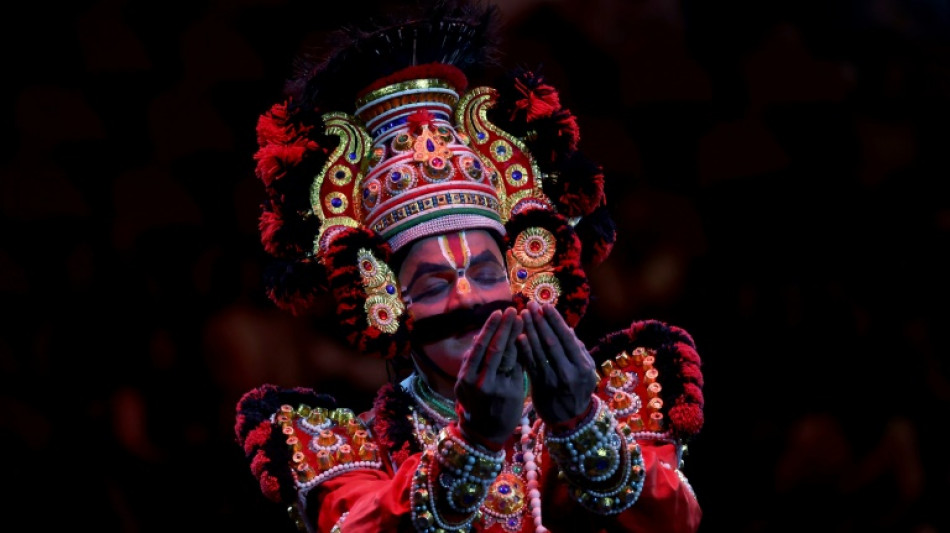
Australia fetes India's Modi with focus on trade, not rights / Photo: © AFP
Australia vowed to take ties with India to the "next level" Tuesday as it hosted Narendra Modi for a lavish visit heavy on trade and light on criticism.
Lured by the world's most populous market and a counterweight to China's growing military, diplomatic and economic clout, Australia's government is layering on the charm.
On Tuesday, Modi will hold a campaign-style rally at a 21,000-capacity Sydney arena -- with Prime Minister Anthony Albanese making a guest appearance.
It is an unusually personal show of support for Modi, a nationalist leader who faces re-election next year and has been criticised for democratic backsliding and discrimination against India's non-Hindus.
Australia and India have a great "strategic alignment", Deputy Prime Minister Richard Marles said, hailing the visit.
"It really does afford the opportunity to take the relationship to the next level," he told the national broadcaster ABC, echoing Modi's own words.
Modi on Monday started his first visit to Australia since 2014, his first year in office.
In the last decade, India's economic performance has been mixed, with missteps curbing growth, but hundreds of millions have been lifted out of poverty.
It is now the second-fastest growing economy in the G20 and a multi-trillion-dollar market.
- 'Blatant' targeting of minorities -
But on the political front, "the world's largest democracy" has become less free and more dangerous for Modi's critics, according to Human Rights Watch's Elaine Pearson.
"Modi's Bharatiya Janata Party (BJP)-led government has been tightening its grip on civil society, using draconian laws to arrest and intimidate activists, journalists, opposition leaders, academics, peaceful protesters, and critics of government policies," she said.
Rights groups say India's 200 million Muslims have also faced increased discrimination and violence since Modi and his Hindu nationalist BJP swept to power in 2014.
Australia, she said, "should be unequivocal in raising human rights with Modi, pointing out that his government's actions belie its international claims of upholding democratic principles."
There was little sign of that kind of criticism at Sydney's Qudos Arena Tuesday, with Modi and Albanese's arrival trailed by a long series of gushing tributes to the Indian leader.
Asked whether Australia would raise India's treatment of Muslims and other minorities, Marles declined to go into detail about a planned Modi-Albanese summit in Sydney on Wednesday.
- 'Massive economy' -
"Ultimately, we are both democracies and that very much underpins the way in which we see the world," Marles said, pointing to the two nations' growing trade and tightening defence relationships.
India is a "growing, massive economy, there are great opportunities for us," he said.
Both countries want an expansion in two-way trade, valued at Aus$46.5 billion (US$31 billion) last year and set to rise after a free-trade deal came into effect in December last year.
On his visit to Australia, Modi will be tapping into the country's fastest-growing and second-largest diaspora, with 673,000 Indian-born citizens in a population of 26 million.
Jay Shah, a director at the India-Australia Diaspora Foundation, predicted "euphoria" at Modi's stadium event in Sydney.
Asked about concerns over the treatment of minorities in India, Shah said he could not understand such claims being made about India.
"We respect all the diverse views," he told AFP.
But there are "large pockets" within the Indian community who oppose Modi's treatment of minorities, said Bilal Rauf, spokesperson for the Australian National Imams Council.
"We are deeply concerned about his visit, and the manner in which he has been welcomed without any of the issues of concern in his own country being raised," Rauf told AFP.
"Those issues of concern relate to the very blatant and overt measures taken against minority groups, Muslims in particular, and people in Kashmir," he added, referring to the disputed Himalayan region claimed by both India and Pakistan.
"We're hopeful that our leaders will raise it as an issue."
A.Robinson--TNT